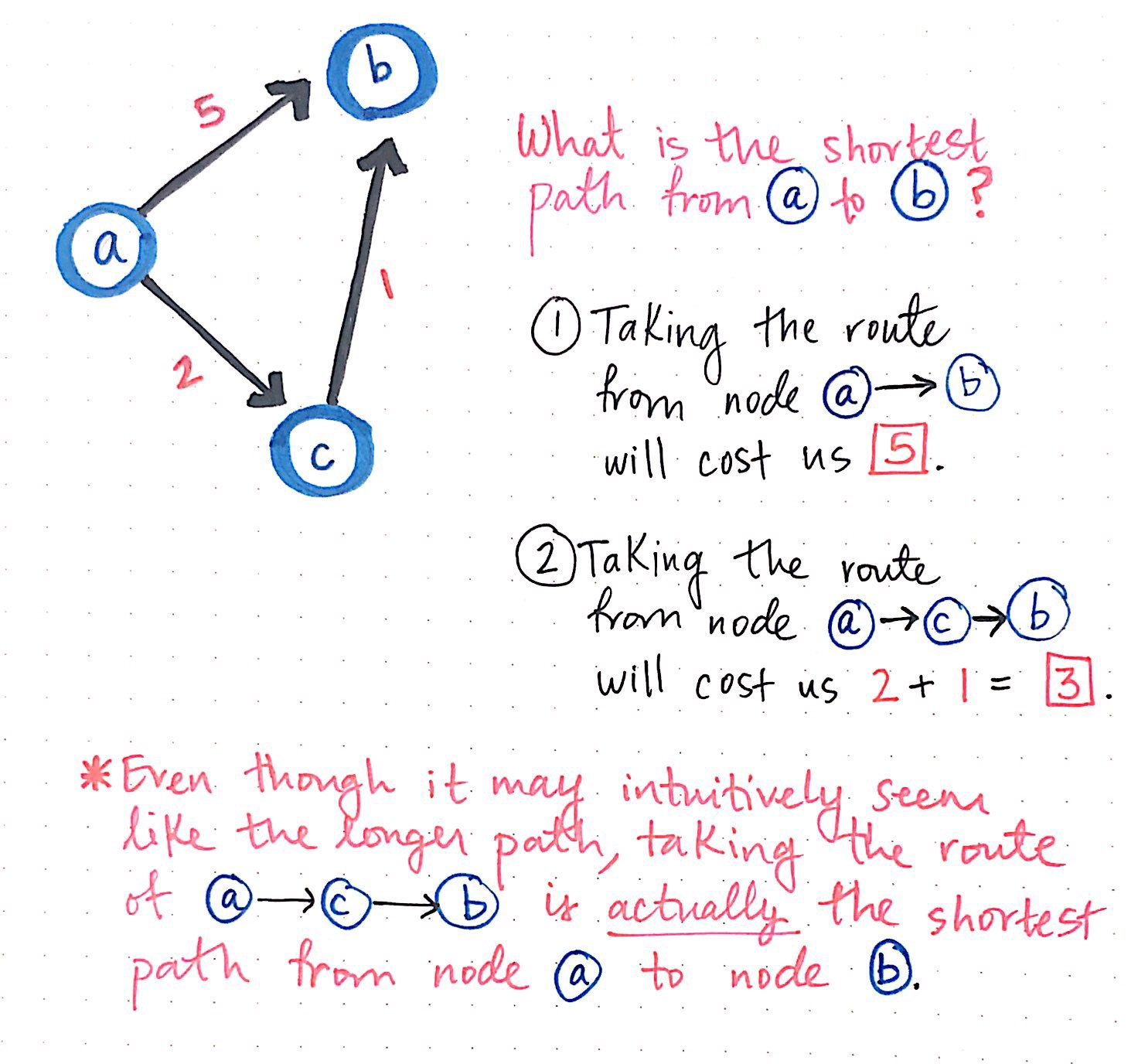
- finding the shortest path between two nodes becomes much trickier when we have to take into account the weights of the edges that we’re traversing through.
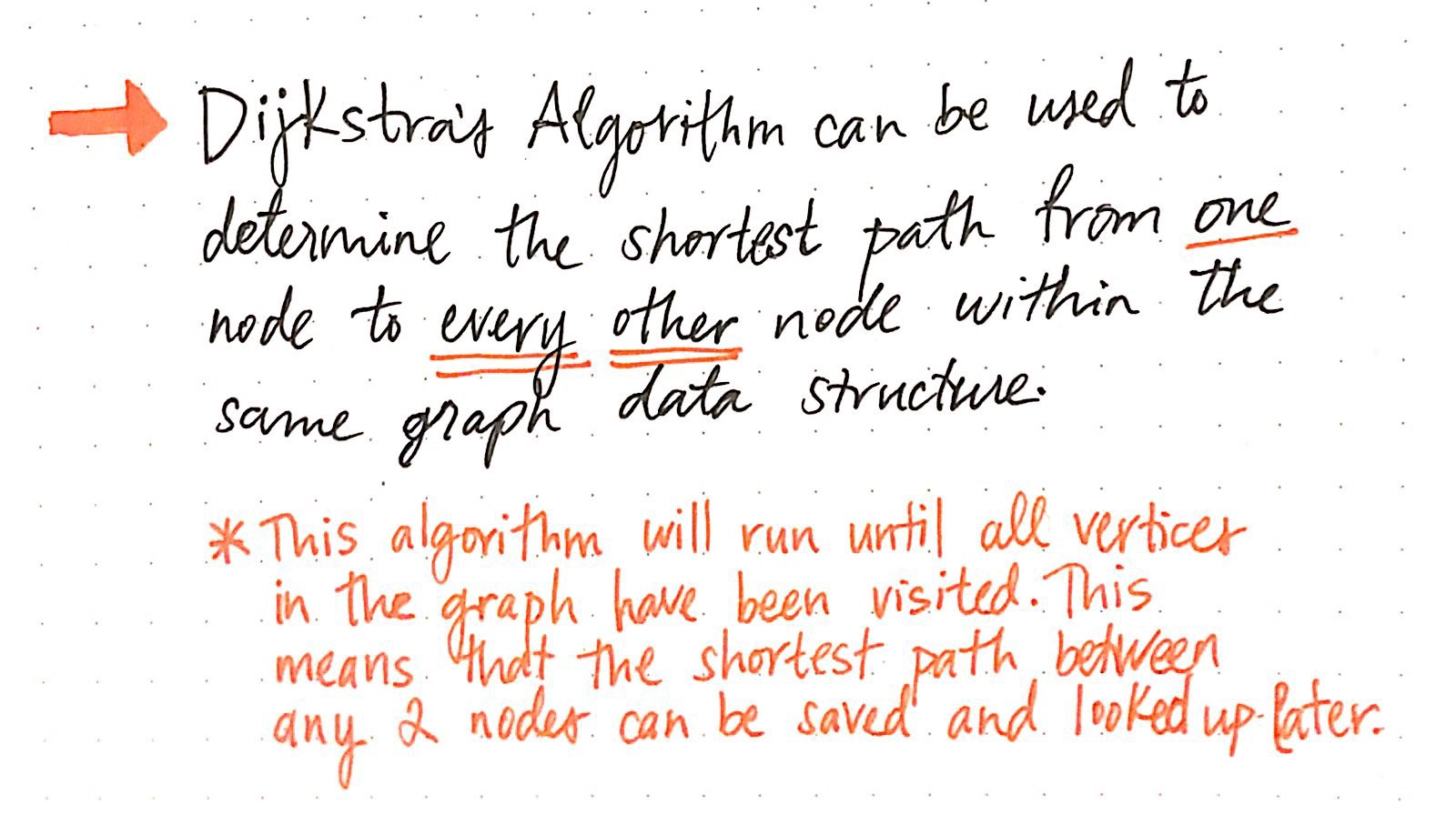
👉 Dijkstra’s algorithm can be used to determine the shortest path from one node in a graph to every other node within the same graph data structure, provided that the nodes are reachable from the starting node.
The algorithm below works for both directed or undirected graph as long as it does not have negative weight on an edge.
import heapq
# graph is represented by adjacency list: List[List[pair]]
# s is the source vertex
def dijkstra(graph, s):
    # set is used to mark finalized vertices
    visited = set()
    # an array to keep the distance from s to this vertex.
    # initialize all distances as infinite, except s
    dist = [float('inf')] * len(graph)
    dist[s] = 0
    # priority queue containing (distance, vertex)
    min_heap = [(0, s)]

    while min_heap:
        # pop the vertex with the minimum distance
        _, u = heapq.heappop(min_heap)

        for v, weight in graph[u]:
            # If there is shorted path from s to v through u.
            # s -> u -> v
            if dist[v] > (dist[u] + weight):
                # Updating distance of v
                dist[v] = dist[u] + weight
                # insert to the queue
                heapq.heappush(min_heap, (dist[v], v))

    return dist
👉 Time complexity is O(V + VlogE), where V is number of vertices in the graph and E is the number of edges in the graph.