new_audit: mixed-content https upgradeability#3953
new_audit: mixed-content https upgradeability#3953paulirish merged 15 commits intoGoogleChrome:masterfrom
Conversation


 christhompson
requested review from
brendankenny,
patrickhulce and
paulirish
as code owners
christhompson
requested review from
brendankenny,
patrickhulce and
paulirish
as code owners

|
One note is that the audit currently has some potential false-negatives, mostly around requests that involve redirects, where it will say a resource is non-upgradeable when it may in fact be upgradeable to HTTPS. These tend to be most prevalent in what I sometimes refer to as "second-order requests" -- requests made by a subresource loaded by the main page (often advertising libraries). One approach I have tried is to only check and report resources loaded by the main frame (where the initiator is the same as the URL loaded by the gatherer). It's a bit of a tradeoff of complete details about the resources requested and accuracy -- if anyone feels strongly about false-negatives, I can make that change. |
christhompson
changed the title

|
Two ideas about false negatives:
|

|
@christhompson is this waiting on review/advice from a Lighthouse person? @paulirish could you suggest someone to review? Thanks! |
|
Yes, this should be ready for review. Also pinging @vinamratasingal who may be able to give more feedback about the UI of the audit report. Re: False negatives, the whitelist would be a nice addition, but there are still some cases that fall outside that (where the current implementation fails to detect a successful upgrade). We still need to load the entire page a second time, so I don't think we'd be able to short-circuit. I think the "Needs Investigation" change may be the best, especially since it frames the audit more positively overall (maybe combined with a tweak to the main audit explanation text). |

|
Hi, just got the chance to look at this. Some quick feedback (also apologies if this had been decided/discussed on a previous thread, I'm just jumping in):
|
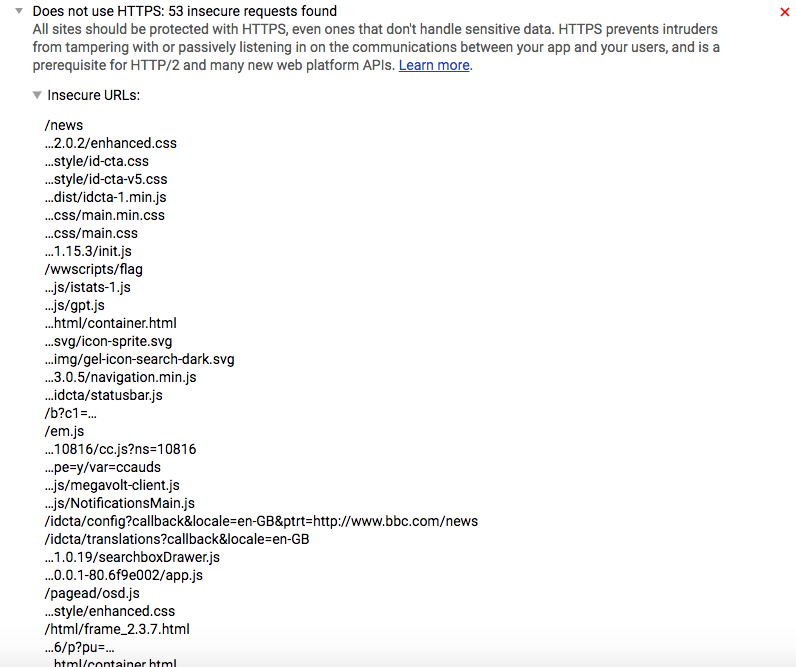

I'd be happy if we could include it in the Best Practices section. I'd thought it was not going to be included in the default config at the moment since it causes an extra page load pass.
I can reduce the text at the top of the audit. I am planning on writing documentation that can be linked to, but was unsure of the process/order for doing that.
This may also help resolve the false-negatives issue. The audit could be framed as "there is no harm in upgrading these resources to HTTPS right now, to maximize your readiness to switch to HTTPS in the future".
I included the Initiator column to try to add a priority level of some sort -- things initiated by the main page are more under the control of the developer, and so they would be higher priority. Maybe it would make sense to only include the resources that were initiated by the main page, especially given the discussion on the previous bullet.
This audit is intended for sites that have not yet migrated to HTTPS. The idea is that they can check whether they can just "flip the switch" to HTTPS by simply changing the relevant URLs to HTTPS, or if they need to contact specific third-parties about how to upgrade. If all URLs are upgradeable, then the developer knows they should have minimal problems when making the switch. |
|
re: Best Practices- ah, I got confused. No, the plan currently is only to expose it via the full config on the CLI, not via Best Practices. re: documentation- we have a tech writer (Kayce B), and it would be good to reach out to him to get the documentation written. re: changes- awesome. Do you mind uploading an updated screenshot so I can take another look? |

 patrickhulce
left a comment
patrickhulce
left a comment
patrickhulce
left a comment
There was a problem hiding this comment.
sorry for the delay here and thanks for the contribution!!
as you note, we'll keep this in a separate config and out of the default until there's a way to do it without adding an additional pass, but overall approach seems reasonable to me.
| insecureUrls.forEach(record => { | ||
| const resource = { | ||
| host: new URL(record.url).hostname, | ||
| full: record.url, |
There was a problem hiding this comment.
nit: how about fullUrl for clarity
| const upgradePassSecureHosts = new Set(); | ||
| upgradedRecords.forEach(record => { | ||
| upgradePassHosts.add(new URL(record.url).hostname); | ||
| if (MixedContent.isSecureRecord(record) && record.finished) { |
There was a problem hiding this comment.
is .finished want we want without checking .failed?
from devtools it seems as though finished will be true even if the request failed, but perhaps in practice we observe something different? :)
There was a problem hiding this comment.
Good call. I added another check for !record.failed.
|
|
||
| const totalRecords = defaultRecords.length; | ||
| const score = 100 * | ||
| (secureRecords.length + 0.5 * upgradeableResources.length) |
There was a problem hiding this comment.
nice! I like this scoring rubric :)
| * @return {string} | ||
| */ | ||
| const btoa = function(str) { | ||
| return Buffer.from(str, 'utf8').toString('base64'); |
There was a problem hiding this comment.
to be honest I find this line more readable than good ol' btoa and since we only use it once I'd vote to nix
at the least maybe we can say encodeAsBase64 or something
There was a problem hiding this comment.
Yeah, that makes sense. I've pulled this inline here.
| return Buffer.from(str, 'base64').toString('utf8'); | ||
| }; | ||
|
|
||
| describe('btoa', () =>{ |
There was a problem hiding this comment.
feels a bit weird to test a function that gets exercised only in the tests, did you mean to expose the btoa from the gatherer file?
There was a problem hiding this comment.
Now that I just inlined the b64 function in the other file, I did the same here and got rid of the test. In hindsight don't think it's a particularly useful path to test (and some of the other tests should break if something strange happens to it).

|
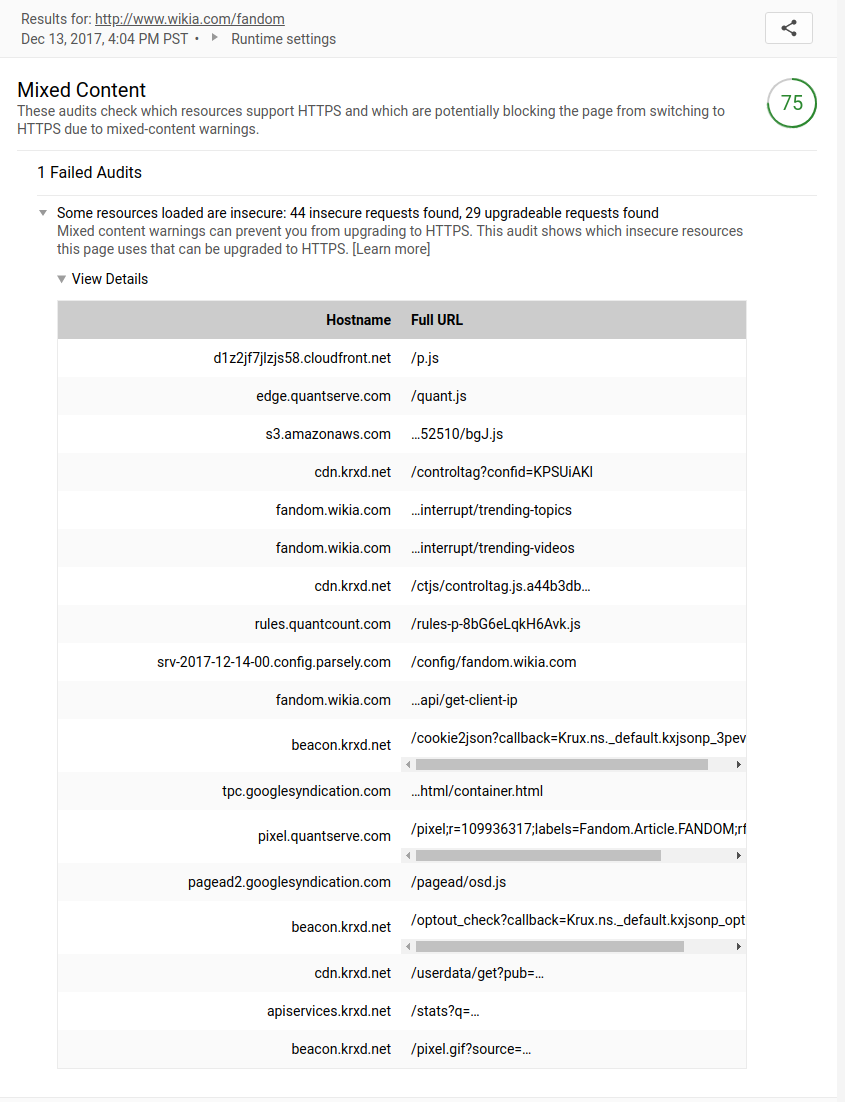
Thanks for the comments. I've updated the PR to address the comments so far. I've simplified the audit report quite a bit by restricting it to list resources that are upgradeable that are initiated by the main page only. Here's what it looks like currently:
|

 paulirish
left a comment
paulirish
left a comment
paulirish
left a comment
There was a problem hiding this comment.
What you've made here looks great. Really like the original UX and the latest revised stuff.
Since this currently relies on interception, we are a little blocked on getting https://bugs.chromium.org/p/chromium/issues/detail?id=764505 sorted out. But since this isn't landing in the default config, we may have some options.
Really nice job putting this one together.
|
This looks great, thanks for working through with us Chris! One last question before giving the LGTM on the UX:
|
|
@vinamratasingal Good catch. With the latest changes I didn't really update the main string. The scoring of the audit will still cause failures on any insecure resources being loaded, but given the new output of the audit, I think something like the following would be good:
I can push a quick update making that change. @paulirish I was a little worried the Experimental nature of request interception would be a pain. I'd been testing the custom config using |
This updates the audit failure text to only reference the number
of upgradeable resources. It also simplifies how resources are
tracked now that we don't output details about non-upgradeable
resources. It also only counts upgradeable resources that were
initiated by the main page for the count and score, so that the
count of upgradeable resources in the text matches the number of
items in the audit report table.
|
New strings LGTM. Mind publishing an updated screenshot so I can take a final pass and LGTM? |
|
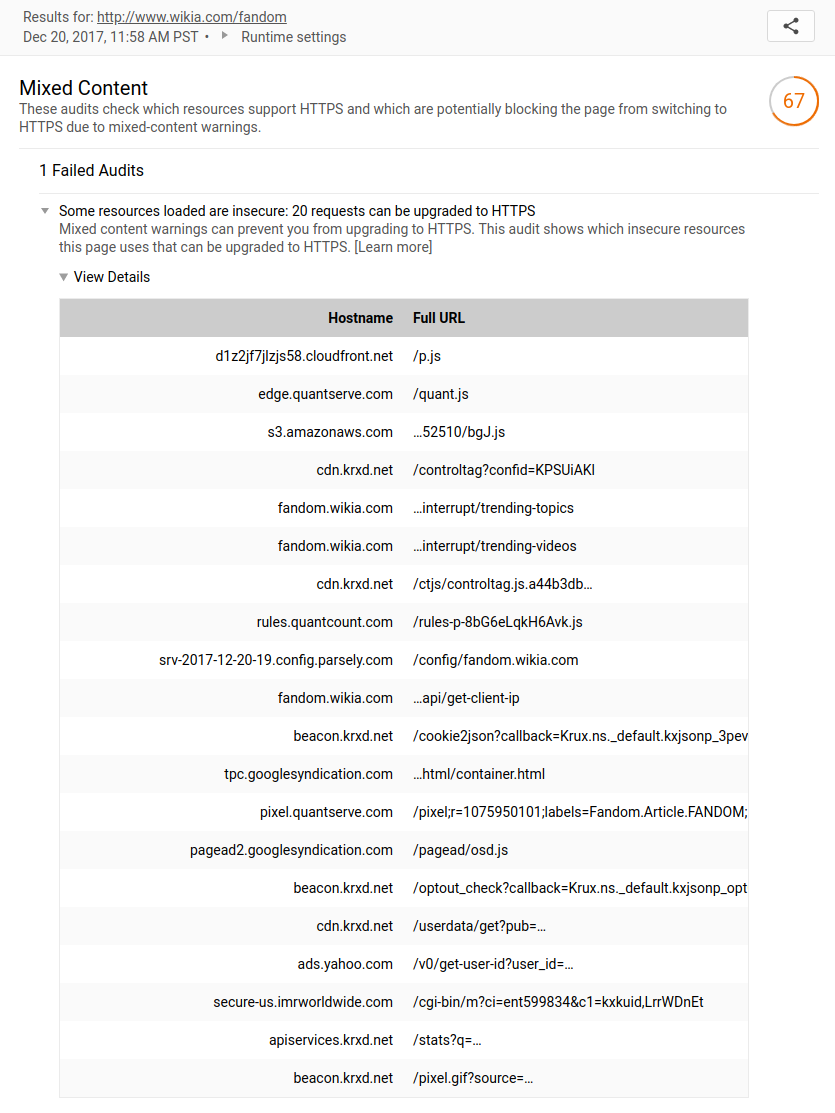
Here's a screenshot of the latest version of the report:
|
|
LGTM |
 paulirish
modified the milestones:
Sprint Seis: December 11 - 22,
Sprint Siete: January 8-19
paulirish
modified the milestones:
Sprint Seis: December 11 - 22,
Sprint Siete: January 8-19
|
Pinging this thread. @paulirish As you mentioned, this currently only works with the Chrome headless flag. Would it still be possible to land this since it isn't included in any default config/category? This would then mostly be a complication to the documentation for how to run the audit. |


|
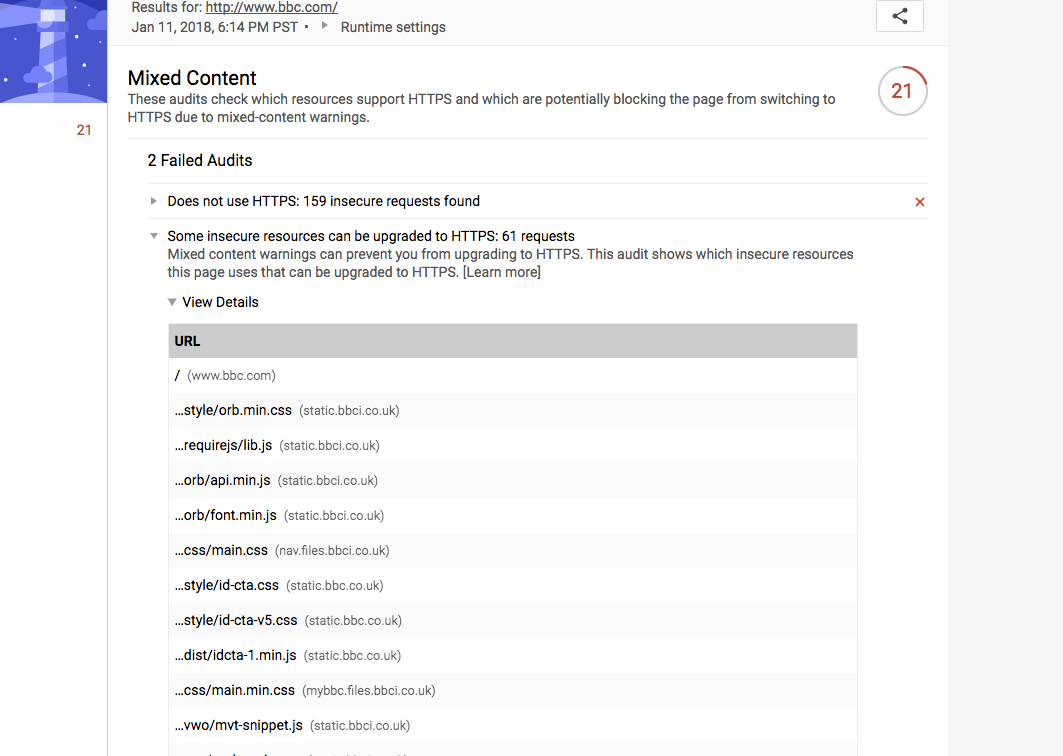
@christhompson yup we can definitely land this. I was playing with this audit today and had a few ideas. Instead of leaving review comments I went ahead and made the changes: christhompson#2 Also now that the Table and URL renderers suck less, I don't think we need the extra Hostname column in the report. Does that work for you? Or would you rather keep it explicit so they're easier to scan. I could go either way.
If this all works, for you, lets land it. Then we can write docs on 1) how to run this audit and 2) what the audit is about. Cheers and thanks for your patience on this one! really appreciate it. |

|
So there's good news and bad news. 👍 The good news is that everyone that needs to sign a CLA (the pull request submitter and all commit authors) have done so. Everything is all good there. 😕 The bad news is that it appears that one or more commits were authored by someone other than the pull request submitter. We need to confirm that all authors are ok with their commits being contributed to this project. Please have them confirm that here in the pull request. Note to project maintainer: This is a terminal state, meaning the |
|
I like the cleanliness of the new column style in your changes -- it also fixes the minor annoyance of the left/right aligned columns in the old table. Adding the |
paulirish
left a comment
paulirish
left a comment
There was a problem hiding this comment.
lgtm!
Thanks again for your patience on this PR. Apologies for the delay.
|
Landed! 🎉 🎉 Some next steps:
|
|
Chris- are you going to take on the work of the docs? Or do we need help from @kaycebasques here? (Kayce does all of our tech docs on developers.google.com) |
|
I have a draft of some docs for this -- I'd be happy to coordinate with Kayce to get them in proper shape. |
|
Sounds good- let me know if you need help with this. Thanks for your patience Chris! :) |

7 participants


This introduces a new gatherer and audit that tests which requests a page makes can be directly upgraded to use HTTPS, and which fail when upgraded. The report gives a list of resources which were loaded insecurely in the default pass, their initiating document, and whether they are upgradeable. This implements the audit proposed in #3164.
It is currently implemented as a separate custom config, as it requires an additional pass in which to do the upgrading. The new pass uses the mixed-content gatherer, which intercepts each HTTP request, and sends an HTTP 302 Found redirect to upgrade it to HTTPS. The audit compares the network records for the default pass with the upgraded requests form the mixed-content pass.
I've also included some basic tests for the functionality of both the gatherer and the audit.
This can currently be run using the following invocation:
lighthouse-cli/index.js --chrome-flags="--headless" --config-path=./lighthouse-core/config/mixed-content.js http://www.bbc.com/The gatherer relies on the Network request interception commands, which may require Canary at the moment since they're currently Experimental.
The audit report looks like this (the "Full URL" column uses Lighthouse's URL type, which reveals the full URL on hover):