local Dark Factory — an autonomous coding pipeline: prompt or labeled GitHub issue → reviewed PR. A learning artifact for composing the 2026 agentic workflow stack — Temporal, Claude Agent SDK, LangGraph, Langfuse, OpenTelemetry.
local-dafa-demo.mp4
54s cut of a ~15min real run, sped up.
- A real, working composition of current agentic-workflow components — meant to be forked, taken apart, and learned from.
- A learning artifact, not a product. No SaaS, no signups, no roadmap promises.
- How It Works
- Prerequisites
- Setup
- Configuration
- Running a Workflow
- GitHub Issue Automation
- Dashboards and Local URLs
- CLI Reference
- Agent Roles
- Prompt Management
- LangGraph Studio
- Worker Images
- Tests
- Repository Map
- Screenshots
Dark Factory has three process layers:
┌────────────────────────────────────────────────────────────────┐
│  Host                                                          │
│  ┌──────────────┐                                              │
│  │  CLI         │  uv run darkfactory run "..." --repo /path   │
│  └──────┬───────┘                                              │
└─────────┼──────────────────────────────────────────────────────┘
          │ Temporal gRPC (localhost:7233)
┌─────────▼──────────────────────────────────────────────────────┐
│  Docker Compose stack                                          │
│  ┌────────────────────────┐   ┌──────────────────────────────┐ │
│  │  Orchestrator          │   │  Per-workflow worker         │ │
│  │  (supervisor-tq)       │──▶│  (agent-tq-<wf_id>)          │ │
│  │  • workflow definitions│   │  • Claude agent SDK calls    │ │
│  │  • launches worker     │   │  • target repo commands      │ │
│  │    containers          │   │  • runs in /workspace        │ │
│  └────────────────────────┘   └──────────────────────────────┘ │
│                                                                │
│  Support services: Temporal · Langfuse · OTel · MinIO ·        │
│                    Postgres · ClickHouse ·                     │
│                     Redis · Claude Monitor                     │
└────────────────────────────────────────────────────────────────┘
Hydrate → Triage → [PO → Architect → Plan Critic] × up to 5
        → Brief gate (human optional) → Build + Test
        → Verify / Fixer loop → PR Creator → Reviewer
        → Merge gate (human optional) → Merge
Human gates pause the workflow until you act on them — via a GitHub label or
comment (issue-driven runs) or the darkfactory gate CLI (prompt runs). Prompt
runs can skip both gates with run --auto-approve-gates; issue-driven runs can
skip them by automating label application.
| Requirement | Notes |
|---|---|
| macOS, Linux, or WSL | Docker must be available. |
| Docker Desktop or Engine with Compose v2 | The orchestrator mounts /var/run/docker.sock to launch worker containers. |
| Python 3.13 | Managed by uv; no system-wide install needed if using uv. |
uv |
Python package and virtualenv manager. curl -LsSf https://astral.sh/uv/install.sh | sh |
Claude Code CLI (claude) |
Install: npm install -g @anthropic-ai/claude-code |
| Claude Code OAuth token | Generate with claude setup-token after installing the CLI. |
| GitHub token (for PR/issue workflows) | Fine-grained token with contents, issues, and pull_requests write access on the target repo. |
GitHub CLI (gh) |
Optional, used by helper scripts. brew install gh / releases. |
git clone https://github.com/your-org/dark-factory.git
cd dark-factory
uv synccp .env.example .envOpen .env and fill in the required values (see Configuration
for the full reference). At minimum:
CLAUDE_CODE_OAUTH_TOKEN=<your-token>   # from: claude setup-token
GITHUB_TOKEN=<your-github-pat> # fine-grained PAT with issues + PR writeThe polyglot worker image bundles Python, Node.js, Java, git, gh, Claude
Code, and the Dark Factory runtime. Build it once before the first run:
docker compose --profile worker-image build darkfactory-worker-imageThis step is separate so you can rebuild the worker image independently without restarting the rest of the stack.
docker compose up -dThis starts all services: Temporal, Langfuse (+ Postgres, ClickHouse, Redis, MinIO), OpenTelemetry collector, transcript transformer, Claude Monitor, and the Dark Factory orchestrator.
Check that every service is healthy:
docker compose psAll containers should reach healthy or running within 30–60 seconds. The
Langfuse web UI is slow to start on first boot (database migrations run on
startup).
uv run darkfactory run --hello-worker --repo /absolute/path/to/any/repoThis confirms the orchestrator can launch a worker container and that the worker can connect back to Temporal — no LLMs are invoked.
uv run darkfactory run "Add input validation to the login form" \
  --repo /absolute/path/to/target/repo
The CLI prints the workflow ID and streams result status. Open Temporal UI and Langfuse to watch progress in real time.
docker compose down          # stop containers, keep volumes
docker compose down -v # stop containers and delete all local stateCopy .env.example to .env and edit it. The table below covers every
variable.
| Variable | Description |
|---|---|
CLAUDE_CODE_OAUTH_TOKEN |
OAuth token for the Claude Code CLI. Generate with claude setup-token. Passed into every worker container. |
GITHUB_TOKEN |
GitHub PAT used by gh and git push inside the worker. Needs contents, issues, pull_requests write on the target repo. |
| Variable | Default | Description |
|---|---|---|
TEMPORAL_ADDRESS |
localhost:7233 |
Temporal frontend endpoint for host-run CLI commands. Compose sets temporal:7233 inside containers automatically. |
| Variable | Default | Description |
|---|---|---|
OTEL_EXPORTER_OTLP_ENDPOINT |
http://localhost:4317 |
OTel collector for host-run commands. Compose overrides to http://otel-collector:4317 inside containers. |
OTEL_SDK_DISABLED |
(unset) | Set true to skip OTel entirely when no collector is running. |
LANGFUSE_HOST |
http://localhost:3000 |
Langfuse endpoint for host-run commands. Compose overrides inside containers. |
LANGFUSE_PUBLIC_KEY |
pk-lf-local |
Langfuse project public key. The local Compose stack pre-seeds this value. |
LANGFUSE_SECRET_KEY |
sk-lf-local |
Langfuse project secret key. The local Compose stack pre-seeds this value. |
LANGFUSE_PROMPTS_ENABLED |
true |
When true, roles fetch prompts from Langfuse first; disk prompts are fallback. |
LANGFUSE_PROMPT_LABEL |
production |
Langfuse prompt label to fetch. |
| Variable | Default | Description |
|---|---|---|
DF_WATCH_REPO |
(empty) | Default owner/name when --repo is omitted from schedule commands. |
DF_WATCH_LABEL |
df:ready |
GitHub label the poller filters on. |
DF_WATCH_INTERVAL_S |
60 |
Polling interval in seconds. |
DF_WATCH_MAX_CONCURRENT |
3 |
Maximum simultaneous issue workflows. |
| Variable | Default | Description |
|---|---|---|
DARKFACTORY_WORKER_IMAGE |
darkfactory-worker:polyglot |
Docker image tag used for per-workflow workers. |
DARKFACTORY_LOG_SDK_ARGV |
(unset) | Set any non-empty value to log Claude SDK arguments. Do not use in production — logs contain prompt content. |
DARKFACTORY_ENVIRONMENT |
local |
Tags spans and traces with an environment label. |
Change these before any shared or production deployment.
| Variable | Default |
|---|---|
LANGFUSE_NEXTAUTH_SECRET |
darkfactory-demo-nextauth-change-me |
LANGFUSE_SALT |
darkfactory-demo-salt-change-me |
LANGFUSE_ENCRYPTION_KEY |
0000…0 (64 hex zeros) |
LANGFUSE_S3_EVENT_UPLOAD_BUCKET |
darkfactory-local-events |
LANGFUSE_S3_MEDIA_UPLOAD_BUCKET |
darkfactory-local-media |
Uncomment and edit any LLM_<ROLE>_MODEL / LLM_<ROLE>_THINKING line in
.env.example to override the model for a specific role. Defaults are defined
in src/darkfactory/llm_factory.py.
# Example: use a faster model for the PO role
LLM_PO_MODEL=claude-haiku-4-5-20251001
LLM_PO_THINKING=off

# Example: enable extended thinking for the Architect
LLM_ARCHITECT_THINKING=onuv run darkfactory run "Implement X" --repo /absolute/path/to/target/repoThe CLI starts the workflow and waits for the result. To fire-and-forget:
uv run darkfactory run "Implement X" --repo /path/to/repo --no-waitA prompt run pauses at the brief and merge gates (see Human gates). To run fully unattended — approving both gates automatically, including the final merge:
uv run darkfactory run "Implement X" --repo /path/to/repo --auto-approve-gatesuv run darkfactory run --hello-worker --repo /path/to/repoThe workflow pauses at two human gates — the brief gate (after planning completes) and the merge gate (after the reviewer approves, before merging). How you act on a gate depends on how the run was started.
The workflow posts the implementation brief (brief gate) or the PR link (merge gate) as a GitHub issue comment, then waits for a label or comment.
Brief gate:
| Action | How |
|---|---|
| Approve | Apply df:approved label or post approve comment |
| Revise | Post revise: <feedback> comment |
| Reject | Post reject comment or apply df:cancel label |
Merge gate:
| Action | How |
|---|---|
| Approve and merge | Apply df:approved label or post approve comment |
| Request fix | Post fix: <instructions> comment |
| Rebuild | Post rebuild comment |
| Reject | Apply df:cancel label or post reject comment |
A prompt run blocks at each gate until you act on it with the darkfactory gate
subcommands, addressed by the workflow ID printed when the run starts. Because a
--wait run holds the terminal, start runs you intend to gate with --no-wait
and note the printed workflow_id.
gate show renders the pending gate — the implementation brief, or the PR plus
reviewer findings at the merge gate — to a local markdown file for review:
# Inspect the pending gate; writes ./.darkfactory/briefs/<workflow-id>.md
uv run darkfactory gate show <workflow-id>

# Brief gate
uv run darkfactory gate approve <workflow-id>
uv run darkfactory gate revise  <workflow-id> --feedback "tighten the API contract"
uv run darkfactory gate reject  <workflow-id> --reason "out of scope"

# Merge gate
uv run darkfactory gate approve <workflow-id>
uv run darkfactory gate fix     <workflow-id> --focus "handle the null case"
uv run darkfactory gate rebuild <workflow-id> --focus "rework the data model"
uv run darkfactory gate reject  <workflow-id> --reason "wrong approach"
approve and reject auto-detect which gate is pending; an action that does
not apply to the current gate (e.g. fix at the brief gate) fails without
sending anything. To skip both gates entirely, start the run with
--auto-approve-gates.
Dark Factory can watch a GitHub repository for labeled issues and run the full pipeline automatically.
# Preview (no changes)
./scripts/sync_github_labels.py owner/name --dry-run

# Apply
./scripts/sync_github_labels.py owner/name
This creates all df:* labels. See docs/github-labels.md
for the full label contract.
GITHUB_TOKEN=<token-with-issues-and-pr-write>
DF_WATCH_REPO=owner/name
DF_WATCH_LABEL=df:readydocker compose up -duv run darkfactory schedule install \
--repo owner/name \
--label df:ready \
--interval 60sApply the df:ready label to any GitHub issue. The poller picks it up within
one interval and starts a workflow. The issue label moves through the lifecycle:
df:ready → df:triaging → df:designing → df:awaiting-approval
         → df:building → df:verifying → df:reviewing
         → df:awaiting-merge → df:in-progress → df:done
The workflow also posts phase comments to the issue at each stage, including the full implementation brief at the brief gate and the PR link at the merge gate.
uv run darkfactory schedule list
uv run darkfactory schedule pause --repo owner/name
uv run darkfactory schedule resume --repo owner/name
uv run darkfactory schedule uninstall --repo owner/nameAfter docker compose up -d, these interfaces are available on your host:
| Service | URL | Credentials | Use |
|---|---|---|---|
| Temporal UI | http://localhost:8233 | — | Inspect workflows, task queues, histories, schedules. Search for IDs starting darkfactory- or df-issue-. |
| Langfuse | http://localhost:3000 | admin@local.dev / password |
Traces, model cost, prompt management, datasets, eval scores. Project: Dark Factory. |
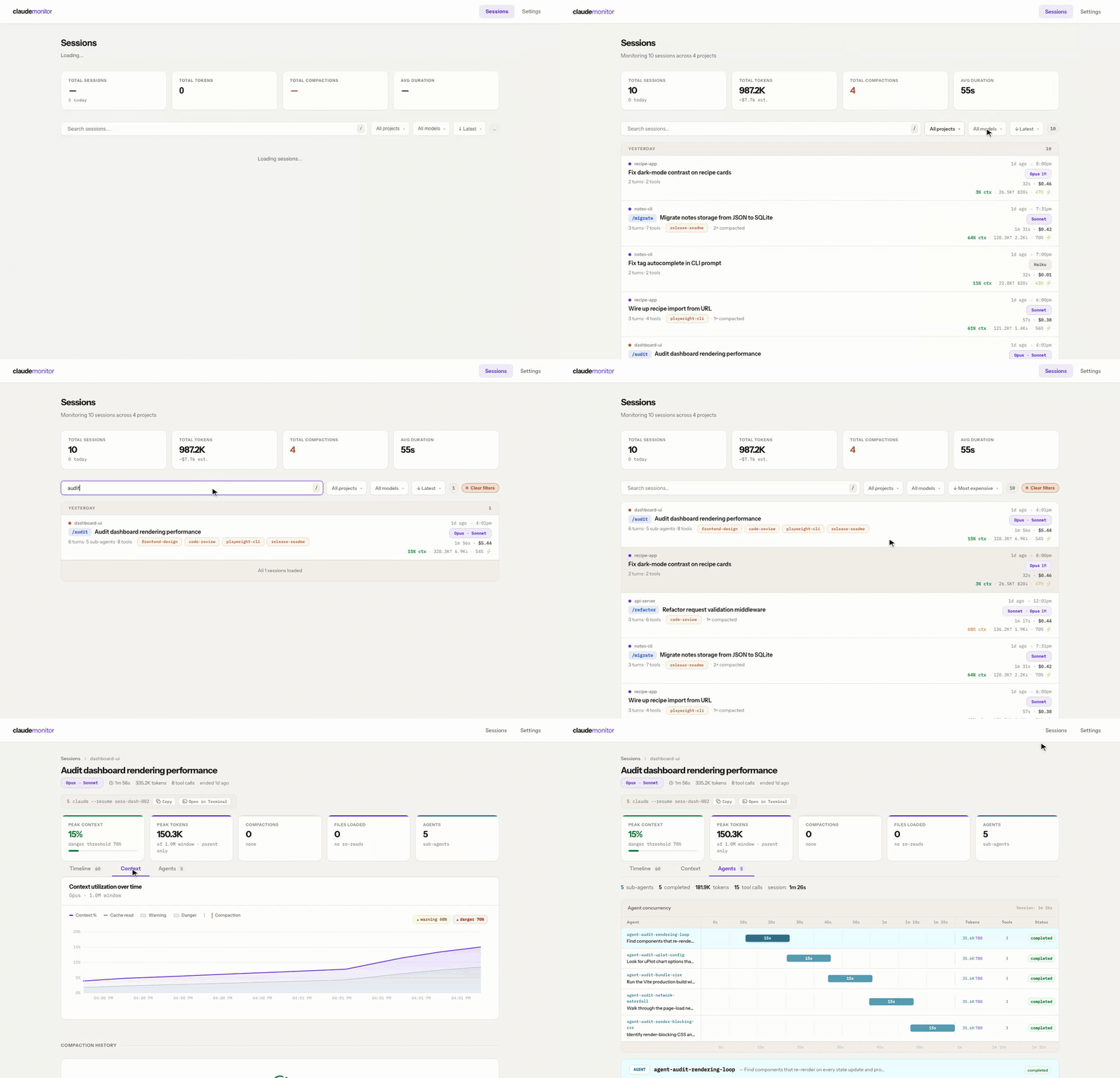
| Claude Monitor | http://localhost:4174 | — | Local observability dashboard for Claude Code sessions. |
| MinIO Console | http://localhost:9001 | minio / miniosecret |
Object browser for local Langfuse S3 buckets. |
| LangGraph dev API | http://127.0.0.1:2024 | — | Optional, only when running uv run langgraph dev --port 2024. |
| Service | Internal purpose |
|---|---|
temporal:7233 |
Temporal frontend — used by SDK and CLI inside containers. |
otel-collector:4317 |
OTel gRPC ingest — used by orchestrator and worker containers. |
otel-collector:4318 |
OTel HTTP ingest — alternative OTel endpoint. |
postgres:5432 |
PostgreSQL — used by Langfuse. |
clickhouse:8123 / 9000 |
ClickHouse — used by Langfuse for event storage. |
redis:6379 |
Redis — used by Langfuse as a queue/cache. |
langfuse-web:3000 |
Langfuse web — used by containers; host-exposed as port 3000. |
When running uv run darkfactory ... from the host (not inside a container),
the CLI connects to:
- Temporal:
localhost:7233 - OTel collector:
http://localhost:4317 - Langfuse:
http://localhost:3000
These match the defaults in .env.example.
uv run darkfactory --help# Wait for result
uv run darkfactory run "Implement X" --repo /path/to/repo
# Fire and forget
uv run darkfactory run "Implement X" --repo /path/to/repo --no-wait
# Unattended — auto-approve the brief and merge gates
uv run darkfactory run "Implement X" --repo /path/to/repo --auto-approve-gates
# Smoke test (no LLMs, confirms worker plumbing only)
uv run darkfactory run --hello-worker --repo /path/to/repoDrives the brief and merge gates of a prompt run by workflow ID. See Human gates for the full flow.
# Render the pending gate to ./.darkfactory/briefs/<workflow-id>.md (--out overrides)
uv run darkfactory gate show <workflow-id>

# Brief gate
uv run darkfactory gate approve <workflow-id>
uv run darkfactory gate revise  <workflow-id> --feedback "<feedback>"
uv run darkfactory gate reject  <workflow-id> --reason "<reason>"

# Merge gate
uv run darkfactory gate approve <workflow-id>
uv run darkfactory gate fix     <workflow-id> --focus "<focus>"
uv run darkfactory gate rebuild <workflow-id> --focus "<focus>"
uv run darkfactory gate reject <workflow-id> --reason "<reason>"uv run darkfactory schedule install --repo owner/name --label df:ready --interval 60s
uv run darkfactory schedule list
uv run darkfactory schedule pause --repo owner/name
uv run darkfactory schedule resume --repo owner/name
uv run darkfactory schedule uninstall --repo owner/nameuv run darkfactory roles list# Dry run (no LLMs, validates dataset loading)
uv run darkfactory eval evals/benchmark.yaml --dry-run
# Run against Langfuse dataset
uv run darkfactory eval evals/benchmark.yaml --dataset-name benchmark-prod
# Run without Langfuse (writes results to stdout)
uv run darkfactory eval evals/benchmark.yaml --tag smoke --no-langfuseEach role lives in src/darkfactory/agents/ and has a companion manifest under
src/darkfactory/agents/manifests/.
| Role | File | Purpose |
|---|---|---|
| PO | po.py |
Product Owner — turns the raw request into a structured problem statement. |
| Architect | architect.py |
Produces a detailed ImplementationBrief with work packages and verification predicates. |
| Plan Critic | plan_critic.py |
Reviews the brief and either approves or requests revisions (up to 5 passes). |
| Builder | builder.py |
Implements each work package by editing target-repo files with full tool access. |
| Tester | tester.py |
Writes and runs tests for each work package. |
| Verifier (semantic) | verifier_semantic.py |
Evaluates whether the build satisfies each verification predicate. |
| Fixer | fixer.py |
Repairs failing predicates reported by the verifier (budget-capped per work package). |
| Reviewer | reviewer.py |
Code-reviews the final branch for quality, security, and correctness. |
| PR Creator | pr_creator.py |
Pushes the branch and opens a GitHub pull request with a structured description. |
| Triage | triage.py |
(Issue-driven mode) Classifies a GitHub issue and decides whether Dark Factory should attempt it. |
| Role | Default model | Thinking |
|---|---|---|
| PO | claude-haiku-4-5-20251001 |
off |
| Architect | claude-sonnet-4-5-20250929 |
off |
| Plan Critic | claude-sonnet-4-5-20250929 |
off |
| Builder | claude-sonnet-4-5-20250929 |
off |
| Tester | claude-sonnet-4-5-20250929 |
off |
| Verifier | claude-sonnet-4-5-20250929 |
off |
| Fixer | claude-sonnet-4-5-20250929 |
on |
| Reviewer | claude-sonnet-4-5-20250929 |
off |
| PR Creator | claude-haiku-4-5-20251001 |
off |
| Triage | claude-haiku-4-5-20251001 |
off |
Override any role at compose time via LLM_<ROLE>_MODEL in .env.
Role system prompts live in src/darkfactory/prompts/ as plain text files.
When LANGFUSE_PROMPTS_ENABLED=true (the default), the runtime fetches prompts
from Langfuse by label at startup, with the disk files as a fallback.
export LANGFUSE_PUBLIC_KEY=pk-lf-local
export LANGFUSE_SECRET_KEY=sk-lf-local

# Preview without uploading
uv run python scripts/upload_prompts_to_langfuse.py --label production --dry-run

# Upload
uv run python scripts/upload_prompts_to_langfuse.py --label production
After uploading, edit prompts directly in the Langfuse UI at
http://localhost:3000 and promote them to the production label. Workflows
started after the promotion will pick up the new prompts automatically.
Four pipeline stages are exposed as standalone LangGraph graphs for interactive development and debugging:
| Graph | Stage | Entry point |
|---|---|---|
triage |
Issue classification | src/darkfactory/stages/triage.py:triage_subgraph |
discovery |
PO → Architect → Plan Critic | src/darkfactory/stages/discovery.py:discovery_subgraph |
build |
Builder + Tester | src/darkfactory/stages/build.py:build_subgraph |
verify |
Verifier + predicate evaluation | src/darkfactory/stages/verify.py:verify_subgraph |
Start the dev server (requires the dev dependency group, included in uv sync):
uv run langgraph dev --port 2024The server reads .env and starts at http://127.0.0.1:2024. Add --no-browser
to skip auto-opening. Connect the LangGraph Studio desktop app to this URL to
step through graphs interactively.
All agent execution and target-repository work happens inside a per-workflow
Docker worker container. The image is configurable via DARKFACTORY_WORKER_IMAGE.
darkfactory-worker:polyglot
Includes:
- Dark Factory runtime: Python 3.13,
uv, Claude Code, Temporal SDK - Repo tools:
git,gh,ripgrep,make, build essentials - Java: Temurin JDK 21, Maven, Gradle
- JavaScript/TypeScript: Node.js, npm, Corepack
- Python projects: Python 3.13, pip,
uv
Build:
docker compose --profile worker-image build darkfactory-worker-imageSet DARKFACTORY_WORKER_IMAGE in .env or on the command line:
DARKFACTORY_WORKER_IMAGE=acme/darkfactory-worker-go:latest docker compose up -dA custom image must satisfy the contract described in
docs/worker-images.md: Python ≥ 3.13, Dark Factory
installed at /opt/darkfactory, /workspace writable by UID/GID 1000:1000,
git/gh/claude/uv available to user 1000.
The simplest customization extends the default:
FROM darkfactory-worker:polyglot
USER root
RUN apt-get update && apt-get install -y --no-install-recommends golang \
    && rm -rf /var/lib/apt/lists/*
USER agent# Full suite
uv run pytest tests/
# Workflow tests only
uv run pytest tests/test_workflow_*.py
# Single test by name
uv run pytest -k "verify_retry" -x
# Skip Docker / CLI / network-dependent tests
uv run pytest -m "not integration"Workflow tests use Temporal's local time-skipping test server. The first run
downloads the binary into .cache/temporal-test-server/. Pre-warm it:
uv run python scripts/bootstrap_temporal_test_server.pySet TEMPORAL_TEST_SERVER_REQUIRED=1 to make the suite fail (instead of skip)
when the test server binary is unreachable — useful in CI.
The transcript transformer has a separate Node test suite:
cd services/transcript-transformer
npm test| Path | Purpose |
|---|---|
src/darkfactory/cli.py |
darkfactory CLI entry point. |
src/darkfactory/runtime/workflow.py |
Main Temporal workflow (manual-prompt mode). |
src/darkfactory/runtime/issue_workflow.py |
GitHub issue-driven workflow. |
src/darkfactory/runtime/activities.py |
All Temporal activities: stage runners + worker container lifecycle. |
src/darkfactory/runtime/orchestrator_main.py |
Long-running orchestrator process (supervisor-tq). |
src/darkfactory/runtime/worker_main.py |
Per-workflow worker process (agent-tq-<wf_id>). |
src/darkfactory/stages/ |
LangGraph subgraph wiring for discovery, build, and verify stages. |
src/darkfactory/agents/ |
Claude Agent SDK role implementations. |
src/darkfactory/agents/manifests/ |
YAML manifests declaring model, tools, and thinking config per role. |
src/darkfactory/prompts/ |
Disk fallback prompts for each role. |
src/darkfactory/llm_factory.py |
Builds ClaudeAgentOptions per role; applies env-var overrides. |
src/darkfactory/state.py |
PipelineState TypedDict with reducer-annotated channels. |
src/darkfactory/templates/comments/ |
Jinja2 templates for GitHub issue phase comments. |
scripts/ |
Helper scripts: label sync, prompt upload, GitHub App token, test server bootstrap. |
services/transcript-transformer/ |
Node service that rewrites Claude transcripts for Claude Monitor. |
docs/ |
Operational docs: label contract, worker images, eval strategy, token rotation. |
evals/ |
Benchmark dataset YAML files. |
tests/ |
Unit, workflow-level, and integration tests. |
docker-compose.yml |
Full local stack definition. |
Dockerfile.worker |
Polyglot worker image. |
Dockerfile.orchestrator |
Orchestrator image. |
otel-collector-config.yaml |
OTel collector pipeline config (Langfuse OTLP exporter + trace coalescing). |
langgraph.json |
LangGraph Studio graph definitions. |
CLAUDE.md |
Architecture reference and contributor conventions (read by Claude Code). |
These screenshots show the local developer stack after docker compose up -d.
Inspect workflow executions, schedules, task queues, and full execution histories.
Search for workflow IDs starting with darkfactory- or df-issue-.

Traces, model cost breakdowns, prompt management, and evaluation scores for the
local Dark Factory project. Login: admin@local.dev / password.

Local observability dashboard for Claude Code sessions — see what your context window is actually doing.
https://github.com/pigorv/claude-monitor
Per-workflow Claude Code transcript viewer, grouped by workflow-friendly project names. Powered by the transcript transformer service.
Object browser for the local Langfuse S3 buckets. Login: minio / miniosecret.

| File | Contents |
|---|---|
CLAUDE.md |
Architecture deep-dive, workflow state machine, agent/tooling details, contributor conventions. |
docs/github-labels.md |
Full GitHub label contract for issue automation. |