Repository containing notes and all projects associated with the complete-javascript-course on udemy.
- JavaScript Fundamentals Part 1
- JavaScript Fundamentals Part 2
- Developer Skills & Editor Setup
- HTML and CSS
- DOM Events
- JavaScript Behind the Scenes
- Data Stuctures, Modern Operators and Strings
JavaScript is a high-level, object-oriented, multi-paradigm (a programming language that supports both procedural and object-oriented programming philosophies) programming language.
- programming language, tool that allows you to control computer
- high-level -abstractions over small details (we don't have to worry about memory management)
- object oriented - mostly based on objects for storing most kinds of data
- mutli-paradigm - you can use different programming styles
Role of Javascript in web development: programming language of the internet, and make content dynamic (building web application).
Modern Frameworks/Libraries for developing in Javascript (100% based on Javascript):
- React
- Angular
- Vue
Javascript can run outside of the web browser. Example: Node.js allows Javascript to run on the server.
Native mobile application development
- React Native
- Ionic
Native desktop application development:
- Electron
Javascript Versions
- ES2015 (released in 2015) was the biggest update to Javascrip language ever, aka ES6
- yearly releases since 2015
- ES = ECMAScript
- ES6 through ES11 (2015 - 2020) are known as modern JavaScript
- really through present date
Where to locate JavaScript <script> callout: Stack Overflow
- Summary: if you place it in the head, HTML stops loading while the website pulls the JavaScript file. Placed at the bottom of the <body> results in the full website being loaded before fetching the JavaScript file, which can lead to slow website loading times. Ideally you place the <script> in the head with using either an async or defer attribute.
- `<script src="path/to/script1.js" async></script>`
- `<script src="path/to/script1.js" defer></script>`
Value - a piece of data (most fundamental programming unit), can be a name or a number (smallest unit of information in JavaScript)
- can be stored in a variable by declaration
- are either an OBJECT or a PRIMITIVE value
- OBJECT:
let me = { name: 'Jonas'}; - PRIMITVE:
let firstName = 'Jonas';
- OBJECT:
Variables - a "box" where you can store a value.
Naming Convention:
- camelCase - first word is lower case, each additional word is capitalized
- cannot start a variable name with a number
let 3years = 3;would throw an error - can only contain numbers, letters, $, and _
- cannot use reserved javascript keyword, for example
new,function,name, etc - do not start with uppercase word (convention because it is reserved for object oriented programming)
- constants are written in ALL UPPERCASE example:
PI = 3.1415 - you should be able to understand the expected data held in the variable from the variable name
- example pairs:
myFirstJobvsjob1,myCurrentJobvsjob2
- example pairs:
- Number: Floating point numbers used for decimals and intergers (always considers the decimal even when not displayed) ex:
let age = 23; - String: Sequence of characters used for text always contained within quotes
''or""ex:let firstName = 'Jonas'; - Boolean: Logical tupe that can only be
trueorfalse, used for making decisions with code ex:let fullAge = true; - Undefined: Value taken by a variable that is not yet defined (
empty value) ex:let childeren; - Null: Also means
empty value - Symbol (ES2015): Value that is unique and cannot be changed
- BigInt(ES2020)): Larger integers than the Number type can hold
JavaScript has a feature called dynamic typing, which means JavaScript automatically selects the data type of the value when stored in a variable.
- use
typeofto determine the assigned typing of a value ex:console.log(typeof true);
- Let (ES6): Used to declare variables that can change later (during execution of our program)
- Changing the assignment value of a variable after it is declared is referred to reassignment OR mutation (mutating a variable).
- useful for declaring empty variables at the beging of a script that are later reassigned values later on in the program
-
Const (ES6): Use this variable declaration when the value of the variable will not change at any point. Infact JavaScript will throw and error if you try to reassign the value after it has been declared.
-
const birthday = 'June 5th, 1986'; console.log(birthday); birthday = '06/05/1986'; console.log(birthday); - the code above will result in
Uncaught TypeError: Assignment to constant variable. - cannot declare empty const variables as you cannot change them later on
const job;, as this will result inUncaught SyntaxError: Missing intializer in const declaration.
-
- Var (oldway): looks similar to
let(can be reassigned), avoid using.
Best practice: Always use const by default and only use let when you are absolutly sure the variable value needs to change at somepoint. Avoid using var.
- minimizing variables that can mutate reduces opportunity for bugs
Operator allows you to transform or combine values
- mathmatical
- addition
+ - subtraction
- - mutiplication
* - division
/ - exponents
**
- addition
- comparison (used to produce boolean values)
- greater than
> - less than
< - greater than or equal to
>= - less than or equal to
<=
- greater than
- logical
- assignment
- equals sign
= - increment
++add one - decrement
--subtract one +=, -=*=,/=x plus, minus, times, divided by x and the value
- equals sign
Mozilla Operator Precedence Resource
JavaScript has 21 difference precedences. A higher precedence number means that operation is prioritized in JavaScript (21 highest priority, 1 lowest priority). In addition to each precedence number, some operations are read left to right such as addition and subtraction, while other are read right to left such as assignment operators.
left to right: 25 - 10 - 5 will result in 10 as the operations are performed left to rightright to left: the result below logs 10, as JavaScript performs the mathmatical operators first, then when complete assigns the result to x.let x; x = 25 - 10 - 5 console.log(x)
Sequence of characters used for text always contained within quotes '' or "" ex: let firstName = 'Jonas';
You can concatenate simple or complex strings using the + operator:
const firstName = "Jonas";
const job = "teacher";
const birthYear = "1991";
const year = 2037;

let jonas = "I'm " + firstName + ', a ' + (year - birthYear) + ' years old ' + job + '!';
console.log(jonas);
A better way to do this would be template literals.
A template literal can assemble multiple pieces into one final string using backticks `` and ${variable_name} to reference any variables.
jonas = `I'm ${firstName}, a ${year - birthYear} years old ${job}!`;
console.log(jonas);
Both of the above produce the same result: I'm Jonas, a 46 years old teacher!
Multi-line strings:
- Oldway:
console.log('String with \n\ multiple \n\ lines'); - Template Literal:
console.log(`String with
multiple
lines`);
If/Else Control structure:
if(condition) {
code to be executed if true
} else {
code to be execute if false
}
Converting a string to a number or boolean, or vice versa. You cannot convert to undefined, null, etc.
Type Conversion - when you manually convert from one type for another.
Number()- function must start with capital N- converts to a number, this doesn't permanently change the value type, it only affects instances where the
Number()function is called.const inputYear = "1991"; console.log(inputYear+18); //result: 199118 console.log(Number(inputYear)+18); //result: 2009 - if you try to use
Number()on a string,Number("Erik");result will be NaN (Not a Number [invalid number]) which ironically has a typeof = number.
- converts to a number, this doesn't permanently change the value type, it only affects instances where the
String()- function must start with captial Sconsole.log(String(23));results in an output of "23".
Type Coercion - when JavaScript automatically converts from one type to another.
- Whenever there is an
+operator between a number and a string, JavaScript will automatically convert that number to a string.console.log("I'm " + 23 + ' years old');, 23 is converted to a string and the result is "I'm 23 years old".
- Whenever there is an
-,*,/,>,<operators between a number and string number, JavaScript converts the strings to a number.console.log("23" - 10);result is 13 as "23" is converted to 23 then 10 is subtracted.
Boolean() function in JavaScript converts a value to a boolean.
- function must start with captial B
Falsey Values (5 only) will all become false when converted to a boolean, all other values will become true.
- 0
console.log(Boolean(0));results infalse - ''
console.log(Boolean(''));results infalse - undefined
console.log(Boolean(undefined));results infalse - null
console.log(Boolean(null));results infalse - NaN
console.log(Boolean(NaN));results infalse
Truthy Values - every other value that is not a falsy value above.
The Boolean() function is rarely used, and we mostly rely on JavaScript Coercion.
JavaScript uses type coercion when using
- example, any value entered into a if else statement, Javascript will automatically try to convert to a boolean using the truthy/falsey number guidelines.
- can use to check if a variable is defined or not:
let height; // or height = 0; <-- this is a bug, because it is defined as 0, but be aware it will say it is undefined
if (height) {
    console.log("Height is defined");
} else {
    console.log("Height is undefined");
}
//result is false because height has no assigned value
height = 1;
if (height) {
    console.log("Height is defined");
} else {
    console.log("Height is undefined");
}
//result is true
== - loose equlity operator
'18' == 18is true ('18' was converted to 18)===- strict equality operator, this does not perform type coercion'18' === 18is false ('18' is not converted to a number)
Try to use the strict === equality operator by default for cleaner code and avoiding bugs.
!= - loose different operator
!== - strict different operator
Again, the strict !== operator is preferred.
Boolean logic is a branch of computer science which uses true and false values to solve complex logic problems, using several logical operators.
Logical Operators:
- AND - if A and B are
true, result returnstrueall other combinations with afalsereturnsfalse - OR - if either A or B are
trueresult will returntrue - NOT - inverts the ture/false value
&& - AND operator
|| - OR operator
! - NOT operator
The switch statement is an alternative way to write and if else statement where you are cycling through multiple variables (example with day of the week shown below). Switch statements typically require slightly more code but are generally easier to understand visually.
Switch Statements are comprised of a few components:
switch(variable_being_cycled){
    case 'alternate_value_for_variable':
        code to be executed;
        additional code to be executed;
        break;
    default:
        code to be executed;
}
- switch(): calls the function on a variable
- case: defines the value being evaluated for that variable, would typically have multiple cases in a switch statement
- break: stops code below the break from being executed
- default: code that will execute if value is called that isn't expected
Switch statement compared to if else statement:
const day = 'monday';

switch(day) {
    case 'monday': //day === 'monday' uses strict equality
        console.log('Plan course structure');
        console.log('Go to coding meetup');
        break;
    case 'tuesday':
        console.log('prepare theory videos');
        break;
    case 'wednesday':
    case 'thursday':
        console.log("write code examples");
        break;
    case 'friday':
        console.log('record videos');
        break;
    case 'saturday':
    case 'sunday':
        console.log('enjoy the weekend');
        break;
    default:
        console.log('not a valid day');
}

//without break; the code goes to the next day.
//same code as switch but written with if else format

if (day === 'monday') {
    console.log('Plan course structure');
    console.log('Go to coding meetup');
} else if (day === 'tuesday'){
    console.log('prepare theory videos');
}else if (day === 'wednesday' || day === 'thursday'){
    console.log("write code examples");
}else if (day === 'friday'){
    console.log('record videos');
}else if (day === 'saturday' || day === 'sunday'){
    console.log('enjoy the weekend');
} else {
    console.log('not a valid day');
}
Expression - a piece of code that produces a value: (3 + 4), 1991, true && false
Statement - a bigger piece of code that does not produce a value of itself
if (23 > 10) { const str = '23 is bigger'; }
- 23 is bigger is a expression
- the whole code is a statement
- expressions cannot be placed in template literal
The Conditional Operator allows you to write something similar to an if else statement but all in one line.
- only one line of code can be executed after true statement,
?precedes condition if true:precedes condition if false- example:
const age = 23;
age >= 21 ? console.log('I can drink wine! 🍷') : console.log('I have to stick with water. 💧');
Is an expression and can be used to conditionally assign values to variables.
const drink = age >= 21 ? 'wine! 🍷' : 'water 💧';

//these two code blocks execute the same thing

let drink;
if (age >= 21){
    drink = 'wine 🍷';
} else{
    drink = 'water 💧';
}
The conditional operator can also be placed in a template literal as it's output is a value.
console.log(`I like to drink ${age >= 21 ? 'wine 🍷' : "water 💧"}`);
Not a replacement for if else statements, but is perfect for taking quick decsions.
1995 Netscape, Bredan Eich creates the first version of JavaScript called Mocha 1996 mocha renamed to livescript and then again to JavaScript, Microsoft copies JavaScript from NetScape and names it JScript 1997 ES1 released to standardize JavaScript 2009 ES5 released with lots of features 2015 ES6 biggest update to language ever, changed to annual release cycle
JavaScript releases always provide backwards compatibility so they don't break the web (all the way back to ES1).
JavaScript is not forwards compatible as they are limited by what the web browsers can read.
How to use modern javascript:
- During Development: use latest version of Google Chrome
- During Production: use Babel to transpile and polyfill your code (convert back to ES5 to ensure browser compatibility).
ES5 is supported by all browsers today.
ES6+ is well supported by all modern browsers but not older browsers (modern JavaScript)
Adding the 'use strict'; as your first line of code in your JavaScript script activates strict mode.
Strict mode does two things:
- Forbids the coder from performing certain actions
- In certain situations creates visible errors in the developer console where without strict mode it would have failed silently
- misspelling variables in code
- preventing from using future keywords as variables (interface, private)
Best practice is to always code in strict mode.
Functions are a piece of code you can reuse over and over again. They can hold multiple lines of code.
function function_name() {
    code to be executed;
}
Calling, invoking, or running the function:
function_name();
Functions can both recieve (parameters) and return data.
- Parameters: represent the input data into a funcition
- `function_name(parameter1, parameter2);
- values of the parameters are called the arguement
- Return: using return at the end of a function allows you to utilize a value or result of the function outside of the function.
- immediately exits the function
- code written after the return line will not be executed (eg: a console.log after the return line)
Principle: Do not repeat yourself (code) (referenced as keeping your code dry). Use functions to maintain clean efficient code.
Function delcalarations can be called before the function is declared, where a function expression cannot. Function expressions are functions stored in a variable. It is developer preference in which method they choose to use.
A function declaration is structure as:
function calcAge1(birthYear) {
    return 2037 - birthYear;
}

const age1 = calcAge1(1991);
console.log(age1);
A function expression is stuctured as:
const calcAge2 = function(birthYear){
    return 2037 - birthYear;
}

const age2 = calcAge2(1991);
console.log(age1, age2);
A special form of function expression that is shorter and faster to write
- Return result is implicit for arrow functions with one line of code to execute
- Multiple code lines require an explicit return call and braces {} to encolse both codes lines
- Multiple paramaters can be handled by placing the parameters in paraenthesis ()
- Arrow functions loose their advantage when the function gets too complex
- Call the function just like function declarations and function expressions
- Arrow functions do not get a "this" keyword (more on this later)
Basic arrow function:
const calcAge3 = birthYear => 2037 - birthYear;
Delcare variable to store arrow function, argument for arrow function, =>, code to be executed and returned.
Multiline arrow function:
const yearsUntilRetirement = birthYear => {
    const age = 2021 - birthYear;
    const retirement = 65 - age;
   return retirement;
}
Note the addition of writing the return line and capturing code in curly braces
Multiline, mulitparameter arrow function:
const yearsUntilRetirement = (birthYear, firstName) => {
    const age = 2021 - birthYear;
    const retirement = 65 - age;
    return `${firstName} retires in ${retirement} years.`
}
Note parameters are now in paranthesis ()
A common practice, that can help maintain dry code and reduce the number of lines in code that need to be updated should the way the code executes.
example:
function cutFruitPieces(fruit){
    return fruit * 4;
}

function fruitProcessor(apples, oranges){
    const applePieces = cutFruitPieces(apples);
    const orangePieces = cutFruitPieces(oranges);
    const juice = `Juice with ${applePieces} apple pieces and ${orangePieces} orange pieces.`;
    return juice;
}

console.log(fruitProcessor(2, 3));
Returns "Juice with 8 apple pieces and 12 orange pieces."
Arrays are a type of datastructure. They can use arrays to bundle multiple variables, without having to declare multiple versions.
- arrays are 0 based, which means the first element in the array is 0
- arrays have properties
- array_name.array_property
- .length for example pull the total number of elements in the array.
Inputing data into an Array:
//non array
const friend1 = "Micheal";
const friend2 = "Steve";
const friend3 = "Peter";
//array
const friends = ['Micheal', "Steven", 'Peter'];
Ensure when making an array of strings the comma is outside of the strings quotation marks.
Alternately you can write array's using this additional syntax:
const years = new Array(1999, 2004, 2012);
Although, using the brackets (literal syntax) is the more common way.
example:
const firstName = 'Jonas';
const jonas = [
    firstName,
    'Schmedtmann',
    2037 - 1991,
    'teacher',
    friends
];
Getting data out of an Array:
You can pull data out of an array using the syntax below, which will result in "Micheal".
console.log(friends[0]);
You can mutate an array by assigning a position in the array a new value.
friends[2] = 'Jay';
Changes last person from Peter to Jay. So even an array declared with const can be mutated. But you cannot reassign all of the values.
When creating arrays you can assign numbers, strings, expressions, variables, or even other arrays to a given position.
const firstName = 'Jonas';
const jonas = [firstName, 'Schmedtmann', 2037 - 1991, 'teacher', friends];
Passing arrays into functions:
.push()- adds and element to the end of an array- returns a value (length of the array), do get that value you can store it in a variable
.unshift()- adds an element to the begining of an array- also returns value (length of the array)
.pop()- removes the last element from an array- returns value of removed element
.shift()- removes the first element from an array- returns value of removed element
.indexOf()- returns index of a value in an array.includes()- returnstrueorfalseif the item is in an array or not
Objects are another type of data structure in JavaScript. They allow you to define key value pairs. A major difference between arrays and objects, is that the order of items in an object does not matter when you want to retrieve the data (JavaScript will display these alphabetically).
- can only access array information based on order information
- use arrays for more ordered information and objects that have less order
Object Literal Structure:
const object_name = {
    key1: 'string_value_key1',
    key2: number_value_key2,
    key3: expression_key3,
    key4: [array_key4]
}
example (compare to array):
const jonas = {
    firstName: 'Jonas',
    lastName: 'Schmedtmann',
    age: 2037 - 1991,
    job: 'teacher',
    friends:['Micheal', "Steven", 'Peter']
};
The above object example has 5 properties (number of key values).
Dot Notation
console.log(jonas.lastName);
Bracket Notation:
console.log(jonas['lastName']);
Both in the example above would return the same value. The only difference is that will bracket notation [] you can place an expression in the brackets to result in the value you want to pull from the object.
const nameKey = 'Name';
console.log(jonas['first' + nameKey]);
console.log(jonas['last' + nameKey]);
When computing a property name, the bracket [] notation must be used, all other cases best practice is to use dot . notation.
Variables cannot be called in dot . notation: object_name.variable_name will return undefined (falsy value). Again, bracket [] notation must used to do this.
Adding values to an Object: Dot notation
- `jonas.location = 'Portugal'; Bracket notation
jonas['twitter'] = '@jonasschmedtman';
Any function attached to an object property is called a method. These functions are declared in the same manner as function expressions, with the only difference being instead of storing the function in a variable, it is now stored in a property of the object.
Example with an object method (calcAge)
const jonas = {
    firstName: 'Jonas',
    lastName: 'Schmedtmann',
    birthYear: 1991,
    job: 'teacher',
    friends:['Micheal', "Steven", 'Peter'],
    hasDriversLicense: true,
    calcAge: function(birthYear){
        return 2037 - birthYear;
    }
};
How to call the value out of a object method (dot & bracket notation):
console.log(jonas.calcAge(1991));
console.log(jonas['calcAge'](1991));
In the example above calcAge is referencing a property birthYear which is already defined in the object. This is repetitive and not a clean way to do this. Object methods actually have a way to call this property directly using the this keyword (this variable) to avoid entering the same data twice.
    calcAge: function(){
           return 2037 - this.birthYear;
    }
Notice - you don't need to put the property in the parenthesis.
If you need to access the result in an object method multiple times, it can be cumbersome to call the function multiple times, so there is a more efficient way to do this. Instead you can calculate the age once and store it in the object and when the value is needed you can pull it from the property.
calcAge: function(){
    this.age = 2037 - this.birthYear;
    return this.age;
}
The result of the function above is now stored in the property .age of jonas.
Array's are actually special objects, which is why we are able to use array methods on them. The difference being, we are able to define our own methods with objects.
Loops are a type of control structure and are fundamental aspect of a programming language as they allow you to automate repetative tasks.
For loop leeps running while condition is TRUE.
For Loop Structure:
for(intial_state; condition; increment){
    code to be executed;
}

for(let rep = 1; rep <= 10; rep++){
    console.log(`Lifting weights repetition ${rep}  `)
}
One of the most useful applications of the for loop is to loop through arrays.
example:
const jonas = [
    'Jonas',
    'Schmedtmann',
    2037 - 1991,
    'teacher',
    ['Micheal', "Steven", 'Peter']
];

//log every element of an array
for (let i = 0; i < jonas.length; i++) {
    console.log(jonas[i]);
}
Loops can not only be used to read from an array, but also write to an existing array.
- when doing this method there are two syntaxes that can be used:
types[i] = typeof jonas [i];types.push(typeof jonas[i]);- it is important to use .push vs .unshift as .unshift will change the order of the values
const types = []; //empty array

for (let i = 0; i < jonas.length; i++) {
    console.log(jonas[i], typeof jonas[i]);
    types.push(typeof jonas[i]);
}
Statements:
continue- exit current condition of loop and continue on starting at the next iteration//only want to print elements that are strings: console.log('---ONLY STRINGS---') for (let i = 0; i < jonas.length; i++) { if (typeof jonas[i] !== 'string') continue; console.log(jonas[i], typeof jonas[i]); }break- completely exit the loop//want to exit loop after finding number: console.log('---BREAK WITH NUMBER---') for (let i = 0; i < jonas.length; i++) { if (typeof jonas[i] === 'number') break; console.log(jonas[i], typeof jonas[i]); }
Looping backwards through an array is very similar to looping forwards. The intial counter, condition, and increment just need to be updated to reflect the new end goal.
example (looping backwards):
    console.log(jonas[i]);
}
Looping in a loop can be used to cycle through various conditions within a loop.
example (loop in loop):
for (let exercise = 1; exercise <= 3; exercise++){
console.log(`-------Starting Exercise ${exercise} -------`)
for(let rep = 1; rep <= 5; rep++){
console.log(`Lifting weights repetition ${rep} 🏋️♀️ `)
}
}
You can only specify the condition in the delcaration of a while loop. The other two components (repetitions and increment) outside of the loop.
The while loop is more versitile because it doesn't need a counter. And as a result you can solve for specific problems when you do not know how many times the loop should run.
let dice = Math.trunc(Math.random() * 6) + 1;
console.log(dice);

while (dice !== 6){
    console.log(`You rolled a ${dice}!`);
    dice = Math.trunc(Math.random() * 6) + 1;
}
Condition must be TRUE for the loop to continue.
If you do not change the condition or re-prompt, you will create an infinite loop.
Solving Problems:
- Make sure you 100% understand the problem. Ask the right questions to get a clear picture of the problem.
- Divide and conquer: Break a big problem into smaller sub-problems.
- Don't be afraid to do as much research as you have to.
- For bigger problems, write pseudo-code before writing the actual code.
Use Google, StackOverflow and MDN to help find solutions you can understand to the problems you are having.
Debugging Process
- Identify the BUG - become aware during development, testing, or user reports, understanding the context (browsers/users)
- Find the BUG - isolate exactly where the bug is happening in the code
- FIX the bug - replace the wrong solution with the new correct solution
- Prevent - search for the same bug in similar code, and/or write tests using testing software
Debugging:
- Using the chrome inspect tool, you can access the .js script in the
Sourcestab and insert break points in the code to identify where the bug is occuring
! in vscode creates the basic html template:
<!DOCTYPE html>
<html lang="en">
<head>
    <meta charset="UTF-8">
    <meta http-equiv="X-UA-Compatible" content="IE=edge">
    <meta name="viewport" content="width=device-width, initial-scale=1.0">
    <title>Document</title>
</head>
<body>

</body>
</html>
Best practice is to use class attributes vs id attributes when applying styling in CSS.
Box Model:

- Content: text, images, etc
- Padding: transparent area around the content, inside of the box
- Border: goes around the padding and the content
- Margin: space between boxes
- Fill Area: area that gets filled with background color or background image
- fills everything inside of margin
Global selector * can be used to select all element types at the beginning of an HTML document and reset them as shown below.
* {
  margin: 0;
  padding: 0;
  box-sizing: border-box;
}
box-sizing: this makes it so when specifying the width of an element, it includes padding and borders.
Selecting an element in JavaScript
document.querySelector('.message')
Selects an element of HTML using the name notation as CSS . for classes, and # for id's.
.textContentretrieves text message
DOM - Document Object Model, a structured representation of HTML documents. Allows JavaScript to access HTML elements and styles to manipulate them. - change text, HTML attributes, and even CSS styles - a connection point between HTML and JavaScript
DOM Structure - the DOM is structured as a tree starting with the DOCUMENT declaration
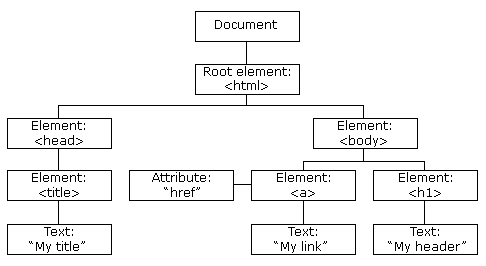
- the DOCUMENT is considered the entry point to the DOM because it is required to select elements
- first child - html element
- second child - head and body elements
- going further accesses more child elements based on the HTML structure
- further still, text for example is child of a
<p>element and can be accessed through the DOM
DOM Manipulation - JavaScript interacting with the webpage
- DOM !== JavaScript
- DOM and DOM methods are part of WEB API's (librarys written in JavaScript and available for our use)
Using the element selection method above you can select an element and its text and assign it a new value using the assignment operator =.
document.querySelector('.message').textContent = '🎉 Correct Number!';
For input fields, .value is used to access or set the value of the field, similar to how .textContent is used to access text.
document.querySelector('.guess').value;
An event is something that happens on the page: keypress, mouse moving, mouse click, etc.
Event Listener Method
- call the method after selecting the element
.addEventListener() - pass in the type of the event 'click'
- reaction to event (event handler) function value
document.querySelector('.check').addEventListener('click', function (){
    console.log(document.querySelector('.guess').value);
});
- the function isn't explictly called in the script but instead called by the event
Start by selecting the element you want to manipulate using the querySelector().
Note traditionally the way items are referenced in CSS are using hypins - between the words, for example background-color. This is not an acceptable way to call it out in JavaScript, so instead it needs to be referenced using camelCase, for example backgroundColor.
- CSS
background-coloris referenced asbackgroundColorin JavaScript
When manipulating a style, the assignment value needs to be input as 'string' that captures the value and any applicable units.
document.querySelector('body').style.backgroundColor = '#60b347';
document.querySelector('.number').style.width = '30rem';
Manipulating styles in this manner does not modifiy the CSS file, it instead creates inline style directly in the HTML document.
Refactoring - to restructure the code without changing how it works. Goal is to improve code and remove duplicate code.
--Modal Window Project--
Selecting all of the elements you need to reference and storing them in variables is a cleaner way to execute a project, vs selecting the element each time it needs to be referenced. This is typically executed at the begining of a script project.
querySelector() only selects the first element with the type, class, or id. to select all, use querySelectorAll().
- selecting all of the elments like this behaves similarly to an array.
- you can cycle through each element using a for loop, and the length of the selector is equivalent to the number of instances there are which can be reprensented by i
for( let i = 0; i < btnsOpenModal.length; i++){
    console.log(btnsOpenModal[i].textContent);
}
Modifying the Class:
- use
.classListwhich has many different modifiers- when calling out the class you want to remove, no need for the
.in front of if you are just passing in the name of the class as a string.modal.classList.remove('hidden');
- when calling out the class you want to remove, no need for the
When you need to manipulate styles on a page, using the classList (adding or removing) is cleaner.
Keyboard events still utlize addEventListener, because the keypress event is another type of event. Keyboard events are global events because they do not happen on one specific element.
- For global events we listen on the whole document.
There are three types of events for the Keyboard
keydown- event is activated when the key is pressed downkeypress- event is continuously activated while the key is pressedkeyup- event is activated when the finger is lifted from the key
We can look at which key was pressed, as event occures e JavaScript will call this function with the event object as an arguement. This works because we don't call this function ourselves (we are only defining it).
- we say hey JavaScript call this function when a keydown event happens, when you do so, please pass in the event object as an arguement.
document.addEventListener('keydown', function (e) { console.log (e.key); if(e.key ==='Escape' && !modal.classList.contains('hidden')) closeModal(); } - using the key property of the key that was pressed, we are able to test for specific key presses as show above.
--Pig Game Project--
There are multiple ways to select an element using an ID
document.querySelector('#score--0');using query selector and # (same as css) and string of ID namedocument.getElementById('score--1');using get by ID and string of ID name- get by ID is techincally faster across a large number of elements, but there is benefit to using the same syntax as classes (easier to read);
Accessing Image Source:
- Use
.srcon a selected element to access the image src. This can then be assigned a value to change the image.diceEl.src = `dice-${dice}.png`;
Toggling:
- using the toggle method
.toggle()the class will be removed if present or added if not present
Use template literals to access specific elements relevent to your code.
JavaScript is a high-level, object oriented, multi-paradigm programming language. (light explanation initially provided at start)
JavaScript further broken down:
- High-level - every program needs HW resources to operate. Low-level lanugages require resource management, where high-level languages don't require resource management.
- one down side is that a program in a high-level language will never be as fast (optimized) as a program developed in a low-level language
- Garbage-collected - algorithm in JS that automatically removes old unused objects from memory to prevent it from getting bogged down
- Interpreted or just-in-time compiled - computers processors only understand 0's and 1's (machine code), JavaScript is written in human readable code that needs to be compiled or interpreted into machine code. This happens inside of the JavaScript engine
- Multi-paradigm - in coding a paradigm is an approach/mindset of structuring code, which will direct your coding style and technique. Paradigms are either imperative or delcarative.
- Procedural Programming - organizing code in linear fashion
- Object-Oriented Programming (OOP) -
- Functional Programming (FP) -
- Prototype-based object-oriented - everything is an object except primative values (numbers, strings, etc). Prototypes inheritence is when an object such as an array is created from a template (protoype) it inherits the methods from the blueprint (prototype).
- First-class Functions - functions are treated as regular variables (you can pass functions into function, return functions from functions) this allows for functional programming (paradigm above).
- Dynamic - dynamically typed (we don't assign data types to variables) and typing can be reassigned. Most other languages require delcaring the type
- Single-threaded - JavaScript runs in one single thread, so it can only do one thing at a time
- concurrency model - how the JavaScript handles multiple tasks happening at the same time
- thread is a set of instructions executed in the CPU
- long-running tasks would block JavaScript? 'no'
- by using an event loop ...
- Non-blocking event loop - by using an event loop long running tasks are executed in the "background" then put back into the main thread once they have finished
JavaScript Engine - a computer program that executes JavaScript code
- every browser has a JavaScript engine
- most well known is google v8
- runs node.js and google chrome
Every JavaScript Engine Contains
- Call Stack - where our code is executed using execution context
- Heap - unstructured memory pool that stores all of the objects our application needs
Compilation vs Interpretation Compilation - the entire source code is converted into machine code at once, which is then written into a portable file that can be executed on any computer.
- code is compiled and can be executed at a later time (think apps on a phone or computer) Interpretation - interpreter runs through source code and executes it line by line (converts to machine code)
- code is read and executed at the same time
- interpretation is SLOWER than complilation
- JavaScript used to be interpreted, but modern JS engines use a mix between compliation and interpretation called just in time interpretation
Just-in-time Interpretation - the entire code is converted into machine code at once and then executed immediately.
- no portable file to execute
Execution as code enters engine:
- Parse code - read the code, the code is parsed into the abstract syntax tree (AST), this step checks for syntax errors.
- Compilation - takes generated AST and coverts to machine code
- Execution - executed immediately
- Optimization - happens after execution and feeds back into compilation
- JS engines will quickly compile the bare minimum to get the code execution and will then will sometimes run multiple optimizations all while the code is being executed to improve performance.
JavaScript Runtime (in browser)
Runtime is a box that contains all of the components that JavaScript needs to run
- JavaScript Engine - heart of the runtime
- WEB APIs - DOM, timers, Fetch API, ...
- CallBack Queue - click, timer, data, ...
- Event Loop - takes functions from the callback queue and puts them into the call stack in the engine
JavaScript Runtime (non-browser)
- JavaScript Engine - heart of the runtime
- C++ Bindings & thread pool
- CallBack Queue - click, timer, data, ...
- Event Loop - takes functions from the callback queue and puts them into the call stack in the engine
Execution Steps (immediately after code compilation):
- Creation of global execution context (top level code, outside of functions)
- functions are only executed when called
- only ever one global execution context per project regardless of size
- Execution of top level code (inside global EC)
- Execution of functions and waiting for callbacks
- one execution context per function, for each function call a new execution context is created
Inside an Execution Context:
- Variable Environment
- let, const, and var delcarations
- functions
- arguments object
- Scope Chain - references to variables that are outside of a function
thiskeyword
All of the content above is generated during the "creation phase", right before execution
Call Stack - the place where execution contexts get stacked on top of each other, to keep track of where we are in the execution
- code runs in the call stack
Scoping - controls how our programs variables are organized and accessed by the JavaScript Engine.
- "where do the variables live?" or "where can I access a variable or where can't I?"
Lexical Scoping - scoping is controlled by the palcement of functions and blocks in the programs code.
- example a function written inside of another function as access to the parent functions variables
Scope - the space or environment in which a certain variable is declared. (3 types of scopes)
- global scope
- function scope
- block scope
Scope of a variable - Region of our code where a certain variable can be accessed.
Global Scope:
- top level code (variables declared outside of any function or block)
- accessible everywhere
Function Scope:
- variables are only accessible inside of the function (NOT outside)
- also called local scope
Block Scope (ES6):
- everything between curly braces
{} - variables are accessible only inside of block
- block scopes only apply to varibles declared with
let, andconst - functions are also blocked scoped in strict mode only
The Scope Chain
- child scopes always have access to parent scope variables all the way up to the global scope
- if a referenced variable is not found in the current scope, JS will continue to look up the parent chain until the varible is found (also know as variable lookup)
- parent scopes will never have access to child scopes (one way street)
- scope chain only works upwards (not down or sideways)
constandletare block-scopedvaris function-scoped
Scope Chain vs Call Stack
- the scope chain has nothing to do with the order in which functions were called
- the scope chain does get its variable environment from the execution context in the call stack
- in other words the scope chain is equal to adding together all of the variable environments of all of the parent scopes
- the order in which functions are called does NOT effect the scope chain, what matters is where the functions are declared!
Hoisting - makes some types of variables accessible/usable in the code before they are actually declared. "Variables lifted to the top of their scope." <- not actually what happens
-
Before execution, code is scanned for variable declarations, and for each variable, a new property is created in the variable envrionment object.
-
Hoisting works differently for each variable type
VARIABLE TYPE HOISTED (Y/N) INTIAL VALUE SCOPE function delcarations YES actual function block varvariablesYES undefined function letandconstvariablesNO uninitialized , TDZ block function expressions and arrows depends if using var,let, orconst- function declarations: can be used before they are declared in the code because they are stored in the variable environment object (even before code starts executing).
varvariables: when attempting to access before it is declared in the code, will returnundefined, this is a common source of bugs and one of the main reasonsletandconstare preferred.letandconstvariables: value set to uninitalized and are placed in the TDZ (Temporal Dead Zone), will cause error if attempting to access before its declared in the code.- function expressions and arrows: depends on how the functions were declared
var,let, orconst, and follows those rules
Temporal Dead Zone: - the region of the scope in which the variable is defined, but can't be used in any way, so it is as if the variable didn't even exist. This will output a reference error.
- this was introduced in ES6 as a way to avoid and catch errors
- accessing variables before they are declared is bad practice and the TDZ helps prevent this
- TDZ also makes
constvariables behave how they are supposed to. (can't reassign)
console.log(me); //undefined
console.log(job); //in TDZ
console.log(year); //in TDZ
var me = 'Jonas';
let job = 'teacher';
const year = '1991';
Window
- window is the global oject of JavaScript in the browser
- accessed by typing
windowin the console
this keyword/variable - special variable that is created for every execution context (every function). Takes the value of (points to) the "owner" of the function in which the this keyword is used.
- value is NOT static - it depends on howw the function is called, and its value is aonly assigned when the function is actually called.
this value for the four (4) ways of calling a function:
- method,
this= object that is calling the methods - simple function call
this= undefined (strict mode only) otherwise points to the global object - arrow functions
this= gets thethiskeyword of the surrounding function (parent) - event listener
this= DOM element that the handler is attached to
this will never point to the function itself, and also not to its variable environment!
Do not use an Arrow Function as a method within an object.
this in a function call inside of a method (object) is undefined as it is treated as a regular function call (per rule 2 above).
- Two (2) solutions to this problem:
- Pre-ES6 Solution: delcare a variable outside of the function typically called
self. const self = this;- sometimes declared as
that - ES6 Solution: use an arrow function as the
thiskeyword will be inherited from the object
- Pre-ES6 Solution: delcare a variable outside of the function typically called
Arguments keyword can be used to see the array of arguments passed into a function. An arrow function doesn't get access to this keyword.
Primative Data Types
- number, string, boolean, undefined, null, symbol, and bigint
- memory called primative types
- stored in CALL STACK in JS Engine
- identifier (variable) points to address created in memory and at that address a value is stored
- values at an address are immutable (cannot be changed), when a new value is assigned to a variable, a new address is created in memory
Objects
- object literal, arrays, functions, and everything else...
- memory called reference types
- stored in memory HEAP in JS Engine
- memory address and value, but the object identifier is stored in the call stack with a separate memory address that has the object address stored as its value
- objects are too large to be stored in the CALL STACK which is why they are stored in the HEAP (near unlimited memory) and are called referenced types becuase they are referenced to the HEAP from the CALL STACK
- setting a new identifier = to another object identifier points the new identifier to the same CALL STACK memory address, which is referencing the obect address in the HEAP.
- copying an object just created a new variable (identifier) that points to the same object
When declaring an object using const you can reassign values to the various properties becuase the object value is pointing to the reference address in the HEAP, so changing the property values does not change the value address of the object identifier.
- you cannot change the object it'self though, because this would change the reference address
const jessica = {
  firstName: 'Jessica',
  lastName: 'Williams',
  age: 27,
  }

  const marriedJessica = jessica;
  marriedJessica.lastName = 'Davis';
  console.log('Before Marriage', jessica);
  console.log('After Marriage', marriedJessica);

  //marriedJessica = {}; not allowed because of const delcaration
Copying an Object (Shallow Copy):
You can create a (shallow) copy an object by assigning a new object identifier using the Object.assign() method with an empty object and the object you want to copy.
const jessica2 = {
firstName: 'Jessica',
lastName: 'Williams',
age: 27,
family: ['Alice', 'Bob'],
}

const jessicaCopy = Object.assign({}, jessica2);
jessicaCopy.lastName = 'Davis';
This however only works on the first level (which is why it is called a shallow copy), so if there is an object in an object the copy and the original will point to the same object.
- example if the family array is modified in jessicaCopy object as shown above, it will also be changed in the jessica2 object because they are both pointing to the same array object.
To truely make an independant copy you would need to create a deep clone, which is a complicated process that relies on external libraries.
- this will be covered later.
Array Destructuring - ES6 feature used to unpack values from an array or object and store them in individual variables. (breack complex structure down into simple structure)
Destructuring of an array occures when declaring variables within brackets and assigning them the value of an array.
const arr = [2, 3, 4];
const [x, y, z] = arr;
The above code creats variables with x = 2, y = 3, and z = 4.
Not all elements of an array need to be used. The following example, the middle value is passed and x = 2, and y = 4 - the empty space , will skip the next array value.
const arr = [2, 3, 4];
const [x, , y] = arr;
Values can be easily swapped using array deconstuction. The following examples swaps the values of the main and secondary course at a resturant:
[main, secondary] = [secondary, main]
console.log(main, secondary);
With destructured arrays you can also create a function that returns an array, and then immediately deconstruct the result into different variables, in short this allows multiple values to be returned from a function.
order: function (starterIndex, mainIndex){
        return [this.starterMenu[starterIndex], this.mainMenu[mainIndex]];
    },
const [starter, mainCourse] = restaurant.order(2, 0);
Destucturing also works with nested arrays:
const nested = [2, 4, [5, 6]];
const [i, , j] = nested;
console.log(i, j); //i = 2, j = [5, 6]

const [i, , [j, k]] = nested;
console.log(i, j, k); //i = 2, j = 5, k = 6
Values can also be assigned to variable as you are deconstructing an array should the lenght of the array be unknown.
const [p, q, r] = [8, 9];
console.log(p, q, r); // r is undefined

const [p = 1, q = 1, r = 1] = [8, 9];
console.log(p, q, r); //r = 1, p/q are reassigned with array value
Destructuring an object is similar to destructing an array, only you use curly braces {} in place of brackets []. Where they differ, is that the variable names need to be written with the exact property names within the braces {} for the desired properties of the object the you are trying to extract into variables. Also since the order of elements in an object do not matter, you don't have to manually skip over them like we do for an array.
const {name, openingHours, categories} = restaurant;
To change the variable name from the object property name simply deconstruct the object adding a colon and new name for the variable.
const {name: restaurantName, openingHours: hours, categories: tags} = restaurant;
Default values can be set for each object variable during deconstruction by using brackets []. These values will be overwritten if an object property exsists with the called name, otherwise will be set to []. This can also be used while assigning a new variable name.
const {menu = [], starterMenu: starters = []} = restaurant;