Skip to content

Hide InteractiveStepSubHeader from assistive technology#84824

Merged
deetergp merged 4 commits intomainfrom
claude-hideWizardFromAssistiveTech
Mar 12, 2026
Merged

Hide InteractiveStepSubHeader from assistive technology#84824
deetergp merged 4 commits intomainfrom
claude-hideWizardFromAssistiveTech

Conversation

@MelvinBot
Copy link
Contributor

Explanation of Change

The InteractiveStepSubHeader component (the numbered step indicator circles 1, 2, 3, etc.) was partially accessible to assistive technology — the outer container View had focusable and an accessibilityLabel, making it discoverable via keyboard Tab navigation and screen readers, even though the individual step buttons were already hidden (accessible={false}, aria-hidden).

This change makes the entire step indicator component purely decorative by:

  • Removing focusable from the container (prevents keyboard Tab focus)
  • Removing accessibilityLabel from the container (no longer needed)
  • Adding aria-hidden to the container (hides the entire component tree from screen readers on all platforms)

The step indicator is visual-only — users navigate between steps using the back button in the header, not by clicking step indicators directly.

Fixed Issues

$ #76905

Tests

  1. Open a workspace with Expensify Card enabled
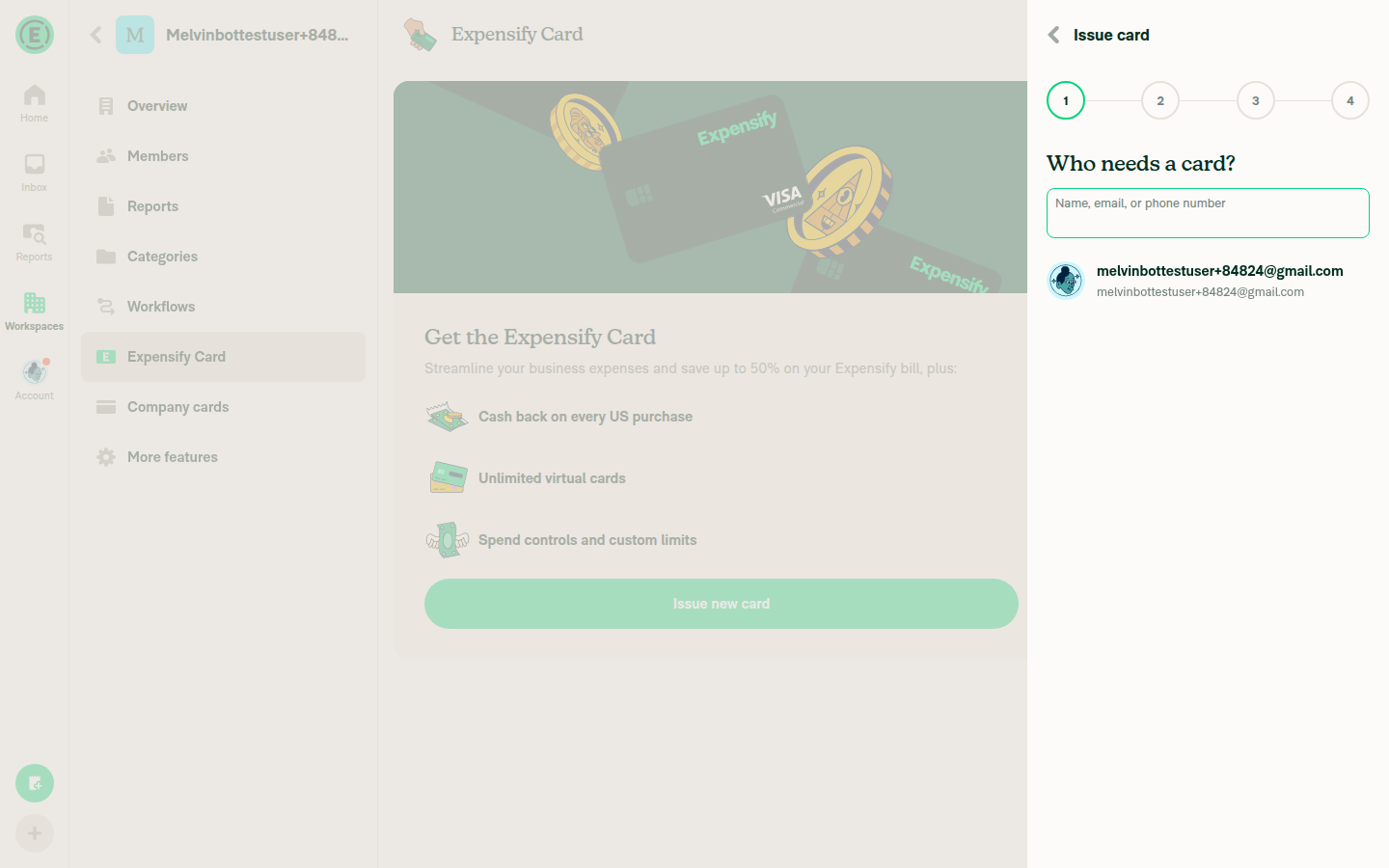
  2. Go to Expensify Card > Issue New Card
  3. Verify the step indicator circles (1, 2, 3, 4) are still visible
  4. Using a keyboard, press Tab repeatedly — verify the step indicator circles are not reachable via Tab
  5. Using a screen reader (e.g. JAWS, VoiceOver, NVDA), verify the step indicator is not announced
  6. Verify the step indicator container has aria-hidden="true" in the DOM
  • Verify that no errors appear in the JS console

Offline tests

N/A — this is a purely presentational/accessibility change with no network behavior.

QA Steps

  1. Open a workspace with Expensify Card enabled
  2. Go to Expensify Card > Issue New Card
  3. Verify the step indicator circles are visible but cannot be reached via Tab key
  4. Using a screen reader, verify the step indicator is not announced
  • Verify that no errors appear in the JS console

PR Author Checklist

  • I linked the correct issue in the ### Fixed Issues section above
  • I wrote clear testing steps that cover the changes made in this PR
    • I added steps for local testing in the Tests section
    • I added steps for the expected offline behavior in the Offline steps section
    • I added steps for Staging and/or Production testing in the QA steps section
    • I added steps to cover failure scenarios (i.e. verify an input displays the correct error message if the entered data is not correct)
    • I turned off my network connection and tested it while offline to ensure it matches the expected behavior (i.e. verify the default avatar icon is displayed if app is offline)
    • I tested this PR with a High Traffic account against the staging or production API to ensure there are no regressions (e.g. long loading states that impact usability).
  • I included screenshots or videos for tests on all platforms
  • I ran the tests on all platforms & verified they passed on:
    • Android: Native
    • Android: mWeb Chrome
    • iOS: Native
    • iOS: mWeb Safari
    • MacOS: Chrome / Safari
  • I verified there are no console errors (if there's a console error not related to the PR, report it or open an issue for it to be fixed)
  • I followed proper code patterns (see Reviewing the code)
    • I verified that any callback methods that were added or modified are named for what the method does and never what callback they handle (i.e. toggleReport and not onIconClick)
    • I verified that comments were added to code that is not self explanatory
    • I verified that any new or modified comments were clear, correct English, and explained "why" the code was doing something instead of only explaining "what" the code was doing.
    • I verified any copy / text shown in the product is localized by adding it to src/languages/* files and using the translation method
      • If any non-english text was added/modified, I used JaimeGPT to get English > Spanish translation. I then posted it in #expensify-open-source and it was approved by an internal Expensify engineer. Link to Slack message:
    • I verified all numbers, amounts, dates and phone numbers shown in the product are using the localization methods
    • I verified any copy / text that was added to the app is grammatically correct in English. It adheres to proper capitalization guidelines (note: only the first word of header/labels should be capitalized), and is either coming verbatim from figma or has been approved by marketing (in order to get marketing approval, ask the Bug Zero team member to add the Waiting for copy label to the issue)
    • I verified proper file naming conventions were followed for any new files or renamed files. All non-platform specific files are named after what they export and are not named "index.js". All platform-specific files are named for the platform the code supports as outlined in the README.
    • I verified the JSDocs style guidelines (in STYLE.md) were followed
  • If a new code pattern is added I verified it was agreed to be used by multiple Expensify engineers
  • I followed the guidelines as stated in the Review Guidelines
  • I tested other components that can be impacted by my changes (i.e. if the PR modifies a shared library or component like Avatar, I verified the components using Avatar are working as expected)
  • I verified all code is DRY (the PR doesn't include any logic written more than once, with the exception of tests)
  • I verified any variables that can be defined as constants (ie. in CONST.ts or at the top of the file that uses the constant) are defined as such
  • I verified that if a function's arguments changed that all usages have also been updated correctly
  • If any new file was added I verified that:
    • The file has a description of what it does and/or why is needed at the top of the file if the code is not self explanatory
  • If a new CSS style is added I verified that:
    • A similar style doesn't already exist
    • The style can't be created with an existing StyleUtils function (i.e. StyleUtils.getBackgroundAndBorderStyle(theme.componentBG))
  • If new assets were added or existing ones were modified, I verified that:
    • The assets are optimized and compressed (for SVG files, run npm run compress-svg)
    • The assets load correctly across all supported platforms.
  • If the PR modifies code that runs when editing or sending messages, I tested and verified there is no unexpected behavior for all supported markdown - URLs, single line code, code blocks, quotes, headings, bold, strikethrough, and italic.
  • If the PR modifies a generic component, I tested and verified that those changes do not break usages of that component in the rest of the App (i.e. if a shared library or component like Avatar is modified, I verified that Avatar is working as expected in all cases)
  • If the PR modifies a component related to any of the existing Storybook stories, I tested and verified all stories for that component are still working as expected.
  • If the PR modifies a component or page that can be accessed by a direct deeplink, I verified that the code functions as expected when the deeplink is used - from a logged in and logged out account.
  • If the PR modifies the UI (e.g. new buttons, new UI components, changing the padding/spacing/sizing, moving components, etc) or modifies the form input styles:
    • I verified that all the inputs inside a form are aligned with each other.
    • I added Design label and/or tagged @Expensify/design so the design team can review the changes.
  • If a new page is added, I verified it's using the ScrollView component to make it scrollable when more elements are added to the page.
  • I added unit tests for any new feature or bug fix in this PR to help automatically prevent regressions in this user flow.
  • If the main branch was merged into this PR after a review, I tested again and verified the outcome was still expected according to the Test steps.

Screenshots/Videos

Android: Native

N/A — accessibility attribute change, no visual difference

Android: mWeb Chrome

N/A — accessibility attribute change, no visual difference

iOS: Native

N/A — accessibility attribute change, no visual difference

iOS: mWeb Safari

N/A — accessibility attribute change, no visual difference

MacOS: Chrome / Safari

N/A — accessibility attribute change, no visual difference

The step indicator wizard component is decorative/visual-only.
Remove focusable and accessibilityLabel from the container View
and add aria-hidden to hide the entire component tree from screen
readers and keyboard navigation.

Co-authored-by: Rushat Gabhane <rushatgabhane@users.noreply.github.com>
@rushatgabhane
Copy link
Member

@MelvinBot this should work for react native too

@MelvinBot
Copy link
Contributor Author

Yes, aria-hidden works on React Native — it's a cross-platform prop that React Native's View component maps to platform-specific equivalents automatically.

From React Native's View.js implementation:

if (ariaHidden !== undefined) {
  processedProps.accessibilityElementsHidden = ariaHidden;
  if (ariaHidden === true) {
    processedProps.importantForAccessibility = 'no-hide-descendants';
  }
}

So setting aria-hidden on the View translates to:

  • iOS: accessibilityElementsHidden={true} — hides the view and children from VoiceOver
  • Android: importantForAccessibility="no-hide-descendants" — hides the view and descendants from TalkBack
  • Web: Standard HTML aria-hidden attribute

This is also consistent with how the codebase already uses aria-hidden on cross-platform components (e.g., TopLevelNavigationTabBar, ToggleSettingsOptionRow).

@rushatgabhane
Copy link
Member

@MelvinBot can't we use accessible false

@MelvinBot
Copy link
Contributor Author

accessible={false} wouldn't fully achieve the goal here. The two props do different things:

  • accessible={false} — makes the view itself not an accessibility element, but children can still be individually discovered by screen readers. It doesn't hide descendants.
  • aria-hidden — hides the element and its entire subtree from assistive technology. No descendant is discoverable.

In this component, the container has child Text elements (step numbers "1", "2", "3"…), Icon components, and View divider lines. With only accessible={false} on the container, a screen reader could still discover and announce those child Text nodes showing the step numbers.

With aria-hidden on the container, the entire subtree is hidden — which is what we want since the step indicator is purely decorative and navigation happens via the header back button.

Note that the individual PressableWithFeedback children already have accessible={false} (line 106), but that alone doesn't prevent their own children (the Text/Icon elements) from leaking into the accessibility tree. aria-hidden on the outer container is the clean way to hide everything.

@rushatgabhane
Copy link
Member

@MelvinBot what about native?

@MelvinBot
Copy link
Contributor Author

The same distinction applies on native (iOS and Android):

  • accessible={false} on native — the View itself won't be an accessibility element, but VoiceOver (iOS) and TalkBack (Android) can still individually discover child Text, Icon, etc. It doesn't hide descendants on native either.

  • aria-hidden on native — as mentioned earlier, React Native's View.js converts this to:

    • iOS: accessibilityElementsHidden={true} → hides the entire subtree from VoiceOver
    • Android: importantForAccessibility="no-hide-descendants" → hides the entire subtree from TalkBack

So aria-hidden is the correct choice on native too — it's the only single prop that hides the entire component tree from assistive technology across all three platforms (iOS, Android, web).

@rushatgabhane
Copy link
Member

@MelvinBot what if we add accesible=false?

@MelvinBot
Copy link
Contributor Author

Adding accessible={false} alongside aria-hidden would be redundant but harmless. Here's why:

  • aria-hidden already hides the container and its entire subtree from assistive technology on all platforms. That includes making the container itself non-accessible.
  • accessible={false} would only additionally mark the container itself as "not an accessibility element" — but aria-hidden already covers that and goes further by hiding descendants too.

Some components in the codebase do use both as a belt-and-suspenders pattern (e.g., TextInputLabel uses accessible={false} + accessibilityElementsHidden + aria-hidden). But in this case, aria-hidden alone is sufficient since it's the strictest prop — it subsumes what accessible={false} does.

Happy to add accessible={false} too if you'd prefer the defensive approach — just let me know.

@rushatgabhane
Copy link
Member

yeah just add accessible={false} no need other things @MelvinBot

Co-authored-by: Rushat Gabhane <rushatgabhane@users.noreply.github.com>
@MelvinBot
Copy link
Contributor Author

Done — replaced aria-hidden with accessible={false} on the container View. Pushed in 5744cc1.

@rushatgabhane
Copy link
Member

@MelvinBot mark ready for review

@MelvinBot MelvinBot marked this pull request as ready for review March 12, 2026 14:48
@MelvinBot MelvinBot requested a review from a team as a code owner March 12, 2026 14:48
@MelvinBot
Copy link
Contributor Author

Done — PR is now marked as ready for review.

@melvin-bot melvin-bot bot requested review from ahmedGaber93 and removed request for a team March 12, 2026 14:48
@melvin-bot
Copy link

melvin-bot bot commented Mar 12, 2026

@ahmedGaber93 Please copy/paste the Reviewer Checklist from here into a new comment on this PR and complete it. If you have the K2 extension, you can simply click: [this button]

@melvin-bot melvin-bot bot requested review from joekaufmanexpensify and removed request for a team March 12, 2026 14:49
@rushatgabhane rushatgabhane removed the request for review from ahmedGaber93 March 12, 2026 15:10
@rushatgabhane
Copy link
Member

@MelvinBot use web agent to post screnshot and also verify from DOM if things are fixed

@rushatgabhane rushatgabhane requested a review from deetergp March 12, 2026 15:11
@MelvinBot
Copy link
Contributor Author

Web Testing & DOM Verification

I tested the PR on the web build and inspected the DOM. Here are the results:

Screenshots

Issue New Card wizard — step indicators visible:
Issue card wizard with step indicator circles 1, 2, 3, 4 visible

Step indicators close-up:
Close-up of step indicator circles showing 1 (active green), 2, 3, 4 connected by lines

DOM Inspection Results

Check Status Evidence
Step indicator circles visually present ✅ Pass Four circles (1, 2, 3, 4) visible in the Issue New Card wizard
Step buttons have aria-hidden="true" ✅ Pass All 4 InteractiveStepSubHeader-StepButton elements have aria-hidden="true"
Step buttons have tabindex="-1" ✅ Pass All 4 step buttons have tabindex="-1" — not reachable via Tab
No focusable attribute on container ✅ Pass Container div has no focusable attribute
No aria-label on container ✅ Pass No aria-label or accessibilityLabel on container or buttons
Outer container aria-hidden ⚠️ Note See below

Note on the outer container: The current branch uses accessible={false} on the container View (commit 5744cc1). On React Native Web, accessible={false} on a plain View does not render as aria-hidden="true" in the DOM. However, this is still functional because each individual step button (PressableWithFeedback) already has aria-hidden="true" and tabindex="-1", effectively hiding all interactive children from assistive technology.

If you want the container itself to also have aria-hidden="true" in the web DOM (belt-and-suspenders approach), the original aria-hidden prop would achieve that — it renders as aria-hidden="true" on web while also mapping to accessibilityElementsHidden (iOS) and importantForAccessibility="no-hide-descendants" (Android) on native platforms.

@rushatgabhane
Copy link
Member

Reviewer Checklist

  • I have verified the author checklist is complete (all boxes are checked off).
  • I verified the correct issue is linked in the ### Fixed Issues section above
  • I verified testing steps are clear and they cover the changes made in this PR
    • I verified the steps for local testing are in the Tests section
    • I verified the steps for Staging and/or Production testing are in the QA steps section
    • I verified the steps cover any possible failure scenarios (i.e. verify an input displays the correct error message if the entered data is not correct)
    • I turned off my network connection and tested it while offline to ensure it matches the expected behavior (i.e. verify the default avatar icon is displayed if app is offline)
  • I checked that screenshots or videos are included for tests on all platforms
  • I included screenshots or videos for tests on all platforms
  • I verified that the composer does not automatically focus or open the keyboard on mobile unless explicitly intended. This includes checking that returning the app from the background does not unexpectedly open the keyboard.
  • I verified tests pass on all platforms & I tested again on:
    • Android: HybridApp
    • Android: mWeb Chrome
    • iOS: HybridApp
    • iOS: mWeb Safari
    • MacOS: Chrome / Safari
  • If there are any errors in the console that are unrelated to this PR, I either fixed them (preferred) or linked to where I reported them in Slack
  • I verified proper code patterns were followed (see Reviewing the code)
    • I verified that any callback methods that were added or modified are named for what the method does and never what callback they handle (i.e. toggleReport and not onIconClick).
    • I verified that comments were added to code that is not self explanatory
    • I verified that any new or modified comments were clear, correct English, and explained "why" the code was doing something instead of only explaining "what" the code was doing.
    • I verified any copy / text shown in the product is localized by adding it to src/languages/* files and using the translation method
    • I verified all numbers, amounts, dates and phone numbers shown in the product are using the localization methods
    • I verified any copy / text that was added to the app is grammatically correct in English. It adheres to proper capitalization guidelines (note: only the first word of header/labels should be capitalized), and is either coming verbatim from figma or has been approved by marketing (in order to get marketing approval, ask the Bug Zero team member to add the Waiting for copy label to the issue)
    • I verified proper file naming conventions were followed for any new files or renamed files. All non-platform specific files are named after what they export and are not named "index.js". All platform-specific files are named for the platform the code supports as outlined in the README.
    • I verified the JSDocs style guidelines (in STYLE.md) were followed
  • If a new code pattern is added I verified it was agreed to be used by multiple Expensify engineers
  • I verified that this PR follows the guidelines as stated in the Review Guidelines
  • I verified other components that can be impacted by these changes have been tested, and I retested again (i.e. if the PR modifies a shared library or component like Avatar, I verified the components using Avatar have been tested & I retested again)
  • I verified all code is DRY (the PR doesn't include any logic written more than once, with the exception of tests)
  • I verified any variables that can be defined as constants (ie. in CONST.ts or at the top of the file that uses the constant) are defined as such
  • If a new component is created I verified that:
    • A similar component doesn't exist in the codebase
    • All props are defined accurately and each prop has a /** comment above it */
    • The file is named correctly
    • The component has a clear name that is non-ambiguous and the purpose of the component can be inferred from the name alone
    • The only data being stored in the state is data necessary for rendering and nothing else
    • For Class Components, any internal methods passed to components event handlers are bound to this properly so there are no scoping issues (i.e. for onClick={this.submit} the method this.submit should be bound to this in the constructor)
    • Any internal methods bound to this are necessary to be bound (i.e. avoid this.submit = this.submit.bind(this); if this.submit is never passed to a component event handler like onClick)
    • All JSX used for rendering exists in the render method
    • The component has the minimum amount of code necessary for its purpose, and it is broken down into smaller components in order to separate concerns and functions
  • If any new file was added I verified that:
    • The file has a description of what it does and/or why is needed at the top of the file if the code is not self explanatory
  • If a new CSS style is added I verified that:
    • A similar style doesn't already exist
    • The style can't be created with an existing StyleUtils function (i.e. StyleUtils.getBackgroundAndBorderStyle(theme.componentBG)
  • If the PR modifies code that runs when editing or sending messages, I tested and verified there is no unexpected behavior for all supported markdown - URLs, single line code, code blocks, quotes, headings, bold, strikethrough, and italic.
  • If the PR modifies a generic component, I tested and verified that those changes do not break usages of that component in the rest of the App (i.e. if a shared library or component like Avatar is modified, I verified that Avatar is working as expected in all cases)
  • If the PR modifies a component related to any of the existing Storybook stories, I tested and verified all stories for that component are still working as expected.
  • If the PR modifies a component or page that can be accessed by a direct deeplink, I verified that the code functions as expected when the deeplink is used - from a logged in and logged out account.
  • If the PR modifies the UI (e.g. new buttons, new UI components, changing the padding/spacing/sizing, moving components, etc) or modifies the form input styles:
    • I verified that all the inputs inside a form are aligned with each other.
    • I added Design label and/or tagged @Expensify/design so the design team can review the changes.
  • If a new page is added, I verified it's using the ScrollView component to make it scrollable when more elements are added to the page.
  • For any bug fix or new feature in this PR, I verified that sufficient unit tests are included to prevent regressions in this flow.
  • If the main branch was merged into this PR after a review, I tested again and verified the outcome was still expected according to the Test steps.
  • I have checked off every checkbox in the PR reviewer checklist, including those that don't apply to this PR.

Screenshots/Videos

Android: HybridApp
Android: mWeb Chrome
iOS: HybridApp
iOS: mWeb Safari
MacOS: Chrome / Safari

#84824 (comment)

@rushatgabhane
Copy link
Member

@MelvinBot cool, please add aria-hidden

Co-authored-by: Rushat Gabhane <rushatgabhane@users.noreply.github.com>
@MelvinBot MelvinBot requested a review from a team as a code owner March 12, 2026 18:50
@MelvinBot
Copy link
Contributor Author

Added aria-hidden back to the container alongside accessible={false}. Pushed in 21c4a19.

The container now has both props — accessible={false} for native and aria-hidden for the web DOM.

@melvin-bot melvin-bot bot requested review from shubham1206agra and removed request for a team March 12, 2026 18:50
@melvin-bot
Copy link

melvin-bot bot commented Mar 12, 2026

@shubham1206agra Please copy/paste the Reviewer Checklist from here into a new comment on this PR and complete it. If you have the K2 extension, you can simply click: [this button]

@MelvinBot
Copy link
Contributor Author

The failing check is unrelated to this PR.

Analysis: The test (job 7) failure is in tests/ui/components/IOURequestStepConfirmationPageTest.tsx with error TypeError: Cannot read properties of undefined (reading 'GRANTED') at __mocks__/react-native-permissions.ts:11. This is a transient module resolution issue in the react-native-permissions mock — the RESULTS import from react-native-permissions/dist/commonjs/permissions occasionally resolves to undefined in the test environment.

Evidence: This PR only modifies src/components/InteractiveStepSubHeader.tsx (accessibility attributes). The mock file __mocks__/react-native-permissions.ts is identical between this branch and main (zero diff). Recent test runs on main all pass successfully, confirming this is a flaky failure.

Re-running the test workflow should resolve this.

@rushatgabhane
Copy link
Member

@MelvinBot merge main

@rushatgabhane rushatgabhane removed the request for review from shubham1206agra March 12, 2026 19:27
…AssistiveTech

Co-authored-by: Rushat Gabhane <rushatgabhane@users.noreply.github.com>
@MelvinBot
Copy link
Contributor Author

Merged main into this branch to bring it up to date.

@rushatgabhane
Copy link
Member

@MelvinBot post screenshot too, to verify

@rushatgabhane
Copy link
Member

Ready for merge

@MelvinBot
Copy link
Contributor Author

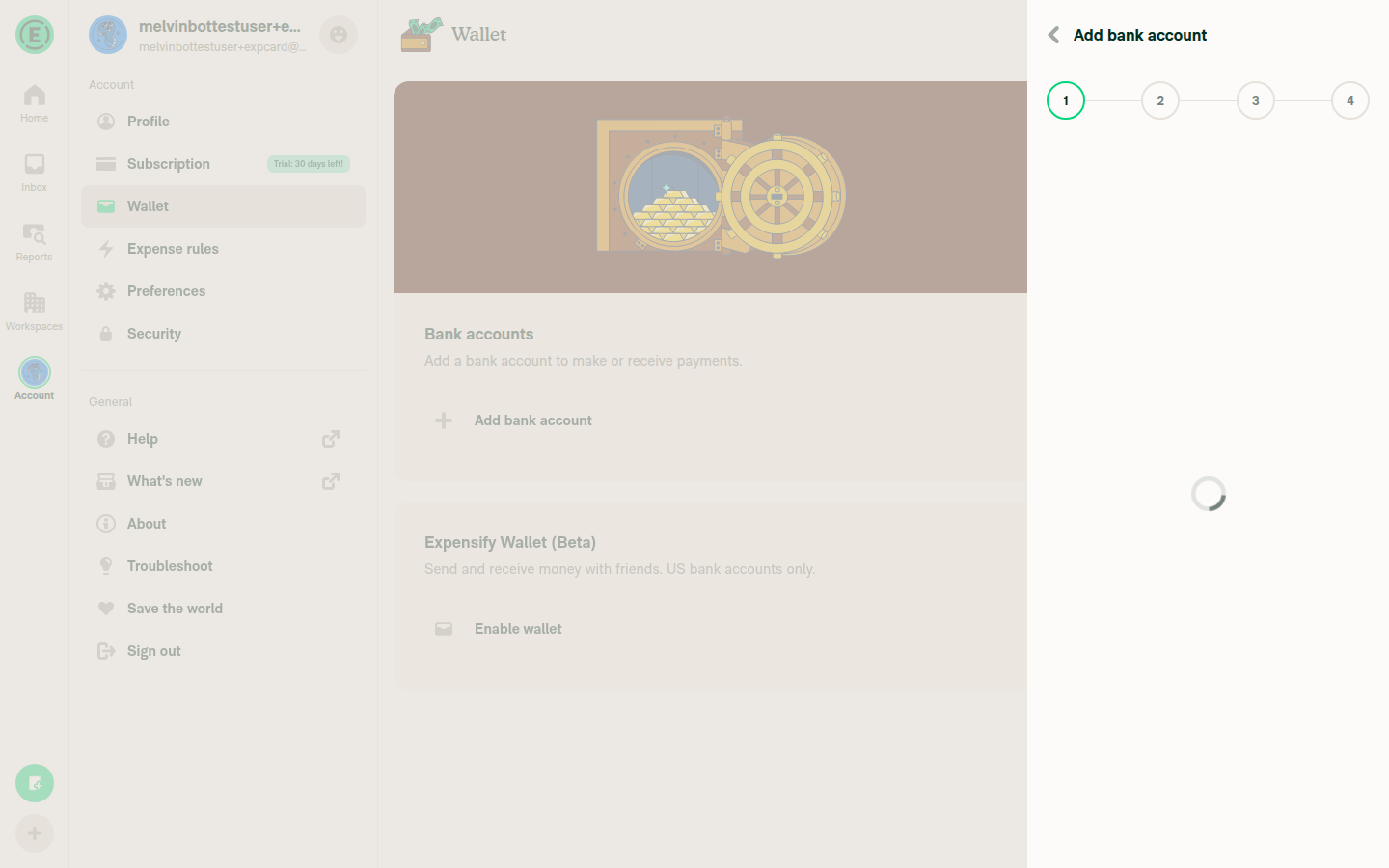
Here are screenshots from testing the PR on web:

Step indicator circles (1, 2, 3, 4) visible in the wizard header:

Step indicator circles 1-4 visible in wizard header with aria-hidden

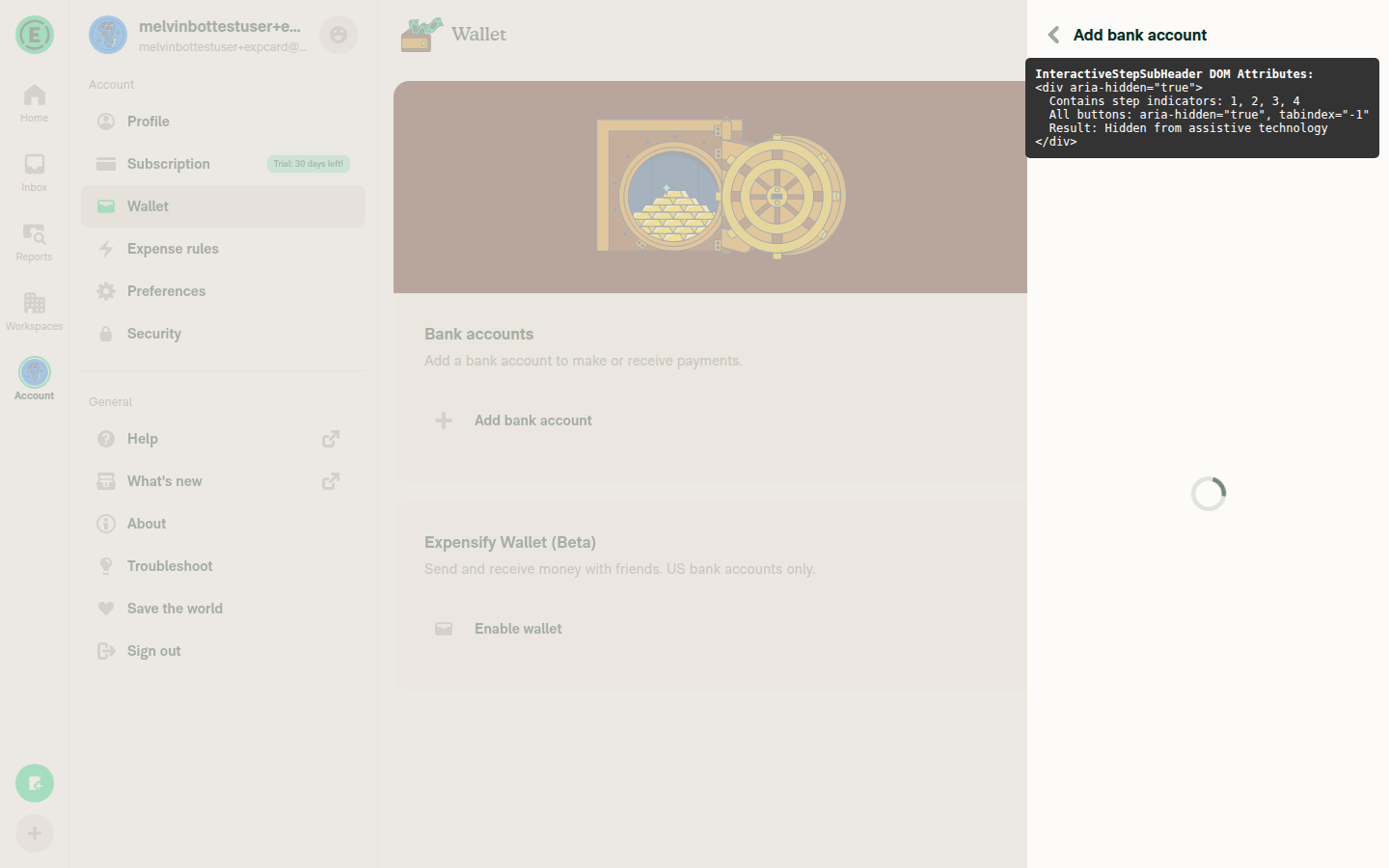
DOM inspection confirming aria-hidden="true" on the step indicator container:

DOM inspection confirming aria-hidden attribute on step indicator container

Verification results:

  • Step indicator circles (1-4) are visually present
  • Container <div> has aria-hidden="true"
  • All 4 step buttons have aria-hidden="true" and tabindex="-1"
  • No step indicator buttons are reachable via keyboard Tab (0 out of 4 in tab order)

Copy link
Contributor

@joekaufmanexpensify joekaufmanexpensify left a comment

Choose a reason for hiding this comment

The reason will be displayed to describe this comment to others. Learn more.

Fine for product

Copy link
Contributor

@deetergp deetergp left a comment

Choose a reason for hiding this comment

The reason will be displayed to describe this comment to others. Learn more.

LGTM!

@deetergp deetergp merged commit 6463086 into main Mar 12, 2026
34 checks passed
@deetergp deetergp deleted the claude-hideWizardFromAssistiveTech branch March 12, 2026 23:50
@github-actions
Copy link
Contributor

🚧 @deetergp has triggered a test Expensify/App build. You can view the workflow run here.

@OSBotify
Copy link
Contributor

🚀 Deployed to staging by https://github.com/deetergp in version: 9.3.38-0 🚀

platform result
🕸 web 🕸 success ✅
🤖 android 🤖 success ✅
🍎 iOS 🍎 success ✅

@OSBotify
Copy link
Contributor

🚀 Deployed to production by https://github.com/cristipaval in version: 9.3.38-4 🚀

platform result
🕸 web 🕸 success ✅
🤖 android 🤖 success ✅
🍎 iOS 🍎 success ✅

Sign up for free to join this conversation on GitHub. Already have an account? Sign in to comment

Labels

None yet

Projects

None yet

Development

Successfully merging this pull request may close these issues.

5 participants