Indenter is a small project that can be seen as a proof of concept of a scalable, fault-tolerant, distributed web service copying the go playground architecture.
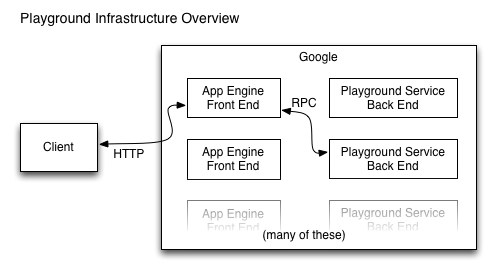
I wanted to know how to build scalable and fault tolerant web application. This start as an experiment and Indenter is a simple example showing an example of such application.
The application is divided into three parts: the front end, serving static content (as well as light dynamic content), the back end (a.k.a. worker, which handle heavy tasks, here launching gofmt command) and the service discovery.
Front End both scale vertically and horizontally. Thanks to goroutines, front end scales vertically (adding resources to a single node allows to handle more requests). But it also scales horizontally (adding new nodes) using some router in front of the front end. Such router can be a simple DNS round-robin strategy. This also enable usage of elastic cloud technique to adapt front end to the workload.
The front end is in charge of serving simple pages (here the static index.html page). It can also handle more dynamic pages which does not require heavy computing. When it receives a request for indenting a file (POST request), it contacts the service discovery daemon (here etcd) to get a list of currently available workers. Then, it choose given a scheduling policy (i.e. pick random one) a worker and asks the indenting of the file using RPC request. The result of this request is sent as result for the client.
A worker is in charge of handling RPC requests from front end entities. Again, at each request a goroutine serves the RPC client, allowing vertical scaling (internally it uses net/http). When a worker starts, it registers itself to the service discovery daemon with a random unique identifier and his (host, port) tuple where a front end can contact it. The entry inside the service discovery daemon has a time to live (ttl) of 20 seconds. Then every 20 seconds a goroutine is responsible to register again to the daemon, allowing to catch workers failures.
To allow front ends entities to find workers to communicate with, a service discovery daemon is used. The chosen one is etcd. etcd is a "highly-available key value store for shared configuration and service discovery". I chose this one as it is distributed, handles failures, is lightweight and written in Go.
All workers register themselves inside a /workers/ directory. This directory is fetched whenever a front end needs the list of available workers.
I wanted to let Indenter as simple as possible in order to be easily reusable by any other projects (the code is under BSD license).
Some possible improvements/usages:
- Adding (distributed) caching to front end to avoid indenting/processing common tasks (as on the playground)
- Front End can handle small dynamic tasks like account management as a real web-site
- Worker can handle other things like launching/compiling an application, sending email, etc.
Simply install etcd (via package manager or source) and launch it (./etcd).
Then
go get github.com/GHugo/indenter/frontend/
go get github.com/GHugo/indenter/worker/
The frontend binary waits the index.html file inside the current directory (a provided one is frontend/index.html). And run the front end (./frontend) and any number of workers (./worker) you want.