Skip to content
Merged
Show file tree
Hide file tree
Changes from all commits
Commits
Show all changes
31 commits
Select commit Hold shift + click to select a range
e82771a
support HTTP "Range" header #6937
pdurbin Sep 3, 2021
875d08d
avoid NPE when HttpHeaders is null #6937
pdurbin Sep 8, 2021
fb8d559
set file size properly for original tabular files #6937
pdurbin Sep 8, 2021
809d20b
send content size from range #6937
pdurbin Sep 8, 2021
29ea256
move range check down so storageIO.getSize() works #6937
pdurbin Sep 30, 2021
35679b5
Merge branch 'develop' into 6937-range #6937
pdurbin Sep 30, 2021
adab554
vary variable header writes by range request #6937
pdurbin Oct 4, 2021
4724e11
get offset working again #6937
pdurbin Oct 5, 2021
f0f0877
delete old setOffset test (was for pre 4724e1) #6937
pdurbin Oct 5, 2021
b02209d
add more offset/range API tests #6937
pdurbin Oct 5, 2021
3d237a8
add release note for HTTP Range header #6937
pdurbin Oct 5, 2021
a57e629
try to make reviewdog happy by replacing tabs with \t #6937
pdurbin Oct 6, 2021
e6233d8
remove redundant ranges.isEmpty() check #6937
pdurbin Oct 6, 2021
ed4ec86
rearranged the handling of the "range requst on a tabular file" speci…
landreev Oct 7, 2021
3e8b193
minor/cosmetic change (#6937)
landreev Oct 7, 2021
12900b7
couple more cosmetic changes in comments/logging
landreev Oct 7, 2021
f6b4a06
add more range API tests #6937
pdurbin Oct 7, 2021
90786ce
fix byte count in docs and release note #6937
pdurbin Oct 7, 2021
a62da5d
as agreed - some cleanup: removing the old, unused legacy code for
landreev Oct 8, 2021
65f1704
final (hopefully) rearrangement of case logic (#6937)
landreev Oct 8, 2021
cea1a14
enable "last bytes from tabular" test (code now works) #6937
pdurbin Oct 8, 2021
bdec095
reduce logging for range code #6937
pdurbin Oct 8, 2021
b688d94
more tests and cleanup #6937
pdurbin Oct 8, 2021
8b173ad
Merge branch 'develop' into 6937-range #6937
pdurbin Oct 14, 2021
eba6563
add curl example for Range header #6937
pdurbin Oct 14, 2021
3024d67
clean up range header error handling #6937
pdurbin Oct 15, 2021
cd16982
Merge branch 'develop' into 6937-range #6937
pdurbin Oct 15, 2021
22d5ffb
move logic to getLength per code review #6937
pdurbin Oct 22, 2021
d197b96
Merge branch 'develop' into 6937-range #6937
pdurbin Oct 22, 2021
fef9ca4
Merge branch 'develop' into 6937-range #6937
pdurbin Nov 5, 2021
07ebf9a
specify 5.9 as version #6937
pdurbin Nov 8, 2021
File filter

Filter by extension

Filter by extension

Conversations
Failed to load comments.
Loading
Jump to
Jump to file
Failed to load files.
Loading
Diff view
Diff view
10 changes: 10 additions & 0 deletions doc/release-notes/6937-range.md
Original file line number Diff line number Diff line change
@@ -0,0 +1,10 @@
### Support for HTTP "Range" Header for Partial File Downloads

Dataverse now supports the HTTP "Range" header, which allows users to download parts of a file. Here are some examples:

- `bytes=0-9` gets the first 10 bytes.
- `bytes=10-19` gets 10 bytes from the middle.
- `bytes=-10` gets the last 10 bytes.
- `bytes=9-` gets all bytes except the first 10.

Only a single range is supported. For more information, see the [Data Access API](https://guides.dataverse.org/en/5.9/api/dataaccess.html) section of the API Guide.
35 changes: 35 additions & 0 deletions doc/sphinx-guides/source/api/dataaccess.rst
Original file line number Diff line number Diff line change
Expand Up @@ -131,6 +131,41 @@ true Generates a thumbnail image by rescaling to the default thumbnai
``N`` Rescales the image to ``N`` pixels wide. ``imageThumb=true`` and ``imageThumb=64`` are equivalent.
============== ===========

Headers:
Copy link
Contributor

@landreev landreev Oct 14, 2021

Choose a reason for hiding this comment

The reason will be displayed to describe this comment to others. Learn more.

This could be nitpicking, but maybe "Supported HTTP Headers"? - to indicate that this is not something we made up ourselves, but a standard HTTP feature? (similarly to how the release note describes it)

Copy link
Member Author

@pdurbin pdurbin Oct 14, 2021

Choose a reason for hiding this comment

The reason will be displayed to describe this comment to others. Learn more.

I guess I put "Headers:" (with a colon) to match "Parameters:" which was already on the page. Here's a screenshot:

Screen Shot 2021-10-14 at 3 51 15 PM

In the same vein, this could be "Supported HTTP Query Parameters". I don't feel strongly about it. I was just trying to keep it short and consistent with the rest of the page. I'm totally with with "HTTP Headers". I guess I'd leave the colon in there for consistency. Lemme know. I'm happy to do whatever here.

I do think an example will make this more clear. More on that in the next comment.

Copy link
Contributor

Choose a reason for hiding this comment

The reason will be displayed to describe this comment to others. Learn more.

I was just anticipating a user reading the guide wondering, "why is this implemented as a header, and not as a query parameter like everything else in your api?" - so my idea was to spell it out - the parameters are proprietary to our api; this header is standard http that we support.
I acknowledged I didn't feel strongly about that suggestion. I agree that an example makes it very clear so I'm ok with it as is.

Copy link
Member Author

Choose a reason for hiding this comment

The reason will be displayed to describe this comment to others. Learn more.

Ok, let's leave it as is for now. At least we link to the MDN docs (screenshot below) so people will probably get the idea that we didn't make it up. 😄

Screen Shot 2021-10-15 at 1 32 57 PM

(It's weird to me that the text in these tables is centered but the bullets are not, by the way. I think I'd prefer for it all to be left justified. I googled it but didn't find a fix right away.)

Copy link
Member Author

Choose a reason for hiding this comment

The reason will be displayed to describe this comment to others. Learn more.

I just put the same table in another Sphinx project (OpenDP) and it looks much more normal:

Screen Shot 2021-10-15 at 1 47 57 PM

I don't think we should fix this now (left justify everything) but it gives me hope that we can fix it someday.

Copy link
Contributor

Choose a reason for hiding this comment

The reason will be displayed to describe this comment to others. Learn more.

The table looks completely normal when you view the .rst on github of course...
Yeah, it has to be something in our sphinx customization.

~~~~~~~~

============== ===========
Header Description
============== ===========
Range Download a specified byte range. Examples:

- ``bytes=0-9`` gets the first 10 bytes.
- ``bytes=10-19`` gets 10 bytes from the middle.
- ``bytes=-10`` gets the last 10 bytes.
- ``bytes=9-`` gets all bytes except the first 10.

Only a single range is supported. The "If-Range" header is not supported. For more on the "Range" header, see https://developer.mozilla.org/en-US/docs/Web/HTTP/Range_requests
============== ===========

Copy link
Contributor

Choose a reason for hiding this comment

The reason will be displayed to describe this comment to others. Learn more.

I feel like an example of a curl command line would help here (and maybe in the release note too?)

Copy link
Member Author

Choose a reason for hiding this comment

The reason will be displayed to describe this comment to others. Learn more.

Yes, absolutely. I'll work on adding a curl example. I don't think a curl example is needed in the release notes, though. We typically link to the guides from the release notes.

Copy link
Member Author

Choose a reason for hiding this comment

The reason will be displayed to describe this comment to others. Learn more.

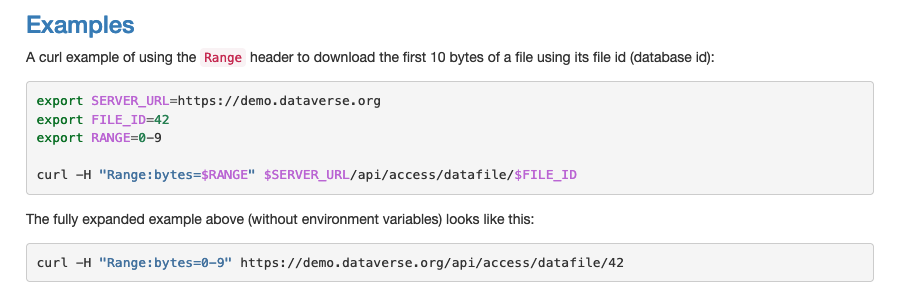
Ok, example added in eba6563. It looks like this:

Screen Shot 2021-10-14 at 4 42 07 PM

As shown, I also added an "Examples" heading with the idea that we can add additional examples for all kinds of basic file access including getting the original, authenticating, etc. The range example is at the top because it's the only one but it can drop down as we add more common examples.

Examples
~~~~~~~~

A curl example of using the ``Range`` header to download the first 10 bytes of a file using its file id (database id):

.. code-block:: bash

export SERVER_URL=https://demo.dataverse.org
export FILE_ID=42
export RANGE=0-9

curl -H "Range:bytes=$RANGE" $SERVER_URL/api/access/datafile/$FILE_ID

The fully expanded example above (without environment variables) looks like this:

.. code-block:: bash

curl -H "Range:bytes=0-9" https://demo.dataverse.org/api/access/datafile/42

Multiple File ("bundle") download
---------------------------------

Expand Down
216 changes: 190 additions & 26 deletions src/main/java/edu/harvard/iq/dataverse/api/DownloadInstanceWriter.java
Original file line number Diff line number Diff line change
Expand Up @@ -36,13 +36,16 @@
import java.net.URISyntaxException;
import java.net.URLEncoder;
import java.util.ArrayList;
import java.util.Arrays;
import java.util.List;
import java.util.logging.Level;
import java.util.logging.Logger;
import javax.inject.Inject;
import javax.ws.rs.ClientErrorException;
import javax.ws.rs.NotFoundException;
import javax.ws.rs.RedirectionException;
import javax.ws.rs.ServiceUnavailableException;
import javax.ws.rs.core.HttpHeaders;
import org.apache.tika.mime.MimeType;
import org.apache.tika.mime.MimeTypeException;
import org.apache.tika.mime.MimeTypes;
Expand Down Expand Up @@ -401,52 +404,140 @@ public void writeTo(DownloadInstance di, Class<?> clazz, Type type, Annotation[]
httpHeaders.add("Content-Type", mimeType + "; name=\"" + finalFileName + "\"");

long contentSize;
boolean useChunkedTransfer = false;
//if ((contentSize = getFileSize(di, storageIO.getVarHeader())) > 0) {

// User may have requested a rangeHeader of bytes.
// Ranges are only supported when the size of the content
// stream is known (i.e., it's not a dynamically generated
// stream.
List<Range> ranges = new ArrayList<>();
String rangeHeader = null;
HttpHeaders headers = di.getRequestHttpHeaders();
if (headers != null) {
rangeHeader = headers.getHeaderString("Range");
}
long offset = 0;
long leftToRead = -1L;
// Moving the "left to read" var. here; - since we may need
// to start counting our rangeHeader bytes outside the main .write()
// loop, if it's a tabular file with a header.

if ((contentSize = getContentSize(storageIO)) > 0) {
logger.fine("Content size (retrieved from the AccessObject): " + contentSize);
httpHeaders.add("Content-Length", contentSize);
try {
ranges = getRanges(rangeHeader, contentSize);
} catch (Exception ex) {
logger.fine("Exception caught processing Range header: " + ex.getLocalizedMessage());
throw new ClientErrorException("Error due to Range header: " + ex.getLocalizedMessage(), Response.Status.REQUESTED_RANGE_NOT_SATISFIABLE);
}

if (ranges.isEmpty()) {
logger.fine("Content size (retrieved from the AccessObject): " + contentSize);
httpHeaders.add("Content-Length", contentSize);
} else {
// For now we only support a single rangeHeader.
long rangeContentSize = ranges.get(0).getLength();
logger.fine("Content size (Range header in use): " + rangeContentSize);
httpHeaders.add("Content-Length", rangeContentSize);

offset = ranges.get(0).getStart();
leftToRead = rangeContentSize;
}
} else {
//httpHeaders.add("Transfer-encoding", "chunked");
//useChunkedTransfer = true;
// Content size unknown, must be a dynamically
// generated stream, such as a subsetting request.
// We do NOT want to support rangeHeader requests on such streams:
if (rangeHeader != null) {
throw new NotFoundException("Range headers are not supported on dynamically-generated content, such as tabular subsetting.");
}

}

// (the httpHeaders map must be modified *before* writing any
// data in the output stream!)
int bufsize;
byte[] bffr = new byte[4 * 8192];
byte[] chunkClose = "\r\n".getBytes();

// before writing out any bytes from the input stream, flush
// Before writing out any bytes from the input stream, write
// any extra content, such as the variable header for the
// subsettable files:
if (storageIO.getVarHeader() != null) {
logger.fine("storageIO.getVarHeader().getBytes().length: " + storageIO.getVarHeader().getBytes().length);
if (storageIO.getVarHeader().getBytes().length > 0) {
if (useChunkedTransfer) {
String chunkSizeLine = String.format("%x\r\n", storageIO.getVarHeader().getBytes().length);
outstream.write(chunkSizeLine.getBytes());
}
outstream.write(storageIO.getVarHeader().getBytes());
if (useChunkedTransfer) {
outstream.write(chunkClose);
// If a rangeHeader is not being requested, let's call that the normal case.
// Write the entire line of variable headers. Later, the rest of the file
// will be written.
if (ranges.isEmpty()) {
logger.fine("writing the entire variable header");
outstream.write(storageIO.getVarHeader().getBytes());
} else {
// Range requested. Since the output stream of a
// tabular file is made up of the varHeader and the body of
// the physical file, we should assume that the requested
// rangeHeader may span any portion of the combined stream.
// Thus we may or may not have to write the header, or a
// portion thereof.
int headerLength = storageIO.getVarHeader().getBytes().length;
if (offset >= headerLength) {
// We can skip the entire header.
// All we need to do is adjust the byte offset
// in the physical file; the number of bytes
// left to write stays unchanged, since we haven't
// written anything.
logger.fine("Skipping the variable header completely.");
offset -= headerLength;
} else {
// We need to write some portion of the header;
// Once we are done, we may or may not still have
// some bytes left to write from the main physical file.
if (offset + leftToRead <= headerLength) {
// This is a more straightforward case - we just need to
// write a portion of the header, and then we are done!
logger.fine("Writing this many bytes of the variable header line: " + leftToRead);
outstream.write(Arrays.copyOfRange(storageIO.getVarHeader().getBytes(), (int)offset, (int)offset + (int)leftToRead));
// set "left to read" to zero, indicating that we are done:
leftToRead = 0;
} else {
// write the requested portion of the header:
logger.fine("Writing this many bytes of the variable header line: " + (headerLength - offset));
outstream.write(Arrays.copyOfRange(storageIO.getVarHeader().getBytes(), (int)offset, headerLength));
// and adjust the file offset and remaining number of bytes accordingly:
leftToRead -= (headerLength - offset);
offset = 0;
}

}
}
}
}

while ((bufsize = instream.read(bffr)) != -1) {
if (useChunkedTransfer) {
String chunkSizeLine = String.format("%x\r\n", bufsize);
outstream.write(chunkSizeLine.getBytes());
// Dynamic streams, etc. Normal operation. No leftToRead.
if (ranges.isEmpty()) {
logger.fine("Normal, non-range request of file id " + dataFile.getId());
while ((bufsize = instream.read(bffr)) != -1) {
outstream.write(bffr, 0, bufsize);
}
outstream.write(bffr, 0, bufsize);
if (useChunkedTransfer) {
outstream.write(chunkClose);
} else if (leftToRead > 0) {
// This is a rangeHeader request, and we still have bytes to read
// (for a tabular file, we may have already written enough
// bytes from the variable header!)
storageIO.setOffset(offset);
// Thinking about it, we could just do instream.skip(offset)
// here... But I would like to have this offset functionality
// in StorageIO, for any future cases where we may not
// be able to do that on the stream directly (?) -- L.A.
logger.fine("Range request of file id " + dataFile.getId());
// Read a rangeHeader of bytes instead of the whole file. We'll count down as we write.
// For now we only support a single rangeHeader.
while ((bufsize = instream.read(bffr)) != -1) {
if ((leftToRead -= bufsize) > 0) {
// Just do a normal write. Potentially lots to go. Don't break.
outstream.write(bffr, 0, bufsize);
} else {
// Get those last bytes or bytes equal to bufsize. Last one. Then break.
outstream.write(bffr, 0, (int) leftToRead + bufsize);
break;
}
}
}

if (useChunkedTransfer) {
String chunkClosing = "0\r\n\r\n";
outstream.write(chunkClosing.getBytes());
}

logger.fine("di conversion param: " + di.getConversionParam() + ", value: " + di.getConversionParamValue());
Expand Down Expand Up @@ -585,4 +676,77 @@ private long getFileSize(DownloadInstance di, String extraHeader) {
}
return -1;
}

/**
* @param range "bytes 0-10" for example. Found in the "Range" HTTP header.
* @param fileSize File size in bytes.
* @throws RunTimeException on any problems processing the Range header.
*/
public List<Range> getRanges(String range, long fileSize) {
// Inspired by https://gist.github.com/davinkevin/b97e39d7ce89198774b4
// via https://stackoverflow.com/questions/28427339/how-to-implement-http-byte-rangeHeader-requests-in-spring-mvc/28479001#28479001
List<Range> ranges = new ArrayList<>();

if (range != null) {
logger.fine("Range header supplied: " + range);

// Technically this regex supports multiple ranges.
// Below we have a check to enforce a single range.
if (!range.matches("^bytes=\\d*-\\d*(,\\d*-\\d*)*$")) {
throw new RuntimeException("The format is bytes=<range-start>-<range-end> where start and end are optional.");
}

// The 6 is to remove "bytes="
String[] parts = range.substring(6).split(",");
if (parts.length > 1) {
// Only allow a single range.
throw new RuntimeException("Only one range is allowed.");
}
// This loop is here in case we ever want to support multiple ranges.
for (String part : parts) {

long start = getRangeStart(part);
long end = getRangeEnd(part);

if (start == -1) {
// start does not exist. Base start off of how many bytes from end.
start = fileSize - end;
end = fileSize - 1;
} else if (end == -1 || end > fileSize - 1) {
// Set end when it doesn't exist.
// Also, automatically set end to size of file if end is beyond
// the file size (rather than throwing an error).
end = fileSize - 1;
}

if (start > end) {
throw new RuntimeException("Start is larger than end or size of file.");
}

ranges.add(new Range(start, end));

}
}

return ranges;
}

/**
* @return Return a positive long or -1 if start does not exist.
*/
public static long getRangeStart(String part) {
// Get everything before the "-".
String start = part.substring(0, part.indexOf("-"));
return (start.length() > 0) ? Long.parseLong(start) : -1;
}

/**
* @return Return a positive long or -1 if end does not exist.
*/
public static long getRangeEnd(String part) {
// Get everything after the "-".
String end = part.substring(part.indexOf("-") + 1, part.length());
return (end.length() > 0) ? Long.parseLong(end) : -1;
}

}
28 changes: 28 additions & 0 deletions src/main/java/edu/harvard/iq/dataverse/dataaccess/Range.java
Original file line number Diff line number Diff line change
@@ -0,0 +1,28 @@
package edu.harvard.iq.dataverse.dataaccess;

public class Range {

// Used to set the offset, how far to skip into the file.
private final long start;
// Used to calculate the length.
private final long end;

public Range(long start, long end) {
this.start = start;
this.end = end;
}

public long getStart() {
return start;
}

public long getEnd() {
return end;
}

// Used to determine when to stop reading.
public long getLength() {
return end - start + 1;
}

}
22 changes: 22 additions & 0 deletions src/main/java/edu/harvard/iq/dataverse/dataaccess/StorageIO.java
Original file line number Diff line number Diff line change
Expand Up @@ -191,6 +191,12 @@ public boolean canWrite() {

/*private int status;*/
private long size;

/**
* Where in the file to seek to when reading (default is zero bytes, the
* start of the file).
*/
private long offset;

private String mimeType;
private String fileName;
Expand Down Expand Up @@ -272,6 +278,10 @@ public long getSize() {
return size;
}

public long getOffset() {
return offset;
}

public InputStream getInputStream() throws IOException {
return in;
}
Expand Down Expand Up @@ -381,6 +391,18 @@ public void setSize(long s) {
size = s;
}

// open() has already been called. Now we can skip, if need be.
public void setOffset(long offset) throws IOException {
InputStream inputStream = getInputStream();
if (inputStream != null) {
inputStream.skip(offset);
// The skip has already been done. Why not record it.
this.offset = offset;
} else {
throw new IOException("Could not skip into InputStream because it is null");
}
}

public void setInputStream(InputStream is) {
in = is;
}
Expand Down
Loading