

E-MLB (Multilevel Benchmark for Event Denoising) is a benchmark specifically designed for the evaluation of event-based denoising algorithms, providing an in-depth analysis of state-of-the-art (SOTA) denoising algorithms' performance across various noise levels and real-world scenes captured by DAVIS 346. For more details, please refer to our published paper E-MLB: Multilevel Benchmark for Event-Based Camera Denoising.
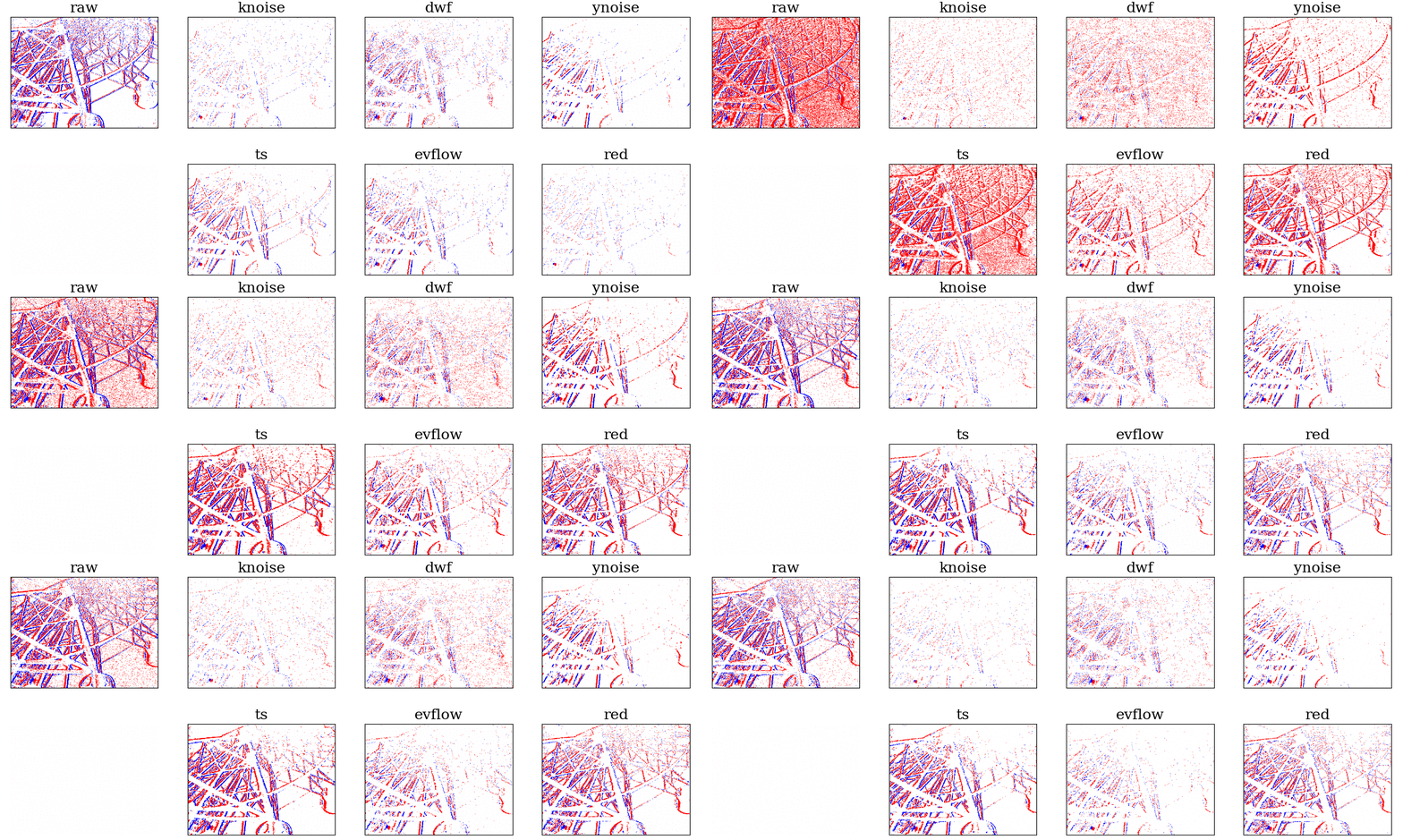
To ensure the running of the project, the following dependencies are need.
- Install common dependencies.
# Install compiler
sudo apt-get install git gcc-13 g++-13 cmake

# Install boost, opencv, eigen3, openblas
sudo apt-get install libboost-dev libopencv-dev libeigen3-dev libopenblas-dev- Install third-party dependencies for dv.
# Add repository
sudo add-apt-repository ppa:inivation-ppa/inivation

# Update
sudo apt-get update

# Install pre dependencies
sudo apt-get install boost-inivation libcaer-dev libfmt-dev liblz4-dev libzstd-dev libssl-dev libusb-1.0-0-dev

# Install dv
sudo apt-get install dv-processing dv-runtime-dev- Initialize our dv-toolkit, for simplifying the processing of event-based data.
# Recursively initialize our submodule
git submodule update --init --recursiveIn this section, the model will be built as Python packages by using pybind11,
allowing directly import in your project. If using C++ language, you can
directly copy the header files in ./include and following
tutorial to
see how to use.
- Install dependencies for building packages.
sudo apt-get install python3-dev python3-pybind11- Create a new virtual environment:
# Create virtual environment
conda create -n emlb python=3.8

# Activate virtual environment
conda activate emlb

# Install requirements
pip install -r requirements.txt

# Install dv-toolkit
pip install external/dv-toolkit/.- Compile with setting
-DEMLB_ENABLE_PYTHON
# create folder
mkdir build && cd build

# compile with samples
CC=gcc-13 CXX=g++-13 cmake .. -DEMLB_ENABLE_PYTHON=ON

# generate library
cmake --build . --config Release- Run
demo.pyto test:
python3 demo.pyBy following the steps below, you will obtain a series of .so files in the
./modules folder, which are third-party modules that can be called by
DV software.
For how to use them, please refer to the "set up for dv" in the
tutorial.
- Compile with setting
-DEMLB_ENABLE_MODULES
# create folder
mkdir build && cd build

# compile with samples
CC=gcc-13 CXX=g++-13 cmake .. -DEMLB_ENABLE_MODULES=ON

# generate library
cmake --build . --config ReleaseAssuming that libtorch is
installed, you can include -DTORCH_DIR=/path/to/libtorch/ to compile deep
learning models. For example, you can build by following instruction.
CC=gcc-13 CXX=g++-13 cmake .. \
    -DEMLB_ENABLE_PYTHON=ON \
    -DTORCH_DIR=<path/to/libtorch>/share/cmake/Torch/
NOTE: download pretrained models here
and paste them into ./modules/net/ folder.
At present, we have implemented the following event-based denoising algorithms.
| Algorithms | Full Name | Year | Languages | DV | Cuda |
|---|---|---|---|---|---|
| TS | Time Surface | 2016 | C++ | ✓ | |
| KNoise | Khodamoradi's Noise | 2018 | C++ | ✓ | |
| EvFlow | Event Flow | 2019 | C++ | ✓ | |
| YNoise | Yang's Noise | 2020 | C++ | ✓ | |
| EDnCNN | Event Denoising CNN | 2020 | C++ | ✓ | |
| DWF | Double Window Filter | 2021 | C++ | ✓ | |
| MLPF | Multilayer Perceptron Filter | 2021 | C++ | ✓ | |
| EvZoom | Event Zoom | 2021 | Python | ✓ | |
| GEF | Guided Event Filter | 2021 | Python | ✓ | |
| RED | Recursive Event Denoisor | - | C++ | ✓ |
You can run eval_denoisor.py to test one of the above denoising algorithms:
python eval_denoisor.py                     \
    --file './data/demo/samples/demo-01.aedat4' \
--denoisor 'ynoise' --file/-f: path of sequence data.--denoisor: select a denoising algorithm. You can revise denoisor's parameters in./configs/denoisors.py.
NOTE: Some algorithms need to install libtorch in advance and compile with cuda.
You can run eval_benchmark.py to test all sequences store in ./data folder.
python eval_benchmark.py  \
    --input_path './data'     \
    --output_path './result'  \
--denoisor 'ynoise' --store_result --store_score--input_path/-i: path of the datasets folder.--output_path/-o: path of saving denoising results.--denoisor: select a denoising algorithm. You can revise denoisor's parameters in./configs/denoisors.py.--store_result: turn on denoising result storing.--store_score: turn on mean ESR score calculation.
NOTE: The structure of the dataset folder must meet the requirements.
Download our Event Noisy Dataset (END), including D-END (Daytime part) and N-END (Night part), then unzip and paste them into ./data folder:
./data/
├── D-END
│   ├── nd00
│   │   ├── Architecture-ND00-1.aedat4
│   │   ├── Architecture-ND00-2.aedat4
│   │   ├── Architecture-ND00-3.aedat4
│   │   ├── Bicycle-ND00-1.aedat4
│   │   ├── Bicycle-ND00-2.aedat4
│   │   ├── ...
│   ├── nd04
│   │   ├── Architecture-ND04-1.aedat4
│   │   ├── Architecture-ND04-2.aedat4
│   │   ├── ...
│   ├── ...
├── N-END
│   ├── nd00
│   │   ├── ...
│   ├── ...
├── ...
Also you can paste your customized datasets into ./data folder (only supported
aedat4 file now). They should be rearranged as the following structure:
./data/
├── <Your Dataset Name>
│   ├── Subclass-1
│   │   ├── Sequences-1.*
│   │   ├── Sequences-2.*
│   │   ├── ...
│   ├── Subclass-2
│   │   ├── Sequences-1.*
│   │   ├── Sequences-2.*
│   │   ├── ...
│   ├── ...
├── ...
We provide a general template to facilitate building your own denoising algorithm, see ./configs/denoisors.py:
class your_denoisor:
    def __init__(self, resolution,
                 modified_params: Dict,
                 default_params: Dict) -> None:
        # /*-----------------------------------*/
        #         initialize parameters
        # /*-----------------------------------*/

    def accept(self, events):
        # /*-----------------------------------*/
        #   receive noise sequence and process
        # /*-----------------------------------*/

    def generateEvents(self):
        # /*-----------------------------------*/
        #   perform denoising and return result
# /*-----------------------------------*/If you use the E-MLB dataset or any of the code in this repository for your research, please cite our paper:
@article{ding2023emlb,
  title     = {E-MLB: Multilevel benchmark for event-based camera denoising},
  author    = {Ding, Saizhe and Chen, Jinze and Wang, Yang and Kang, Yu and Song, Weiguo and Cheng, Jie and Cao, Yang},
  journal   = {IEEE Transactions on Multimedia},
  volume    = {26},
  pages     = {65--76},
  year      = {2023},
  publisher = {IEEE}
}We would like to thank Yang Wang for his valuable insights and support in this project.