




PhpDependencyAnalysis is an extendable static code analysis for object-oriented
PHP-Projects to generate dependency graphs
from abstract datatypes (Classes, Interfaces and Traits) based on namespaces.
Dependencies can be aggregated to build graphs for several levels, like Package-Level or Layer-Level.
Each dependency can be verified to a defined architecture.
Read the Introduction-Chapter for further informations.
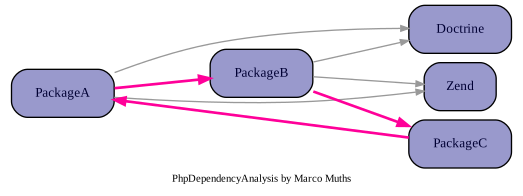
See more examples.
For graph creation GraphViz is required on your machine, which is
an open source graph visualization software and available for the most platforms.
After installing GraphViz the recommended way to install
mamuz/php-dependency-analysis is..
$ curl -OsSL https://raw.github.com/mamuz/PhpDependencyAnalysis/master/download/phpda.pubkey
$ curl -OsSL https://raw.github.com/mamuz/PhpDependencyAnalysis/master/download/phpda
$ chmod +x phpda
The three lines above will, in order:
- Download the public key to the current directory
- Download the phar file to the current directory
- Make the phar file executable
The phar file is securely signed with OpenSSL. To be able to execute the phar file,
the public key must be named as the phar file, with .pubkey added,
and must be placed in the same directory. That means don't change the name and location of the public key.
Use the provided update command to get the latest version.
$ phpda update$ composer require --dev mamuz/php-dependency-analysis- High customizing level
- Graph creation on customized levels respectively different scopes and layers
- Supports Usage-Graph, Call-Graph and Inheritance-Graph
- Dependencies can be aggregated such as to a package, a module or a layer
- Detecting cycles and violations between layers in a tiered architecture
- Verifiying dependency graph against a user-defined reference architecture
- Collected namespaces of dependencies are modifiable to meet custom use cases
- Printing graphs in several formats (HTML, SVG, DOT, JSON)
- Extandable by adding user-defined plugins for collecting and displaying
- Compatible to PHP7 Features, like
Return Type DeclarationsandAnonymous Classes
Phpda can run out of the box by using a prepared configuration.
As you can see configuration is defined by a YAML file.
To provide your own configuration create a yml file, e.g. located in ./myconfig.yml:
mode: 'usage'
source: './src'
filePattern: '*.php'
ignore: 'tests'
formatter: 'PhpDA\Writer\Strategy\Svg'
target: './phpda.svg'
groupLength: 1
visitor:
  - PhpDA\Parser\Visitor\TagCollector
  - PhpDA\Parser\Visitor\SuperglobalCollector
visitorOptions:
  PhpDA\Parser\Visitor\Required\DeclaredNamespaceCollector: {minDepth: 2, sliceLength: 2}
  PhpDA\Parser\Visitor\Required\MetaNamespaceCollector: {minDepth: 2, sliceLength: 2}
  PhpDA\Parser\Visitor\Required\UsedNamespaceCollector: {minDepth: 2, sliceLength: 2}
  PhpDA\Parser\Visitor\TagCollector: {minDepth: 2, sliceLength: 2}
Perform an analysis with that configuration:
$ phpda analyze ./myconfig.ymlAfter that open the graph file ./phpda.svg with your prefered tool.
Read the Configuration-Chapter to get knowledge about all available options.
As contributors and maintainers of this project you have to respect the Code of Coduct
See record of changes made to this project here
Before opening up a pull-request please read the Contributing-Guideline
Check the resources in Code Analysis Section at Awesome PHP