enh:Airfoil fins normal force coefficient derivative calculation. #117
Conversation


Fixed airfoil lift calculation

|
A masterpiece!!!!!!!!!!!!!!!!!!!!!!!!! @MateusStano thanks for showing up... Great contribution " It is not as exact as the formula that is currently used for trapezoidal fins but is a good approximation."
|

The equations are documented here: docs/technical/aerodynamics/Fins_Lift_Coefficient.pdf I wrote it as an explanation/documentation. I don't know if its any good but everything I used should be in there |
|
Great Stano, really appreciate your expertise writing this document, it will definetely help a lot! I think the best candidates to revivew the calculations here are @Lucas-KB and @lucasfourier , as they were working on aerodynamic. Perhaps in the next week they will be able to review and merge. Otherwise, I hope @giovaniceotto could hep earlier, or evene @brunosorban . |

 giovaniceotto
left a comment
giovaniceotto
left a comment
giovaniceotto
left a comment
There was a problem hiding this comment.
@MateusStano, incredible work! I still need to understand the equations a little bit better before I can fully review your code, but for now, here is a suggestion:
- When defining a Function object based on a callable (i.e. a python function or a lambda), it does not make sence to set interpolation and extrapolation methods. Example:
This:
cldata = Function(
    lambda x, mach: clalpha * x,
    ["Alpha (rad)", "Mach"],
    "Cl",
    interpolation="linear",
    extrapolation="natural",
)
Can be replaced by:
cldata = Function(
    source=lambda alpha, mach: clalpha * alpha,
    inputs=["Alpha (rad)", "Mach"],
    outputs="Cl",
)
One question: how different are equations 6 and 15 of the theory you submitted? In termos of relative change, what's the percentage difference for a typical fin?
Ah good to know! Will change that right now
The difference seems to be that equation 6 gives a result 63% smaller then equation 15. In other words, the lift generated by the airfoils is 63% bigger than with trapezoildal plane fins. Here is a comparison with the compareFunction method: The yellow line is the airfoiled one. |
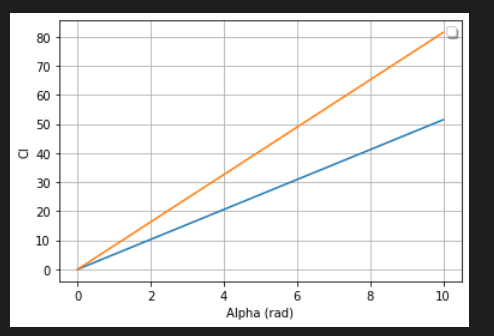

|
To be honest, I am quite intrigued by the difference. I would like to first review this difference before proceeding to merging this PR. |
 MateusStano
changed the title
MateusStano
changed the title

 Gui-FernandesBR
changed the title
Gui-FernandesBR
changed the title
3 participants


Pull request type
Please check the type of change your PR introduces:
Pull request checklist
Please check if your PR fulfills the following requirements, depending on the type of PR:
ReadMe, Docs and GitHub maintenance:
Code base maintenance (refactoring, formatting, renaming):
black rocketpy) has passed locally and any fixes were madepytest --runslow) have passed locallyCode base additions (for bug fixes / features):
black rocketpy) has passed locally and any fixes were madepytest --runslow) have passed locallyWhat is the current behavior?
The current calculation of the normal force coefficient derivative for airfoil fins assumes that the term where the derivative of the lift coefficient is multiplied by alpha is a constant value. However, for curves that are not linear that simplification does not apply due to another intermediate derivative term.
What is the new behavior?
The calculations now use a generic formula of the lift coefficient derivative based on thin airfoil theory, which is more in the lines of what Barrowman showed in his paper. This calculation works for any fin shape, with airfoil or not. It is not as exact as the formula that is currently used for trapezoidal fins but is a good approximation.
Does this introduce a breaking change?
Other information
Since the new calculation of the lift coefficient derivative takes into account the number of Mach I had to change a bit more of the code than just what relates to the fins. The changes are nothing major but they can be useful when adding supersonic calculations. I also made a pdf with more in-depth documentation.