We were among the 50 students across the nation to participate in the AI @ Meta Hackathon at Meta's global HQ in Menlo Park, CA, where we explored how VR, AI, and mixed reality can make life easier and more meaningful.
Spatial Scholar is a mixed reality learning companion built for the Meta Quest 3. It turns a spoken learning request into an interactive 3D concept map anchored in your real space, with an AI-guided explanation.
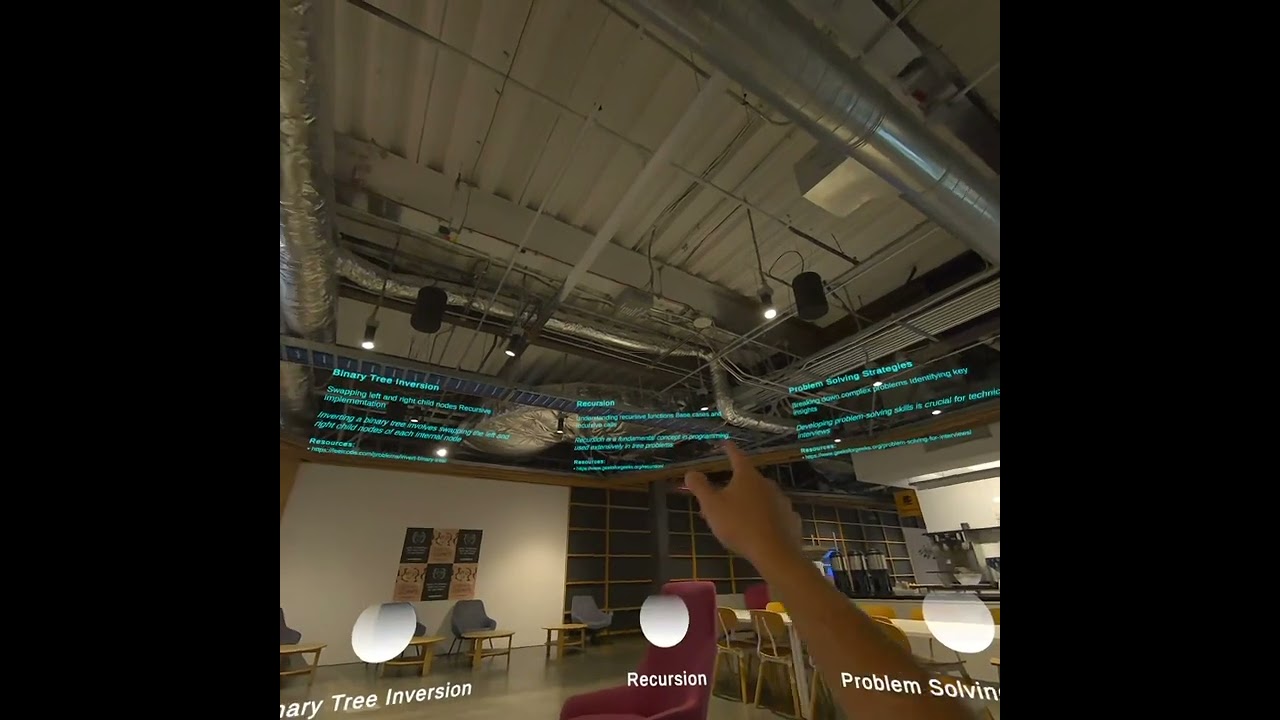
- Voice → lesson: you ask a question out loud (e.g., “Teach me BFS vs DFS”)
- Concept breakdown: the system generates a short explanation + a structured concept graph
- 3D visualization: nodes/edges render as a spatial graph in passthrough
- Speech + text: the explanation is spoken and saved for reuse
Learning content still lives on flat screens (docs, videos, chat windows). We wanted a way to:
- visualize abstract topics in 3D
- show relationships/prereqs spatially
- make explanations feel more “hands-on” and memorable
- Speech input in Unity
- A structured prompt is sent to Llama 4
- The model returns:
- a short explanation
- a JSON concept graph (nodes + relationships)
- Unity parses the JSON and renders a dynamic 3D graph in passthrough
- TTS reads the explanation out loud
- Meta Quest 3
- Unity (C#)
- Meta XR SDK (passthrough / spatial visualization)
- Llama 4 (reasoning + JSON graph generation)
- Hugging Face + ElevenLabs (model + speech integration)
- Custom agents:
LlmAgentSpeechToTextAgentTextToSpeechAgent
- JSON graph parser + runtime graph layout/renderer
- Voice-based requests
- LLM explanation output (speech + text)
- JSON concept graph generation
- 3D nodes + edges in passthrough
- Expandable/interactable graph layout
- Hand-based node expansion and richer visual subtopics
- Persistent “knowledge rooms”
- Multi-user sessions
- Light assessments (quick checks / recall prompts)
- Optional integrations (Canvas / Google Classroom)
Built by Ansh, Riten, Vinay, Ashlie, and Nathan