Skip to content
Closed
Show file tree
Hide file tree
Changes from all commits
Commits
File filter

Filter by extension

Filter by extension

Conversations
Failed to load comments.
Loading
Jump to
Jump to file
Failed to load files.
Loading
Diff view
Diff view
17 changes: 13 additions & 4 deletions src/te/schedule/message_passing.cc
Original file line number Diff line number Diff line change
Expand Up @@ -62,6 +62,13 @@ void PassDownDomain(const Stage& stage,
return actx->Simplify(indexdiv(a + (b - 1), b));
};

auto minimum_or_later = [actx](PrimExpr a, PrimExpr b) {
if (actx->CanProve(a < b)) {
return actx->Simplify(a);
}
return actx->Simplify(b);
};

auto& state = *p_state;
// forwar iteration on relations
for (IterVarRelation rel : stage->relations) {
Expand All @@ -74,15 +81,17 @@ void PassDownDomain(const Stage& stage,
const Range& range_parent = state.at(r->parent);
if (r->factor.defined()) {
Update(p_state, r->inner,
Range::make_by_min_extent(0, r->factor), actx);
Range::make_by_min_extent(
0, minimum_or_later(range_parent->extent, r->factor)), actx);
Update(p_state, r->outer,
Range::make_by_min_extent(
0, ceil_div(range_parent->extent, r->factor)), actx);
} else {
Update(p_state, r->outer, Range::make_by_min_extent(0, r->nparts), actx);
Update(p_state, r->inner,
Update(p_state, r->outer,
Range::make_by_min_extent(
0, ceil_div(range_parent->extent, r->nparts)), actx);
0, minimum_or_later(range_parent->extent, r->nparts)), actx);
Update(p_state, r->inner,
Range::make_by_min_extent(0, ceil_div(range_parent->extent, r->nparts)), actx);
}
} else if (const FuseNode* r = rel.as<FuseNode>()) {
if (!state.count(r->outer) || !state.count(r->inner)) {
Expand Down
14 changes: 14 additions & 0 deletions tests/python/unittest/test_schedule_bound_inference.py
Original file line number Diff line number Diff line change
Expand Up @@ -81,6 +81,19 @@ def test_bound_split_divisible():
assert bounds[xo].extent == m
assert bounds[xi].extent.value == 8

def test_bound_split_ext_less_than_factor():
m = 8
I = tvm.placeholder((m,), name='I')
EF = tvm.compute((m,), lambda i: I[i] * 2, name = "EF")
E = tvm.compute((m,), lambda i: EF[i] * 2, name = "E")
s = tvm.create_schedule([E.op])
xo, xi = s[E].split(s[E].op.axis[0], factor = 32)
s[EF].compute_at(s[E], xo)

bounds = tvm.schedule.InferBound(s)
assert isinstance(bounds, tvm.container.Map)
assert bounds[xi].extent.value == m

def test_bound_tile_divisible():
m = tvm.var('m')
l = tvm.var('l')
Expand Down Expand Up @@ -423,4 +436,5 @@ def _check(B, A=A):
test_bound_fusesplit1()
test_bound_fusesplit2()
test_bound_split_divisible()
test_bound_split_ext_less_than_factor()
test_bound_tile_divisible()
4 changes: 0 additions & 4 deletions tests/python/unittest/test_schedule_tensor_core.py
Original file line number Diff line number Diff line change
Expand Up @@ -339,17 +339,13 @@ def test_tensor_core_batch_conv():
ty, yo = s[AS].split(xo, nparts=block_col_warps)
t = s[AS].fuse(nn, ii)
to, ti = s[AS].split(t, factor=warp_size)
s[AS].bind(tx, thread_y)
Copy link
Member

Choose a reason for hiding this comment

The reason will be displayed to describe this comment to others. Learn more.

Can you explain the reason for these changes?

Copy link
Contributor Author

Choose a reason for hiding this comment

The reason will be displayed to describe this comment to others. Learn more.

Sure. Before the test change, thread_y are bound to stage Conv's 3rd IterVar, n.outer.inner ranging in [0, 0], and W.shared's 3rd, ax3.outer ranging in [0, 1], as shown blow. These two stages are in one kernel.

Without my change, although its parent's ext is only 1, n.outer.inner is set to [min=0, ext=2], because the split factor is 2. n.outer.inner and ax3.outer's are allowed to bind to the same thread, as their ranges match.

With my change, n.outer.inner's range is set to [min=0, ext=1]. Ranges are different and both IterVars can't bind to the same thread. I got this error:

  [bt] (0) /local2/data/tvm/gitlab/tvm-source-yongfeng/build/libtvm.so(dmlc::LogMessageFatal::~LogMessageFatal()+0x4d) [0x7fd190b9c9b9]
  File "/local2/data/tvm/gitlab/tvm-source-yongfeng/src/te/schedule/message_passing.cc", line 46
TVMError: Check failed: match: iter_var(threadIdx.y, , threadIdx.y) domain already inferred, cannot prove their extents are the same 1 vs 2

Similar problems happen to other IterVars binding to threadIdx.y and threadIdx.z.

Stop binding Apad.shared and W.shared's IterVars to threadIdx.y and threadIdx.z avoids such problem. The generated code are different. I attach them at the end. Let me show some diff first. Old code is on the left, new on the right. Here are the first two sets of diff:

diff0

The fill fragment part benefits from this PR. However, since I removed thread binding for Apad.shared and W.shared, the second diff show some regression -- more memory copying.

These are the last sets of diff:
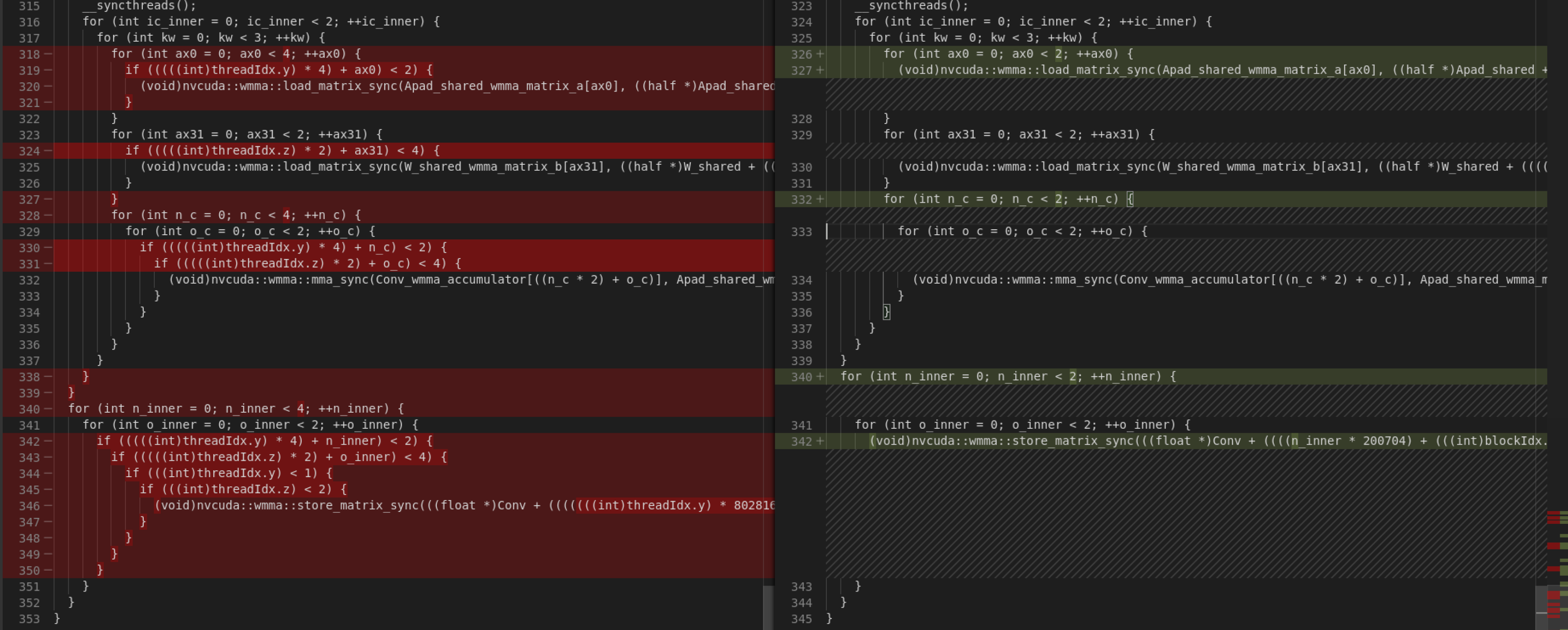
diff1

The new code look more concise than the old one in all these cases.

Overall, the test shows running time reduces from 0.060 ms to 0.035 ms. I haven't done other performance checking.

This PR makes auto bound inference more accurate/reasonable. However, this old test seems using split to force n.outer.inner's range to be larger than necessary. This PR changes this behavior of split, making it less expressive. Is this behavior a semantics by design?

A more general use case for threads binding: we would like to have a kernel with multiple stages to use same threads differently in each stage. For example, some stages need more threads than others. We don't mind allocating enough threads to satisfy the most demanding stage. But we also want to avoid unnecessary traversal (e.g. the likely statements) or memory allocation (e.g. Conv_wmma_accumulator shown above) due to the extra range. Is there a good way to achieve both?

Attach the entire generated CUDA code blow.

Before:

#if defined(__CUDA_ARCH__) && (__CUDA_ARCH__ >= 530)
#include <cuda_fp16.h>
__device__ half max(half a, half b)
{
  return __hgt(__half(a), __half(b)) ? a : b;
}
__device__ half min(half a, half b)
{
  return __hlt(__half(a), __half(b)) ? a : b;
}
#else

typedef unsigned short uint16_t;
typedef unsigned char uint8_t;
typedef signed char int8_t;
typedef int int32_t;
typedef unsigned long long uint64_t;
typedef unsigned int uint32_t;

#define TVM_FORCE_INLINE inline __attribute__((always_inline))
#define TVM_XINLINE TVM_FORCE_INLINE __device__ __host__
#define TVM_ALIGNED(x) __attribute__ ((aligned(x)))
#define TVM_HALF_OPERATOR(RTYPE, OP)                              \
  TVM_XINLINE RTYPE operator OP (half a, half b) {                \
    return RTYPE(float(a) OP float(b));                           \
  }                                                               \
  template<typename T>                                            \
  TVM_XINLINE RTYPE operator OP (half a, T b) {                   \
    return RTYPE(float(a) OP float(b));                           \
  }                                                               \
  template<typename T>                                            \
  TVM_XINLINE RTYPE operator OP (T a, half b) {                   \
    return RTYPE(float(a) OP float(b));                           \
  }

#define TVM_HALF_ASSIGNOP(AOP, OP)                                \
  template<typename T>                                            \
  TVM_XINLINE half operator AOP (const T& a) {                    \
    return *this = half(float(*this) OP float(a));                \
  }                                                               \
  template<typename T>                                            \
  TVM_XINLINE half operator AOP (const volatile T& a) volatile {  \
    return *this = half(float(*this) OP float(a));                \
  }

class TVM_ALIGNED(2) half {
 public:
  uint16_t half_;

  static TVM_XINLINE half Binary(uint16_t value) {
    half res;
    res.half_ = value;
    return res;
  }

  TVM_XINLINE half() {}

  TVM_XINLINE half(const float& value) { constructor(value); }
  TVM_XINLINE explicit half(const double& value) { constructor(value); }
  TVM_XINLINE explicit half(const int8_t& value) { constructor(value); }
  TVM_XINLINE explicit half(const uint8_t& value) { constructor(value); }
  TVM_XINLINE explicit half(const int32_t& value) { constructor(value); }
  TVM_XINLINE explicit half(const uint32_t& value) { constructor(value); }
  TVM_XINLINE explicit half(const long long& value) { constructor(value); }
  TVM_XINLINE explicit half(const uint64_t& value) { constructor(value); }

  TVM_XINLINE operator float() const {                          \
    return float(half2float(half_));                            \
  }                                                             \
  TVM_XINLINE operator float() const volatile {                 \
    return float(half2float(half_));                            \
  }


  TVM_HALF_ASSIGNOP(+=, +)
  TVM_HALF_ASSIGNOP(-=, -)
  TVM_HALF_ASSIGNOP(*=, *)
  TVM_HALF_ASSIGNOP(/=, /)

  TVM_XINLINE half operator+() {
    return *this;
  }

  TVM_XINLINE half operator-() {
    return half(-float(*this));
  }

  TVM_XINLINE half operator=(const half& a) {
    half_ = a.half_;
    return a;
  }

  template<typename T>
  TVM_XINLINE half operator=(const T& a) {
    return *this = half(a);
  }

  TVM_XINLINE half operator=(const half& a) volatile {
    half_ = a.half_;
    return a;
  }

  template<typename T>
  TVM_XINLINE half operator=(const T& a) volatile {
    return *this = half(a);
  }

 private:
  union Bits {
    float f;
    int32_t si;
    uint32_t ui;
  };

  static int const fp16FractionBits = 10;
  static int const fp32FractionBits = 23;
  static int32_t const fp32FractionMask = ~(~0u << fp32FractionBits);   // == 0x7fffff
  static int32_t const fp32HiddenBit = 1 << fp32FractionBits;   // == 0x800000
  static int const shift = fp32FractionBits - fp16FractionBits;   // == 13
  static int const shiftSign = 16;
  static int32_t const expAdjust = 127 - 15;   // exp32-127 = exp16-15, so exp16 = exp32 - (127-15)

  static int32_t const infN = 0x7F800000;   // flt32 infinity
  static int32_t const maxN = 0x477FFFFF;   // max flt32 that's a flt16 normal after >> by shift
  static int32_t const minN = 0x38800000;   // min flt16 normal as a flt32
  static int32_t const maxZ = 0x33000000;   // max fp32 number that's still rounded to zero in fp16
  static int32_t const signN = 0x80000000;  // flt32 sign bit

  static int32_t const infC = infN >> shift;
  static int32_t const nanN = (infC + 1) << shift;   // minimum flt16 nan as a flt32
  static int32_t const maxC = maxN >> shift;
  static int32_t const minC = minN >> shift;
  static int32_t const signC = signN >> shiftSign;  // flt16 sign bit

  static int32_t const mulN = 0x52000000;  // (1 << 23) / minN
  static int32_t const mulC = 0x33800000;  // minN / (1 << (23 - shift))

  static int32_t const subC = 0x003FF;  // max flt32 subnormal down shifted
  static int32_t const norC = 0x00400;  // min flt32 normal down shifted

  static int32_t const maxD = infC - maxC - 1;
  static int32_t const minD = minC - subC - 1;

  TVM_XINLINE uint16_t float2half(const float& value) const {
    Bits v;
    v.f = value;
    uint32_t sign = v.si & signN;    // grab sign bit
    v.si ^= sign;                    // clear sign bit from v
    sign >>= shiftSign;              // logical shift sign to fp16 position

    if (v.si <= maxZ) {
      // Handle eventual zeros here to ensure
      // vshift will not exceed 32 below.
      v.ui = 0;
    } else if (v.si < minN) {
      // Handle denorms
      uint32_t exp32 = v.ui >> fp32FractionBits;
      int32_t exp16 = exp32 - expAdjust;
      // If exp16 == 0 (just into the denorm range), then significant should be shifted right 1.
      // Smaller (so negative) exp16 values should result in greater right shifts.
      uint32_t vshift = 1 - exp16;
      uint32_t significand = fp32HiddenBit | (v.ui & fp32FractionMask);
      v.ui = significand >> vshift;
      v.ui += (v.ui & 0x3fff) != 0x1000 || (significand & 0x7ff) ? 0x1000 : 0;
    } else if (v.si <= maxN) {
      // Handle norms
      v.ui += (v.ui & 0x3fff) != 0x1000 ? 0x1000 : 0;
      v.ui -= expAdjust << fp32FractionBits;
    } else if (v.si <= infN) {
      v.si = infN;
    } else if (v.si < nanN) {
      v.si = nanN;
    }

    v.ui >>= shift;
    return sign | (v.ui & 0x7fff);
  }

  // Same as above routine, except for addition of volatile keyword
  TVM_XINLINE uint16_t float2half(
    const volatile float& value) const volatile {
    Bits v;
    v.f = value;
    uint32_t sign = v.si & signN;    // grab sign bit
    v.si ^= sign;                    // clear sign bit from v
    sign >>= shiftSign;              // logical shift sign to fp16 position

    if (v.si <= maxZ) {
      // Handle eventual zeros here to ensure
      // vshift will not exceed 32 below.
      v.ui = 0;
    } else if (v.si < minN) {
      // Handle denorms
      uint32_t exp32 = v.ui >> fp32FractionBits;
      int32_t exp16 = exp32 - expAdjust;
      // If exp16 == 0 (just into the denorm range), then significant should be shifted right 1.
      // Smaller (so negative) exp16 values should result in greater right shifts.
      uint32_t vshift = 1 - exp16;
      uint32_t significand = fp32HiddenBit | (v.ui & fp32FractionMask);
      v.ui = significand >> vshift;
      v.ui += (v.ui & 0x3fff) != 0x1000 || (significand & 0x7ff) ? 0x1000 : 0;
    } else if (v.si <= maxN) {
      // Handle norms
      v.ui += (v.ui & 0x3fff) != 0x1000 ? 0x1000 : 0;
      v.ui -= expAdjust << fp32FractionBits;
    } else if (v.si <= infN) {
      v.si = infN;
    } else if (v.si < nanN) {
      v.si = nanN;
    }

    v.ui >>= shift;
    return sign | (v.ui & 0x7fff);
  }

  TVM_XINLINE float half2float(const uint16_t& value) const {
    Bits v;
    v.ui = value;
    int32_t sign = v.si & signC;
    v.si ^= sign;
    sign <<= shiftSign;
    v.si ^= ((v.si + minD) ^ v.si) & -(v.si > subC);
    v.si ^= ((v.si + maxD) ^ v.si) & -(v.si > maxC);
    Bits s;
    s.si = mulC;
    s.f *= v.si;
    int32_t mask = -(norC > v.si);
    v.si <<= shift;
    v.si ^= (s.si ^ v.si) & mask;
    v.si |= sign;
    return v.f;
  }

  TVM_XINLINE float half2float(
    const volatile uint16_t& value) const volatile {
    Bits v;
    v.ui = value;
    int32_t sign = v.si & signC;
    v.si ^= sign;
    sign <<= shiftSign;
    v.si ^= ((v.si + minD) ^ v.si) & -(v.si > subC);
    v.si ^= ((v.si + maxD) ^ v.si) & -(v.si > maxC);
    Bits s;
    s.si = mulC;
    s.f *= v.si;
    int32_t mask = -(norC > v.si);
    v.si <<= shift;
    v.si ^= (s.si ^ v.si) & mask;
    v.si |= sign;
    return v.f;
  }

  template<typename T>
  TVM_XINLINE void constructor(const T& value) {
    half_ = float2half(float(value));
  }
};

TVM_HALF_OPERATOR(half, +)
TVM_HALF_OPERATOR(half, -)
TVM_HALF_OPERATOR(half, *)
TVM_HALF_OPERATOR(half, /)
TVM_HALF_OPERATOR(bool, >)
TVM_HALF_OPERATOR(bool, <)
TVM_HALF_OPERATOR(bool, >=)
TVM_HALF_OPERATOR(bool, <=)

TVM_XINLINE half __float2half_rn(const float a) {
  return half(a);
}
#endif


// Pack two half values.
static inline __device__ __host__ unsigned
__pack_half2(const half x, const half y) {
  unsigned v0 = *((unsigned short *)&x);
  unsigned v1 = *((unsigned short *)&y);
  return (v0 << 16) | v1;
}
#include <mma.h>
extern "C" __global__ void default_function_kernel0( half* __restrict__ A,  half* __restrict__ W,  float* __restrict__ Conv) {
  nvcuda::wmma::fragment<nvcuda::wmma::accumulator, 16, 16, 16, float> Conv_wmma_accumulator[8];
  __shared__ half Apad_shared[3072];
  __shared__ half W_shared[6144];
  nvcuda::wmma::fragment<nvcuda::wmma::matrix_a, 16, 16, 16, half, nvcuda::wmma::row_major> Apad_shared_wmma_matrix_a[4];
  nvcuda::wmma::fragment<nvcuda::wmma::matrix_b, 16, 16, 16, half, nvcuda::wmma::row_major> W_shared_wmma_matrix_b[2];
  for (int n_c_init = 0; n_c_init < 4; ++n_c_init) {
    for (int o_c_init = 0; o_c_init < 2; ++o_c_init) {
      (void)nvcuda::wmma::fill_fragment(Conv_wmma_accumulator[((n_c_init * 2) + o_c_init)], 0.000000e+00f);
    }
  }
  for (int kh = 0; kh < 3; ++kh) {
    __syncthreads();
    for (int ax2 = 0; ax2 < 3; ++ax2) {
      for (int ax3 = 0; ax3 < 2; ++ax3) {
        for (int ax4_ax5_fused_outer = 0; ax4_ax5_fused_outer < 8; ++ax4_ax5_fused_outer) {
          if ((((int)threadIdx.z) + ((int)threadIdx.y)) < 2) {
            if (((int)threadIdx.z) < 1) {
              Apad_shared[((((((((int)threadIdx.z) * 1536) + (((int)threadIdx.y) * 1536)) + (ax2 * 512)) + (ax3 * 256)) + (ax4_ax5_fused_outer * 32)) + ((int)threadIdx.x))] = (((((1 <= ((((int)blockIdx.z) / 14) + kh)) && (((((int)blockIdx.z) / 14) + kh) < 15)) && (1 <= (ax2 + (((int)blockIdx.z) % 14)))) && ((ax2 + (((int)blockIdx.z) % 14)) < 15)) ? A[(((((((((((int)threadIdx.z) * 100352) + (((int)threadIdx.y) * 100352)) + (kh * 7168)) + (((int)blockIdx.z) * 512)) + (ax2 * 512)) + (ax3 * 256)) + (ax4_ax5_fused_outer * 32)) + ((int)threadIdx.x)) - 7680)] : __float2half_rn(0.000000e+00f));
            }
          }
        }
      }
    }
    for (int ax1 = 0; ax1 < 3; ++ax1) {
      for (int ax21 = 0; ax21 < 2; ++ax21) {
        if (((((int)threadIdx.y) * 2) + ((int)threadIdx.z)) < 4) {
          if (((int)threadIdx.z) < 2) {
            ((__shared__ uint4*)(W_shared + (((((ax1 * 2048) + (ax21 * 1024)) + (((int)threadIdx.y) * 512)) + (((int)threadIdx.z) * 256)) + (((int)threadIdx.x) * 8))))[0] = (( uint4*)(W + ((((((kh * 6144) + (ax1 * 2048)) + (ax21 * 1024)) + (((int)threadIdx.y) * 512)) + (((int)threadIdx.z) * 256)) + (((int)threadIdx.x) * 8))))[0];
          }
        }
      }
    }
    __syncthreads();
    for (int ic_inner = 0; ic_inner < 2; ++ic_inner) {
      for (int kw = 0; kw < 3; ++kw) {
        for (int ax0 = 0; ax0 < 4; ++ax0) {
          if (((((int)threadIdx.y) * 4) + ax0) < 2) {
            (void)nvcuda::wmma::load_matrix_sync(Apad_shared_wmma_matrix_a[ax0], ((half *)Apad_shared + ((((((int)threadIdx.y) * 6144) + (ax0 * 1536)) + (kw * 512)) + (ic_inner * 256))), 16);
          }
        }
        for (int ax31 = 0; ax31 < 2; ++ax31) {
          if (((((int)threadIdx.z) * 2) + ax31) < 4) {
            (void)nvcuda::wmma::load_matrix_sync(W_shared_wmma_matrix_b[ax31], ((half *)W_shared + ((((kw * 2048) + (ic_inner * 1024)) + (((int)threadIdx.z) * 512)) + (ax31 * 256))), 16);
          }
        }
        for (int n_c = 0; n_c < 4; ++n_c) {
          for (int o_c = 0; o_c < 2; ++o_c) {
            if (((((int)threadIdx.y) * 4) + n_c) < 2) {
              if (((((int)threadIdx.z) * 2) + o_c) < 4) {
                (void)nvcuda::wmma::mma_sync(Conv_wmma_accumulator[((n_c * 2) + o_c)], Apad_shared_wmma_matrix_a[n_c], W_shared_wmma_matrix_b[o_c], Conv_wmma_accumulator[((n_c * 2) + o_c)]);
              }
            }
          }
        }
      }
    }
  }
  for (int n_inner = 0; n_inner < 4; ++n_inner) {
    for (int o_inner = 0; o_inner < 2; ++o_inner) {
      if (((((int)threadIdx.y) * 4) + n_inner) < 2) {
        if (((((int)threadIdx.z) * 2) + o_inner) < 4) {
          if (((int)threadIdx.y) < 1) {
            if (((int)threadIdx.z) < 2) {
              (void)nvcuda::wmma::store_matrix_sync(((float *)Conv + (((((((int)threadIdx.y) * 802816) + (n_inner * 200704)) + (((int)blockIdx.z) * 1024)) + (((int)threadIdx.z) * 512)) + (o_inner * 256))), Conv_wmma_accumulator[((n_inner * 2) + o_inner)], 16, nvcuda::wmma::mem_row_major);
            }
          }
        }
      }
    }
  }
}

After:

#if defined(__CUDA_ARCH__) && (__CUDA_ARCH__ >= 530)
#include <cuda_fp16.h>
__device__ half max(half a, half b)
{
  return __hgt(__half(a), __half(b)) ? a : b;
}
__device__ half min(half a, half b)
{
  return __hlt(__half(a), __half(b)) ? a : b;
}
#else

typedef unsigned short uint16_t;
typedef unsigned char uint8_t;
typedef signed char int8_t;
typedef int int32_t;
typedef unsigned long long uint64_t;
typedef unsigned int uint32_t;

#define TVM_FORCE_INLINE inline __attribute__((always_inline))
#define TVM_XINLINE TVM_FORCE_INLINE __device__ __host__
#define TVM_ALIGNED(x) __attribute__ ((aligned(x)))
#define TVM_HALF_OPERATOR(RTYPE, OP)                              \
  TVM_XINLINE RTYPE operator OP (half a, half b) {                \
    return RTYPE(float(a) OP float(b));                           \
  }                                                               \
  template<typename T>                                            \
  TVM_XINLINE RTYPE operator OP (half a, T b) {                   \
    return RTYPE(float(a) OP float(b));                           \
  }                                                               \
  template<typename T>                                            \
  TVM_XINLINE RTYPE operator OP (T a, half b) {                   \
    return RTYPE(float(a) OP float(b));                           \
  }

#define TVM_HALF_ASSIGNOP(AOP, OP)                                \
  template<typename T>                                            \
  TVM_XINLINE half operator AOP (const T& a) {                    \
    return *this = half(float(*this) OP float(a));                \
  }                                                               \
  template<typename T>                                            \
  TVM_XINLINE half operator AOP (const volatile T& a) volatile {  \
    return *this = half(float(*this) OP float(a));                \
  }

class TVM_ALIGNED(2) half {
 public:
  uint16_t half_;

  static TVM_XINLINE half Binary(uint16_t value) {
    half res;
    res.half_ = value;
    return res;
  }

  TVM_XINLINE half() {}

  TVM_XINLINE half(const float& value) { constructor(value); }
  TVM_XINLINE explicit half(const double& value) { constructor(value); }
  TVM_XINLINE explicit half(const int8_t& value) { constructor(value); }
  TVM_XINLINE explicit half(const uint8_t& value) { constructor(value); }
  TVM_XINLINE explicit half(const int32_t& value) { constructor(value); }
  TVM_XINLINE explicit half(const uint32_t& value) { constructor(value); }
  TVM_XINLINE explicit half(const long long& value) { constructor(value); }
  TVM_XINLINE explicit half(const uint64_t& value) { constructor(value); }

  TVM_XINLINE operator float() const {                          \
    return float(half2float(half_));                            \
  }                                                             \
  TVM_XINLINE operator float() const volatile {                 \
    return float(half2float(half_));                            \
  }


  TVM_HALF_ASSIGNOP(+=, +)
  TVM_HALF_ASSIGNOP(-=, -)
  TVM_HALF_ASSIGNOP(*=, *)
  TVM_HALF_ASSIGNOP(/=, /)

  TVM_XINLINE half operator+() {
    return *this;
  }

  TVM_XINLINE half operator-() {
    return half(-float(*this));
  }

  TVM_XINLINE half operator=(const half& a) {
    half_ = a.half_;
    return a;
  }

  template<typename T>
  TVM_XINLINE half operator=(const T& a) {
    return *this = half(a);
  }

  TVM_XINLINE half operator=(const half& a) volatile {
    half_ = a.half_;
    return a;
  }

  template<typename T>
  TVM_XINLINE half operator=(const T& a) volatile {
    return *this = half(a);
  }

 private:
  union Bits {
    float f;
    int32_t si;
    uint32_t ui;
  };

  static int const fp16FractionBits = 10;
  static int const fp32FractionBits = 23;
  static int32_t const fp32FractionMask = ~(~0u << fp32FractionBits);   // == 0x7fffff
  static int32_t const fp32HiddenBit = 1 << fp32FractionBits;   // == 0x800000
  static int const shift = fp32FractionBits - fp16FractionBits;   // == 13
  static int const shiftSign = 16;
  static int32_t const expAdjust = 127 - 15;   // exp32-127 = exp16-15, so exp16 = exp32 - (127-15)

  static int32_t const infN = 0x7F800000;   // flt32 infinity
  static int32_t const maxN = 0x477FFFFF;   // max flt32 that's a flt16 normal after >> by shift
  static int32_t const minN = 0x38800000;   // min flt16 normal as a flt32
  static int32_t const maxZ = 0x33000000;   // max fp32 number that's still rounded to zero in fp16
  static int32_t const signN = 0x80000000;  // flt32 sign bit

  static int32_t const infC = infN >> shift;
  static int32_t const nanN = (infC + 1) << shift;   // minimum flt16 nan as a flt32
  static int32_t const maxC = maxN >> shift;
  static int32_t const minC = minN >> shift;
  static int32_t const signC = signN >> shiftSign;  // flt16 sign bit

  static int32_t const mulN = 0x52000000;  // (1 << 23) / minN
  static int32_t const mulC = 0x33800000;  // minN / (1 << (23 - shift))

  static int32_t const subC = 0x003FF;  // max flt32 subnormal down shifted
  static int32_t const norC = 0x00400;  // min flt32 normal down shifted

  static int32_t const maxD = infC - maxC - 1;
  static int32_t const minD = minC - subC - 1;

  TVM_XINLINE uint16_t float2half(const float& value) const {
    Bits v;
    v.f = value;
    uint32_t sign = v.si & signN;    // grab sign bit
    v.si ^= sign;                    // clear sign bit from v
    sign >>= shiftSign;              // logical shift sign to fp16 position

    if (v.si <= maxZ) {
      // Handle eventual zeros here to ensure
      // vshift will not exceed 32 below.
      v.ui = 0;
    } else if (v.si < minN) {
      // Handle denorms
      uint32_t exp32 = v.ui >> fp32FractionBits;
      int32_t exp16 = exp32 - expAdjust;
      // If exp16 == 0 (just into the denorm range), then significant should be shifted right 1.
      // Smaller (so negative) exp16 values should result in greater right shifts.
      uint32_t vshift = 1 - exp16;
      uint32_t significand = fp32HiddenBit | (v.ui & fp32FractionMask);
      v.ui = significand >> vshift;
      v.ui += (v.ui & 0x3fff) != 0x1000 || (significand & 0x7ff) ? 0x1000 : 0;
    } else if (v.si <= maxN) {
      // Handle norms
      v.ui += (v.ui & 0x3fff) != 0x1000 ? 0x1000 : 0;
      v.ui -= expAdjust << fp32FractionBits;
    } else if (v.si <= infN) {
      v.si = infN;
    } else if (v.si < nanN) {
      v.si = nanN;
    }

    v.ui >>= shift;
    return sign | (v.ui & 0x7fff);
  }

  // Same as above routine, except for addition of volatile keyword
  TVM_XINLINE uint16_t float2half(
    const volatile float& value) const volatile {
    Bits v;
    v.f = value;
    uint32_t sign = v.si & signN;    // grab sign bit
    v.si ^= sign;                    // clear sign bit from v
    sign >>= shiftSign;              // logical shift sign to fp16 position

    if (v.si <= maxZ) {
      // Handle eventual zeros here to ensure
      // vshift will not exceed 32 below.
      v.ui = 0;
    } else if (v.si < minN) {
      // Handle denorms
      uint32_t exp32 = v.ui >> fp32FractionBits;
      int32_t exp16 = exp32 - expAdjust;
      // If exp16 == 0 (just into the denorm range), then significant should be shifted right 1.
      // Smaller (so negative) exp16 values should result in greater right shifts.
      uint32_t vshift = 1 - exp16;
      uint32_t significand = fp32HiddenBit | (v.ui & fp32FractionMask);
      v.ui = significand >> vshift;
      v.ui += (v.ui & 0x3fff) != 0x1000 || (significand & 0x7ff) ? 0x1000 : 0;
    } else if (v.si <= maxN) {
      // Handle norms
      v.ui += (v.ui & 0x3fff) != 0x1000 ? 0x1000 : 0;
      v.ui -= expAdjust << fp32FractionBits;
    } else if (v.si <= infN) {
      v.si = infN;
    } else if (v.si < nanN) {
      v.si = nanN;
    }

    v.ui >>= shift;
    return sign | (v.ui & 0x7fff);
  }

  TVM_XINLINE float half2float(const uint16_t& value) const {
    Bits v;
    v.ui = value;
    int32_t sign = v.si & signC;
    v.si ^= sign;
    sign <<= shiftSign;
    v.si ^= ((v.si + minD) ^ v.si) & -(v.si > subC);
    v.si ^= ((v.si + maxD) ^ v.si) & -(v.si > maxC);
    Bits s;
    s.si = mulC;
    s.f *= v.si;
    int32_t mask = -(norC > v.si);
    v.si <<= shift;
    v.si ^= (s.si ^ v.si) & mask;
    v.si |= sign;
    return v.f;
  }

  TVM_XINLINE float half2float(
    const volatile uint16_t& value) const volatile {
    Bits v;
    v.ui = value;
    int32_t sign = v.si & signC;
    v.si ^= sign;
    sign <<= shiftSign;
    v.si ^= ((v.si + minD) ^ v.si) & -(v.si > subC);
    v.si ^= ((v.si + maxD) ^ v.si) & -(v.si > maxC);
    Bits s;
    s.si = mulC;
    s.f *= v.si;
    int32_t mask = -(norC > v.si);
    v.si <<= shift;
    v.si ^= (s.si ^ v.si) & mask;
    v.si |= sign;
    return v.f;
  }

  template<typename T>
  TVM_XINLINE void constructor(const T& value) {
    half_ = float2half(float(value));
  }
};

TVM_HALF_OPERATOR(half, +)
TVM_HALF_OPERATOR(half, -)
TVM_HALF_OPERATOR(half, *)
TVM_HALF_OPERATOR(half, /)
TVM_HALF_OPERATOR(bool, >)
TVM_HALF_OPERATOR(bool, <)
TVM_HALF_OPERATOR(bool, >=)
TVM_HALF_OPERATOR(bool, <=)

TVM_XINLINE half __float2half_rn(const float a) {
  return half(a);
}
#endif


// Pack two half values.
static inline __device__ __host__ unsigned
__pack_half2(const half x, const half y) {
  unsigned v0 = *((unsigned short *)&x);
  unsigned v1 = *((unsigned short *)&y);
  return (v0 << 16) | v1;
}
#include <mma.h>
extern "C" __global__ void default_function_kernel0( half* __restrict__ A,  half* __restrict__ W,  float* __restrict__ Conv) {
  nvcuda::wmma::fragment<nvcuda::wmma::accumulator, 16, 16, 16, float> Conv_wmma_accumulator[4];
  __shared__ half Apad_shared[3072];
  __shared__ half W_shared[6144];
  nvcuda::wmma::fragment<nvcuda::wmma::matrix_a, 16, 16, 16, half, nvcuda::wmma::row_major> Apad_shared_wmma_matrix_a[2];
  nvcuda::wmma::fragment<nvcuda::wmma::matrix_b, 16, 16, 16, half, nvcuda::wmma::row_major> W_shared_wmma_matrix_b[2];
  for (int n_c_init = 0; n_c_init < 2; ++n_c_init) {
    for (int o_c_init = 0; o_c_init < 2; ++o_c_init) {
      (void)nvcuda::wmma::fill_fragment(Conv_wmma_accumulator[((n_c_init * 2) + o_c_init)], 0.000000e+00f);
    }
  }
  for (int kh = 0; kh < 3; ++kh) {
    __syncthreads();
    for (int ax0_outer = 0; ax0_outer < 2; ++ax0_outer) {
      for (int ax0_inner_outer = 0; ax0_inner_outer < 4; ++ax0_inner_outer) {
        for (int ax2 = 0; ax2 < 3; ++ax2) {
          for (int ax3 = 0; ax3 < 2; ++ax3) {
            for (int ax4_ax5_fused_outer = 0; ax4_ax5_fused_outer < 8; ++ax4_ax5_fused_outer) {
              if ((ax0_inner_outer + ax0_outer) < 2) {
                if (ax0_inner_outer < 1) {
                  Apad_shared[((((((ax0_inner_outer * 1536) + (ax0_outer * 1536)) + (ax2 * 512)) + (ax3 * 256)) + (ax4_ax5_fused_outer * 32)) + ((int)threadIdx.x))] = (((((1 <= ((((int)blockIdx.z) / 14) + kh)) && (((((int)blockIdx.z) / 14) + kh) < 15)) && (1 <= (ax2 + (((int)blockIdx.z) % 14)))) && ((ax2 + (((int)blockIdx.z) % 14)) < 15)) ? A[(((((((((ax0_inner_outer * 100352) + (ax0_outer * 100352)) + (kh * 7168)) + (((int)blockIdx.z) * 512)) + (ax2 * 512)) + (ax3 * 256)) + (ax4_ax5_fused_outer * 32)) + ((int)threadIdx.x)) - 7680)] : __float2half_rn(0.000000e+00f));
                }
              }
            }
          }
        }
      }
    }
    for (int ax1 = 0; ax1 < 3; ++ax1) {
      for (int ax21 = 0; ax21 < 2; ++ax21) {
        for (int ax3_outer = 0; ax3_outer < 2; ++ax3_outer) {
          for (int ax3_inner_outer = 0; ax3_inner_outer < 4; ++ax3_inner_outer) {
            if (((ax3_outer * 2) + ax3_inner_outer) < 4) {
              if (ax3_inner_outer < 2) {
                ((__shared__ uint4*)(W_shared + (((((ax1 * 2048) + (ax21 * 1024)) + (ax3_outer * 512)) + (ax3_inner_outer * 256)) + (((int)threadIdx.x) * 8))))[0] = (( uint4*)(W + ((((((kh * 6144) + (ax1 * 2048)) + (ax21 * 1024)) + (ax3_outer * 512)) + (ax3_inner_outer * 256)) + (((int)threadIdx.x) * 8))))[0];
              }
            }
          }
        }
      }
    }
    __syncthreads();
    for (int ic_inner = 0; ic_inner < 2; ++ic_inner) {
      for (int kw = 0; kw < 3; ++kw) {
        for (int ax0 = 0; ax0 < 2; ++ax0) {
          (void)nvcuda::wmma::load_matrix_sync(Apad_shared_wmma_matrix_a[ax0], ((half *)Apad_shared + (((ax0 * 1536) + (kw * 512)) + (ic_inner * 256))), 16);
        }
        for (int ax31 = 0; ax31 < 2; ++ax31) {
          (void)nvcuda::wmma::load_matrix_sync(W_shared_wmma_matrix_b[ax31], ((half *)W_shared + ((((kw * 2048) + (ic_inner * 1024)) + (((int)threadIdx.z) * 512)) + (ax31 * 256))), 16);
        }
        for (int n_c = 0; n_c < 2; ++n_c) {
          for (int o_c = 0; o_c < 2; ++o_c) {
            (void)nvcuda::wmma::mma_sync(Conv_wmma_accumulator[((n_c * 2) + o_c)], Apad_shared_wmma_matrix_a[n_c], W_shared_wmma_matrix_b[o_c], Conv_wmma_accumulator[((n_c * 2) + o_c)]);
          }
        }
      }
    }
  }
  for (int n_inner = 0; n_inner < 2; ++n_inner) {
    for (int o_inner = 0; o_inner < 2; ++o_inner) {
      (void)nvcuda::wmma::store_matrix_sync(((float *)Conv + ((((n_inner * 200704) + (((int)blockIdx.z) * 1024)) + (((int)threadIdx.z) * 512)) + (o_inner * 256))), Conv_wmma_accumulator[((n_inner * 2) + o_inner)], 16, nvcuda::wmma::mem_row_major);
    }
  }
}

Copy link
Member

Choose a reason for hiding this comment

The reason will be displayed to describe this comment to others. Learn more.

I see. It is my fault to make such a "wrong" testcase. Thank you for finding and fixing it.

However, this "bug" shows two discuss points about this PR:

Possibility in thread binding

If we still want to bind the loops, which have different extents, to the same threadIdx. Can we make it after this PR?

Before

for (int i = 0; i < 31; ++i) {
   B[i] = C[i] + 1
}
for (int j = 0; j < 32; ++j) {
   C[i] = A[i] * 2
}

After

// attr [iter_var(threadIdx.x, , threadIdx.x)] thread_extent = 32
if (threadIdx.x < 31) {
   B[i] = C[i] + 1
}
// attr [iter_var(threadIdx.x, , threadIdx.x)] thread_extent = 32
   C[i] = A[i] * 2

This case is really rare. So it will not block the PR merging but worths to think about it.

Schedule in AutoTVM

Today, we can make sure the schedule is correct (maybe slow but it can run) in different sizes.
In AutoTVM, We will search for many schedules and most of them will contain imperfect split. So, there will be more failure cases after this PR, although they are almost bad schedules. I'm not sure whether it will influence the cost model.

Generally, these two cases are not common in most uses. So I will approve this PR after CI's green. I just remind you of these and like to listen to your thought.

Copy link
Contributor Author

Choose a reason for hiding this comment

The reason will be displayed to describe this comment to others. Learn more.

I have similar questions, especially echo on your first one. I didn't know how to schedule your example properly until I read your code. After my change, I don't know how to do that. That's why I wonder whether this behavior of split is by design or just a work around. How about bringing this discussion to the forum to get insight from @tqchen and more people.

My intuition to your second question is that my PR is neutral. While it disallows certain schedules, it also enables/improves others. When we think about auto scheduling, it may be more helpful. Fundamentally, we need to address the first question. AutoTVM will benefit from this PR, once we can express more requests about thread binding and infer bounds more accurately at the same time.

Copy link
Member

Choose a reason for hiding this comment

The reason will be displayed to describe this comment to others. Learn more.

That‘s great. Can you create a discussion thread in https://discuss.tvm.ai?

s[AS].bind(ty, thread_z)
s[AS].bind(ti, thread_x)

kh, kw, ic, o, ii, oo = WS.op.axis
tx, xo = s[WS].split(o, nparts=block_row_warps)
ty, yo = s[WS].split(xo, nparts=block_col_warps)
t = s[WS].fuse(ii, oo)
to, ti = s[WS].split(t, nparts=warp_size)
s[WS].bind(tx, thread_y)
s[WS].bind(ty, thread_z)
s[WS].bind(to, thread_x)
s[WS].vectorize(ti)

Expand Down
1 change: 0 additions & 1 deletion topi/python/topi/cuda/conv2d_direct.py
Original file line number Diff line number Diff line change
Expand Up @@ -106,7 +106,6 @@ def schedule_direct_cuda(cfg, s, conv):
tx, fused = s[load].split(fused, nparts=cfg["tile_x"].size[2])
s[load].bind(tz, tvm.thread_axis("threadIdx.z"))
s[load].bind(ty, tvm.thread_axis("threadIdx.y"))
s[load].bind(tx, tvm.thread_axis("threadIdx.x"))

# unroll
s[output].pragma(kernel_scope, 'auto_unroll_max_step', cfg['auto_unroll_max_step'].val)
Expand Down