

Note
Lucid color palette
Version: v2.0.0
Status: Stable (2026-04-02)
- cybrdots -- Dotfiles for Arch Linux
- cybrpapers -- Wallpaper collection
- cybrcore -- The source
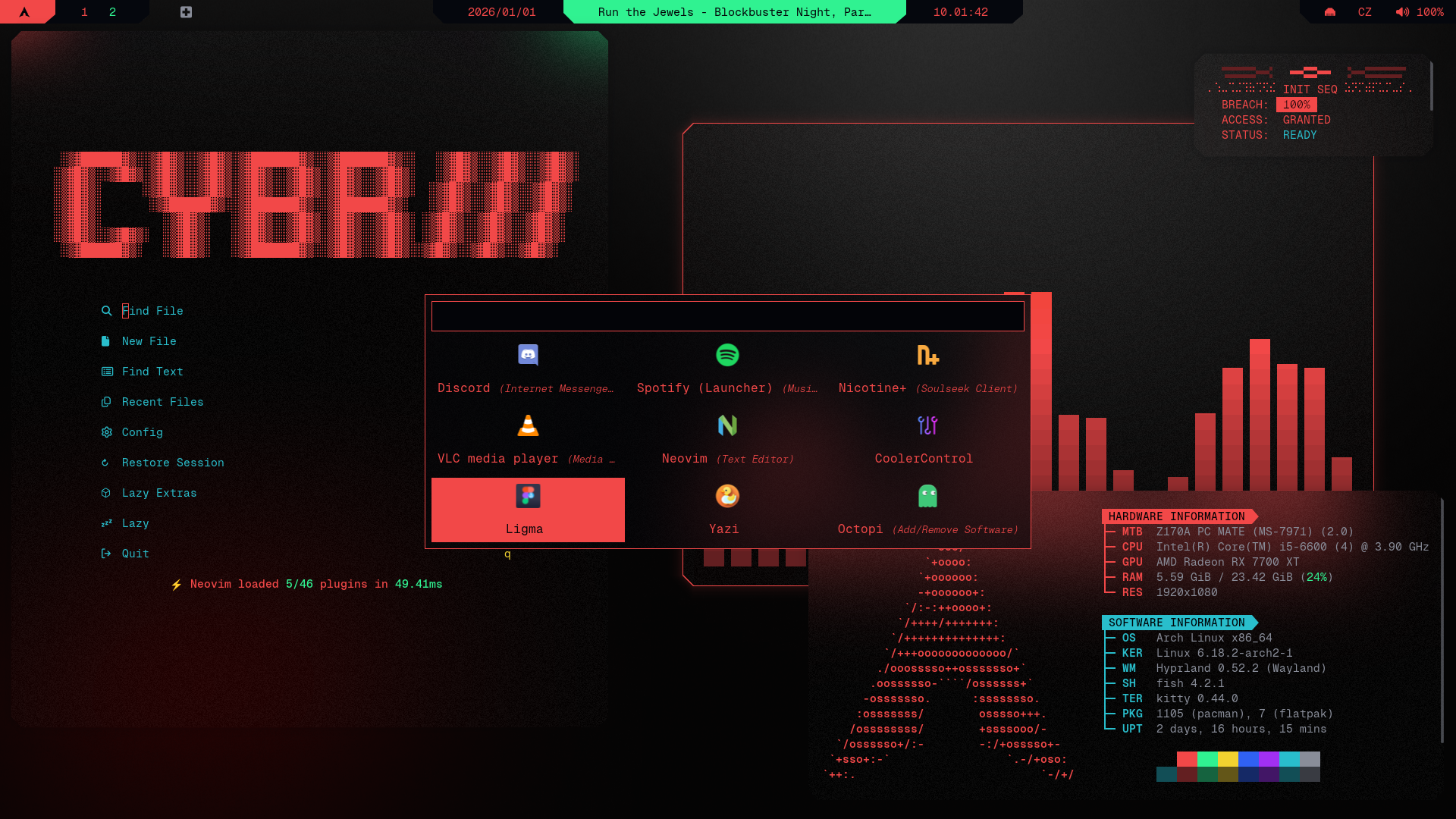
Left-to-right: Neovim, rofi-launcher, cava, fastfetch, custom script ↗
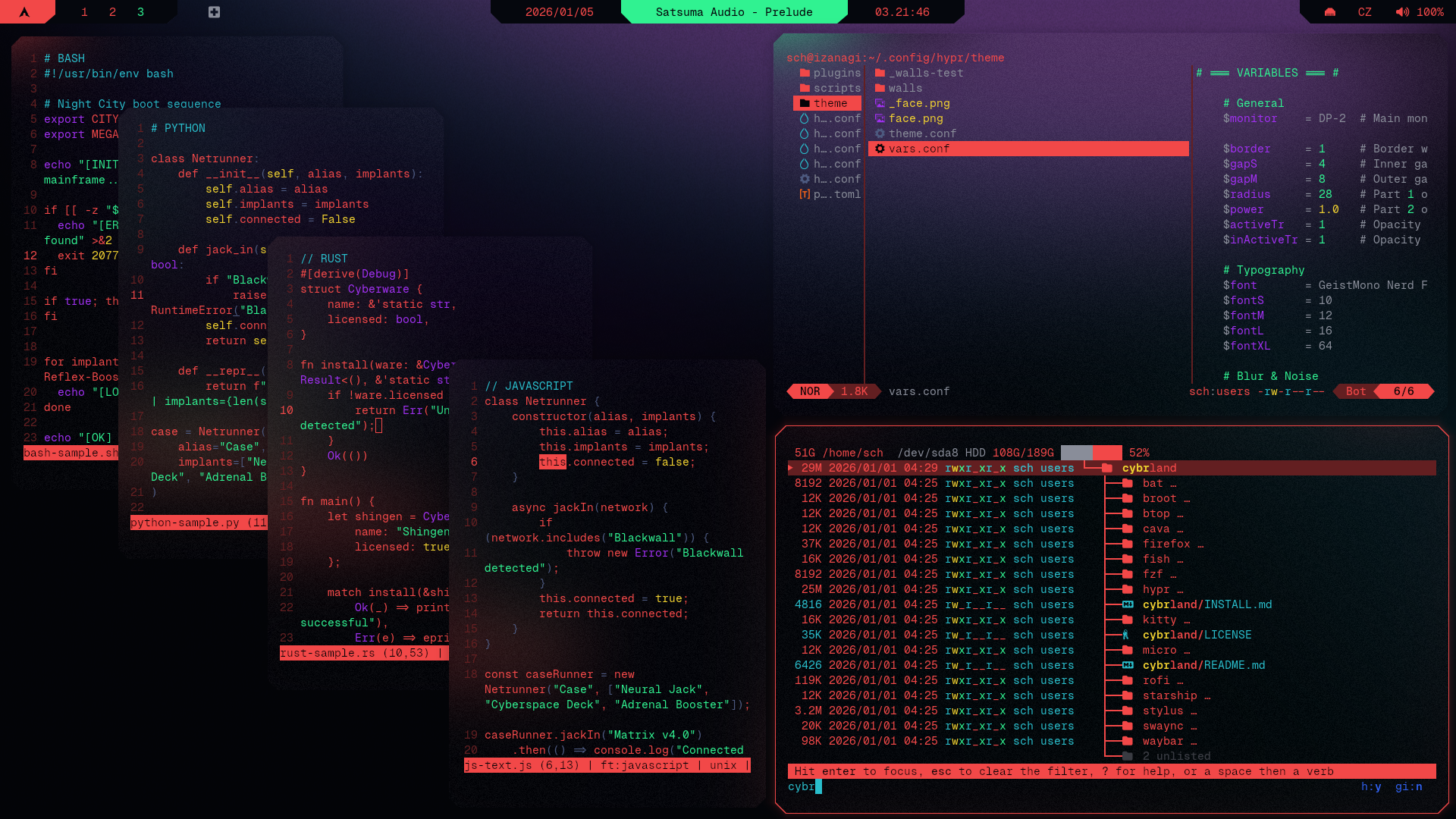
Left-to-right: stacked micro, yazi, broot ↗
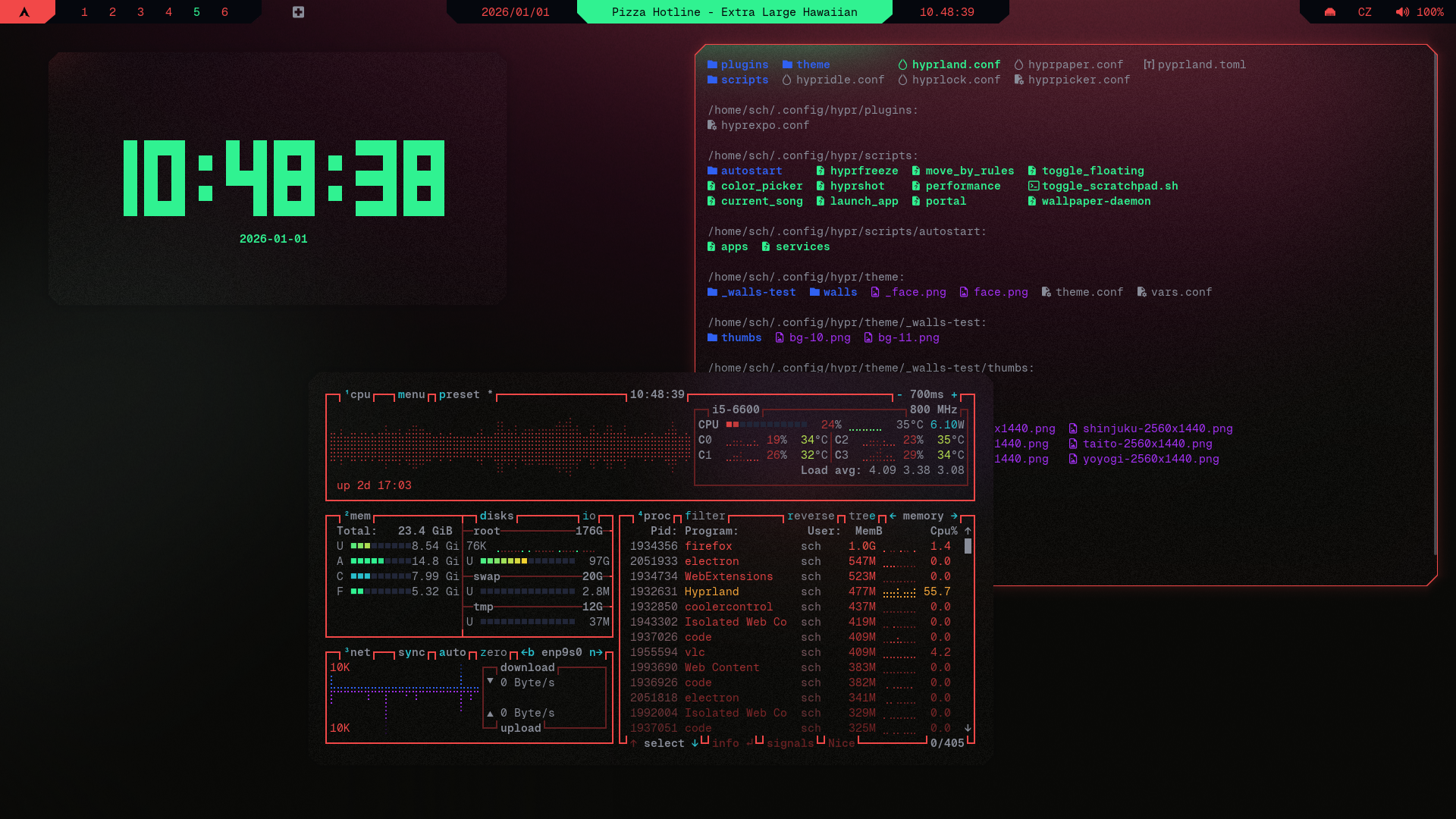
Left-to-right: clock, btop, ls ↗
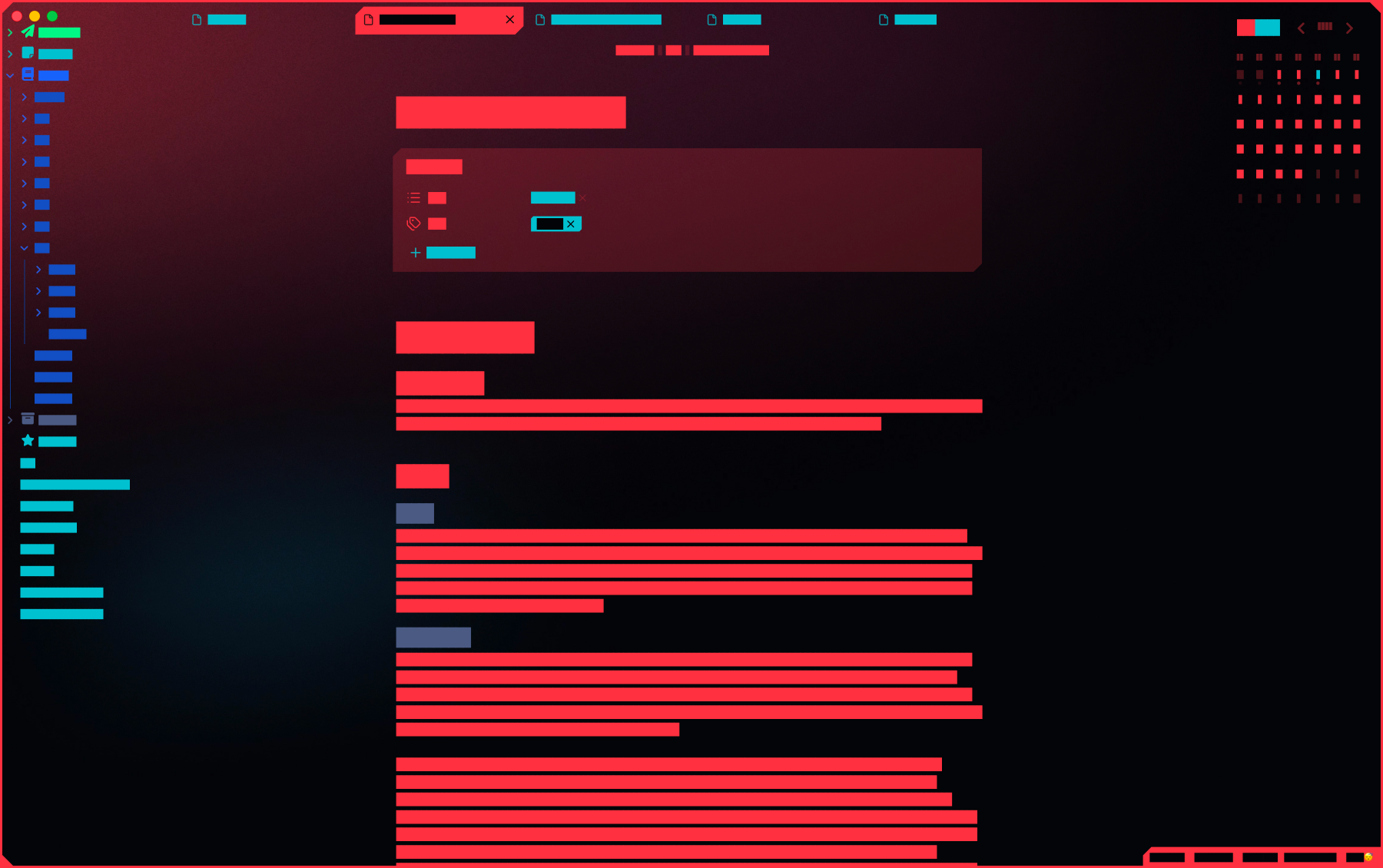
Obsidian ↗
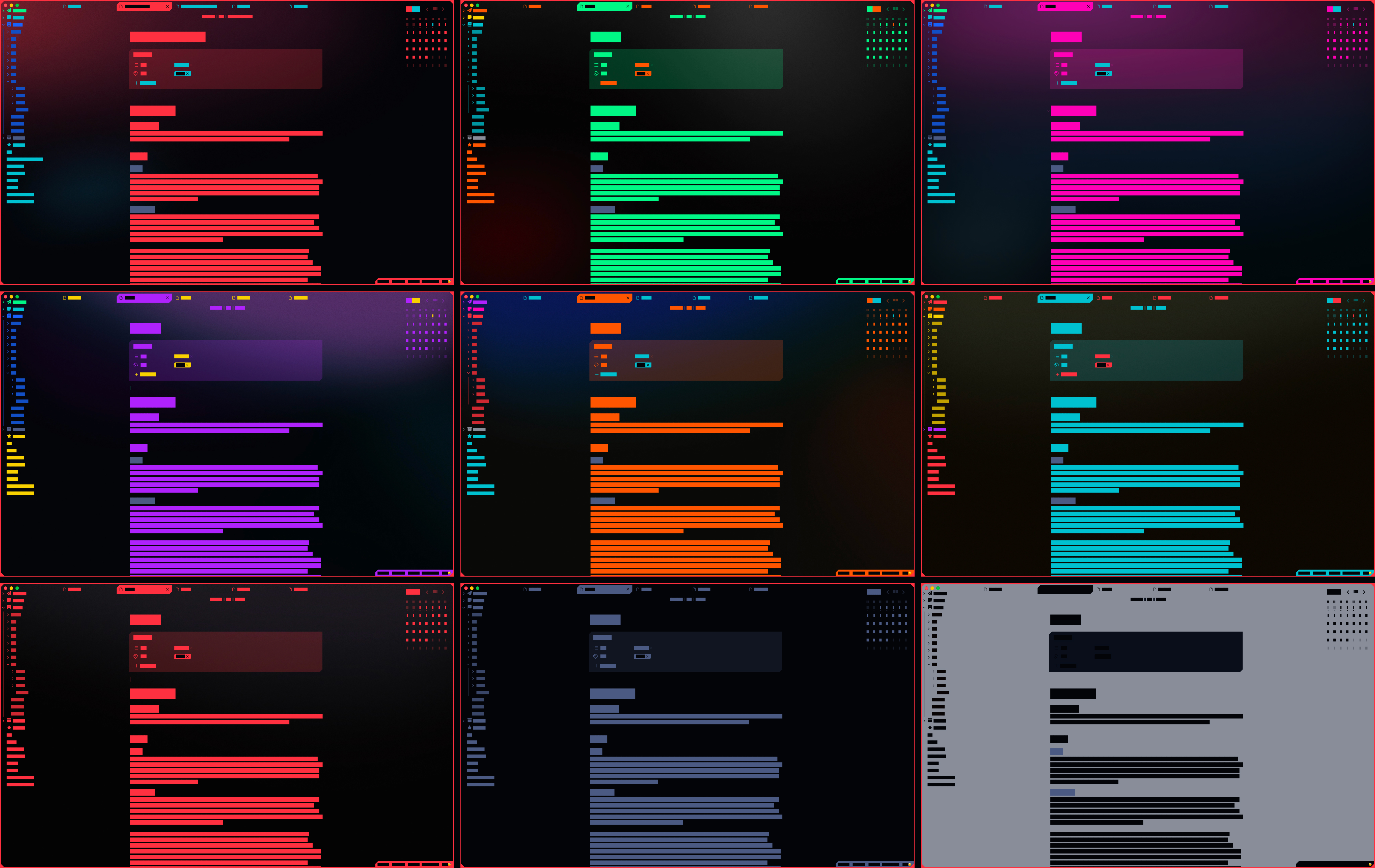
Obsidian ↗ (some possible color combinations)
| Labels | Hex | RGB | HSL | |
|---|---|---|---|---|
 |
Black (no0) | #030408 |
rgb(3, 4, 8) |
hsl(228, 63%, 3%) |
 |
Black mid (no1) | #05070D |
rgb(5, 7, 13) |
hsl(225, 44%, 4%) |
 |
Black light (no2) | #0A0E1A |
rgb(10, 14, 26) |
hsl(225, 44%, 7%) |
 |
Red base (re0) | #F24848 |
rgb(242, 72, 72) |
hsl(0, 87%, 62%) |
 |
Red mid (re1) | #631F21 |
rgb(99, 31, 33) |
hsl(358, 52%, 25%) |
 |
Red dark (re2) | #331215 |
rgb(51, 18, 21) |
hsl(355, 48%, 14%) |
 |
Green base (gr0) | #30F291 |
rgb(48, 242, 145) |
hsl(150, 88%, 57%) |
 |
Green mid (gr1) | #15633F |
rgb(21, 99, 63) |
hsl(152, 65%, 24%) |
 |
Green dark (gr2) | #0C3423 |
rgb(12, 52, 35) |
hsl(155, 62%, 13%) |
 |
Yellow base (ye0) | #F2D230 |
rgb(242, 210, 48) |
hsl(50, 88%, 57%) |
 |
Yellow mid (ye1) | #635618 |
rgb(99, 86, 24) |
hsl(50, 61%, 24%) |
 |
Yellow dark (ye2) | #332D10 |
rgb(51, 45, 16) |
hsl(50, 52%, 13%) |
 |
Blue base (bl0) | #3061F2 |
rgb(48, 97, 242) |
hsl(225, 87%, 57%) |
 |
Blue mid (bl1) | #152966 |
rgb(21, 41, 102) |
hsl(225, 66%, 24%) |
 |
Blue dark (bl2) | #0C1737 |
rgb(12, 23, 55) |
hsl(225, 64%, 13%) |
 |
Violet base (vi0) | #A130F2 |
rgb(161, 48, 242) |
hsl(275, 88%, 57%) |
 |
Violet mid (vi1) | #421666 |
rgb(66, 22, 102) |
hsl(273, 65%, 24%) |
 |
Violet dark (vi2) | #230D37 |
rgb(35, 13, 55) |
hsl(271, 62%, 13%) |
 |
Cyan base (cy0) | #29BECC |
rgb(41, 190, 204) |
hsl(185, 67%, 48%) |
 |
Cyan mid (cy1) | #124E56 |
rgb(18, 78, 86) |
hsl(187, 65%, 20%) |
 |
Cyan dark (cy2) | #0B292F |
rgb(11, 41, 47) |
hsl(190, 62%, 11%) |
 |
White base (wh0) | #898D99 |
rgb(137, 141, 153) |
hsl(225, 7%, 57%) |
 |
White mid (wh1) | #393B42 |
rgb(57, 59, 66) |
hsl(227, 7%, 24%) |
 |
White dark (wh2) | #1E2025 |
rgb(30, 32, 37) |
hsl(223, 10%, 13%) |
 |
Metal grey base (me0) | #4D5A80 |
rgb(77, 90, 128) |
hsl(225, 25%, 40%) |
 |
Metal grey mid (me1) | #212638 |
rgb(33, 38, 56) |
hsl(227, 26%, 17%) |
 |
Metal grey dark (me2) | #0D1120 |
rgb(13, 17, 32) |
hsl(227, 42%, 9%) |
 |
Orange base (og0) | #F26118 |
rgb(242, 97, 24) |
hsl(20, 89%, 52%) |
 |
Orange mid (og1) | #63290E |
rgb(99, 41, 14) |
hsl(19, 75%, 22%) |
 |
Orange dark (og2) | #33170B |
rgb(51, 23, 11) |
hsl(18, 65%, 12%) |
 |
Pink base (pi0) | #F230B2 |
rgb(242, 48, 178) |
hsl(320, 88%, 57%) |
 |
Pink mid (pi1) | #63164C |
rgb(99, 22, 76) |
hsl(318, 64%, 24%) |
 |
Pink dark (pi2) | #330D2A |
rgb(51, 13, 42) |
hsl(314, 59%, 13%) |
Recommended usage of colors:

    no0            background
    re0            main text, outlines
    gr0            success state
    ye0            warning
    bl0            ---
    cy0            ---
    wh0            small text
    og0            ---

    no1 & no2      hover, states, depth
    re1 & re2      hover, states, depth
    gr1 & gr2      hover, states, depth
    ye1 & ye2      hover, states, depth
    bl1 & bl2      hover, states, depth
    pu1 & pu2      hover, states, depth
    cy1 & cy2      hover, states, depth
    wh1 & wh2      hover, states, depth
    me1 & me2      hover, states, depth
    og1 & og2      hover, states, depth
Recommended combinations:

I used hsb color space (hue, saturation, brightness) to define starting values,
to then generate the palette. Final exported colors differ after contrast
adjustments and black-overlay blending (more on that below).

Starting values:
    Main:
        red         hsb(0, 80%, 95%)
        green       hsb(150, 80%, 95%)
        yellow      hsb(50, 80%, 95%)
        blue        hsb(225, 80%, 95%)
        violet      hsb(275, 80%, 95%)
        cyan        hsb(185, 80%, 80%)
        orange      hsb(10, 80%, 95%)
    UI:
        black       hsb(225, 60%, 3%)
        white       hsb(225, 10%, 60%)
        grey        hsb(225, 40%, 50%)

Main colors are hsb(x, 80%, 95%), where x is the hue.

    Except for:
		Cyan		brightness 80 to accommodate for its perceived brightness
		Orange		saturation 90 to better distinguish it from red
Naming convention is optimized for simplicity and for auto-complete use.
The goal was for each color to have a different first letter.

    Color names:
        red         re
        green       gr
        yellow      ye
        blue        bl
        violet      vi
        cyan        cy
        orange      or
		pink		pi
        black       no       as in: no-signal
        grey        me       as in: metal
Main goal was to hit at least AA score in contrast ratio on black:

    re0 on no0      (AA)
    gr0 on no0      (AAA)
    ye0 on no0      (AAA)
    bl0 on no0      (AA Large)
    vi0 on no0      (AA Large)
    cy0 on no0      (AAA)
    wh0 on no0      (AA)
    me0 on no0      (AA Large)
    og0 on no0      (AA)
	pi0 on no0		(AA)
Darker shades (xy1 and xy2) are created by mixing each base color (xy0) with
the black base (no0). This guarantees consistent darkening across the palette
and avoids potential issues with semi-transparent rgba overlays.

    Opacity settings:
        xy1         40%
        xy2         20%

    Example:
        re1         = color-mix(in srgb, var(--no0), var(--no0) 40%);
		re2			= color-mix(in srgb, var(--no0), var(--no0) 20%);

Resulting colors are then used to define the final hexadecimal and HSL values.
After mixing base color with black base, these are the resulting colors:

    Black:
        no0         hsl(228, 63%, 3%)
        no1         hsl(225, 44%, 4%)
        no2         hsl(225, 44%, 7%)
    Red:
        re0         hsl(0, 87%, 62%)
        re1         hsl(358, 52%, 25%)
        re2         hsl(355, 48%, 14%)
    Green:
        gr0         hsl(150, 88%, 57%)
        gr1         hsl(152, 65%, 24%)
        gr2         hsl(155, 62%, 13%)
    Yellow:
        ye0         hsl(50, 88%, 57%)
        ye1         hsl(50, 61%, 24%)
        ye2         hsl(50, 52%, 13%)
    Blue:
        bl0         hsl(225, 87%, 57%)
        bl1         hsl(225, 66%, 24%)
        bl2         hsl(225, 64%, 13%)
    Violet:
        vi0         hsl(275, 88%, 57%)
        vi1         hsl(273, 65%, 24%)
        vi2         hsl(271, 62%, 13%)
    Cyan:
        cy0         hsl(185, 67%, 48%)
        cy1         hsl(187, 65%, 20%)
        cy2         hsl(190, 62%, 11%)
    White:
        wh0         hsl(225, 7%, 57%)
        wh1         hsl(227, 7%, 24%)
        wh2         hsl(223, 10%, 13%)
    Grey:
        me0         hsl(225, 25%, 40%)
        me1         hsl(227, 26%, 17%)
        me2         hsl(227, 42%, 9%)
    Orange:
        og0         hsl(20, 89%, 52%)
        og1         hsl(19, 75%, 22%)
        og2         hsl(18, 65%, 12%)
	Pink:
        pi0         hsl(320, 88%, 57%)
        pi1         hsl(318, 64%, 24%)
        pi2         hsl(314, 59%, 13%)
- Validate contrast and distinguishability under simulated color vision deficiency (CVD) conditions.
- Adjust og0 to be more recognizable next to re0