Add a new font-editor that uses Enable to draw fonts#928
Conversation


This font editor is laregly toolkit independent - it embeds a Window with a
Label component to display the font and the simple editor uses the Pyface
font dialog to get new font values.

Some functionality is broken out into experimental base classes for building
editors with components.


|
Comments from manual testing; I haven't yet looked at the code. Minor feature request: for the demo script, in the case where I'm editing the text view, it would be nice to also see which font has ultimately been selected. (I'm entering random things like "20 point Comic Sans", pressing return, and not being sure whether the result is actually comic sans or not. Well, okay, in this case, I am sure that it's not just by looking at the results, but more generally ...) In manual testing of the demo script (with wx; I haven't yet tried with Qt), I get a traceback if I click on "Cancel" after launching the font dialog with either the "simple" button or the "custom" button. Otherwise, this is looking good. Exception occurred in traits notification handler for event object: TraitChangeEvent(object=<enable.tools.button_tool.ButtonTool object at 0x7fb930be7780>, name='clicked', old=<undefined>, new=True)
Traceback (most recent call last):
File "/Users/mdickinson/.edm/envs/enable-test-3.6-wx/lib/python3.6/site-packages/traits/observation/_trait_event_notifier.py", line 122, in __call__
self.dispatcher(handler, event)
File "/Users/mdickinson/.edm/envs/enable-test-3.6-wx/lib/python3.6/site-packages/traits/observation/observe.py", line 27, in dispatch_same
handler(event)
File "/Users/mdickinson/.edm/envs/enable-test-3.6-wx/lib/python3.6/site-packages/enable/trait_defs/ui/kiva_font_editor.py", line 100, in button_clicked
pyface_font = get_font(self.window.control, pyface_font)
File "/Users/mdickinson/.edm/envs/enable-test-3.6-wx/lib/python3.6/site-packages/pyface/font_dialog.py", line 37, in get_font
result = dialog.open()
File "/Users/mdickinson/.edm/envs/enable-test-3.6-wx/lib/python3.6/site-packages/pyface/i_dialog.py", line 168, in open
self.close()
File "/Users/mdickinson/.edm/envs/enable-test-3.6-wx/lib/python3.6/site-packages/pyface/ui/wx/font_dialog.py", line 51, in close
self.font = Font.from_toolkit(wx_font)
File "/Users/mdickinson/.edm/envs/enable-test-3.6-wx/lib/python3.6/site-packages/pyface/font.py", line 354, in from_toolkit
return cls(**toolkit_font_to_properties(toolkit_font))
File "/Users/mdickinson/.edm/envs/enable-test-3.6-wx/lib/python3.6/site-packages/pyface/ui/wx/font.py", line 160, in toolkit_font_to_properties
family = wx_family_to_generic_family[toolkit_font.GetFamily()]
wx._core.wxAssertionError: C++ assertion "IsOk()" failed at /Users/robind/projects/bb2/dist-osx-py36/build/ext/wxWidgets/src/common/fontcmn.cpp(407) in GetFamily(): invalid font |
Update: I'm only seeing this with wx, not with PyQt5. |

Unfortunately we don't have any way of telling whether the given description is "matching" a font - basically this generates a font object which is passed over to the backend to do whatever it will with it. What Qt does with that in the QPainter backend follows a completely different path compared to what the agg backends do, and there is currently no feedback on what the result is. And in all cases it "matches" something, it's just that the match might be really bad. So in this it's a lot like CSS fonts: you can type whatever you want as a font descriptor in CSS, but whether the browser renders anything like what you asked for is hugely dependent on the browser, the OS, the user's installed fonts, what you make available via the website, etc. Even the So I don't know what we could do to improve the UX here without fairly substantial changes. |
Probably lack of testing on my part, but can you tell me what version of WxPython? I think we don't fully support 4.1 right now. |

 mdickinson
left a comment
mdickinson
left a comment
mdickinson
left a comment
There was a problem hiding this comment.
Code LGTM; a few nitpick-level comments. There's also the wx traceback reported earlier; that might be worth an issue if it's not going to be fixed in this PR.
| @@ -1,4 +1,4 @@ | |||
| # (C) Copyright 2005-2022 Enthought, Inc., Austin, TX | |||
| # (C) Copyright 2005-2021 Enthought, Inc., Austin, TX | |||
There was a problem hiding this comment.
Looks like this change should be reverted.
| """ Test the interaction between traitsui and enable's ComponentEditor. | ||
| """ | ||
| import unittest | ||
| from unittest import mock |
There was a problem hiding this comment.
There seem to be a good number of unused imports here. Flake8 shows me this:
enable/tests/trait_defs/test_kiva_font_editor.py:13:1: F401 'unittest.mock' imported but unused
enable/tests/trait_defs/test_kiva_font_editor.py:15:1: F401 'pyface.font.Font as PyfaceFont' imported but unused
enable/tests/trait_defs/test_kiva_font_editor.py:16:1: F401 'pyface.font_dialog' imported but unused
enable/tests/trait_defs/test_kiva_font_editor.py:17:1: F401 'traits.api.Any' imported but unused
enable/tests/trait_defs/test_kiva_font_editor.py:24:1: F401 'enable.tests._testing.get_dialog_size' imported but unused
enable/tests/trait_defs/test_kiva_font_editor.py:24:1: F401 'enable.tests._testing.skip_if_not_qt' imported but unused
enable/tests/trait_defs/test_kiva_font_editor.py:24:1: F401 'enable.tests._testing.skip_if_not_wx' imported but unused
|
|
||
| Editor = toolkit_object("editor:Editor") | ||
| if not issubclass(Editor, BaseEditor): | ||
| Editor = object |
There was a problem hiding this comment.
I'm assuming that this is so that the import doesn't break if the toolkit is "null"; is that correct? It might be worth an explanatory comment.
There was a problem hiding this comment.
Yes, I believe so; this behaviour was copied from earlier code. It is possible it may not be needed any more.
There was a problem hiding this comment.
Yep, still needed here; may be removable in #929 which re-works the trait which uses the editor.
|
|
||
| return width, height | ||
|
|
||
| def set_size_policy(self, direction, resizable, springy, stretch): |
There was a problem hiding this comment.
It would be nice to have some documentation about the expected types of the various arguments here.
There was a problem hiding this comment.
This is an internal Qt backend method (despite being public): full documentation is here https://github.com/enthought/traitsui/blob/44459d729ca013a6b58cebda2bf94bd789de8b7c/traitsui/qt4/editor.py#L298-L322
I can copy it over if you think it is needed.
| from pyface.font import Font as PyfaceFont | ||
| from pyface.font_dialog import get_font | ||
| from traits.api import Bool, Callable, Instance, Str, observe | ||
| from traits.trait_base import SequenceTypes |
There was a problem hiding this comment.
Possibly not for this PR, but it would be good to move away from this use of SequenceTypes. Like anything else not in one of the Traits *.api modules, it's not a supported part of the Traits API and may move or disappear in a future Traits version.
Actually, I'm not sure it's even useful here; see question below.
There was a problem hiding this comment.
Agreed. I'd like a better way to express the listy/tuply-sort of things consistently and in one place - we already have some definitintions that aren't common which differ eg. on the status of numpy arrays. There was also some reason why collections.abc.Sequence didn't work for this purpose.
| """ | ||
| face_name = font.face_name | ||
| if isinstance(face_name, SequenceTypes): | ||
| face_name = face_name[0] |
There was a problem hiding this comment.
Is this branch exercised? The Font constructor seems to enforce that face_name is always an instance of str, and I don't seem to hit this branch at all when running the test suite. (If the branch is needed, it might be good to have a test that exercises it.)
There was a problem hiding this comment.
This was just copied over from the previous implementation.
I think what this allows is that the function can be used on Font-like objects that can specify "if we don't have font X, font Y is acceptable" via a list of font names (eg. as the Pyface Font does, although this code predates that class). So I don't want to just change it now, but I'll add an issue.
It's whatever was installed by |

| def string_value(self, value, format_func=None): | ||
| if self.factory.sample_text: | ||
| return self.factory.sample_text | ||
|
|
||
| return super().string_value(value, str_font) |

There was a problem hiding this comment.
Did you intend to ignore the value of format_func here? And shouldn't it be self.factory.format_func instead of str_font?
There was a problem hiding this comment.
Yes, this is intentional, and it's the way that it is because of the terribly convoluted way that TraitsUI editors produce string values. But in any case, for this editor, the only way it is called is from _get_str_value which doesn't supply format_func.
| self.font = self.value | ||
| super().update_editor() | ||
|
|
||
| def string_value(self, value, format_func=None): |
There was a problem hiding this comment.
Is this some magic TraitsUI function which is used to supply the value of the str_value trait? It's a bit confusing for a naïve reader.
There was a problem hiding this comment.
Yes, precisely. The TraitsUI stuff is a mess, but the core need for this is this is what you call if you need a string representation of a possible valid value for the editor. It's used to get the string representation of the current value by _get_str_value, but other editors use it for things like formatting the bounds of a range editor or the possible values of an enum editor.
The typical code-path bounces back and forth between editor and factory and is somewhat confusing. I'll add a docstring with a bit of explanation.
That is looking like a Pyface issue. |
Opened enthought/pyface#1130 |
|
I have opened #932 for the case of multiple font faces. |
3 participants


This font editor is largely toolkit independent: it embeds a
Windowwith aLabelcomponent to display the font and the simple editor uses the Pyface font dialog to get new font values. It also includes some drive-by fixes to theLabelcomponent (eg. mis-drawn borders, not updating when size of widget changes).There is a demo of the code in
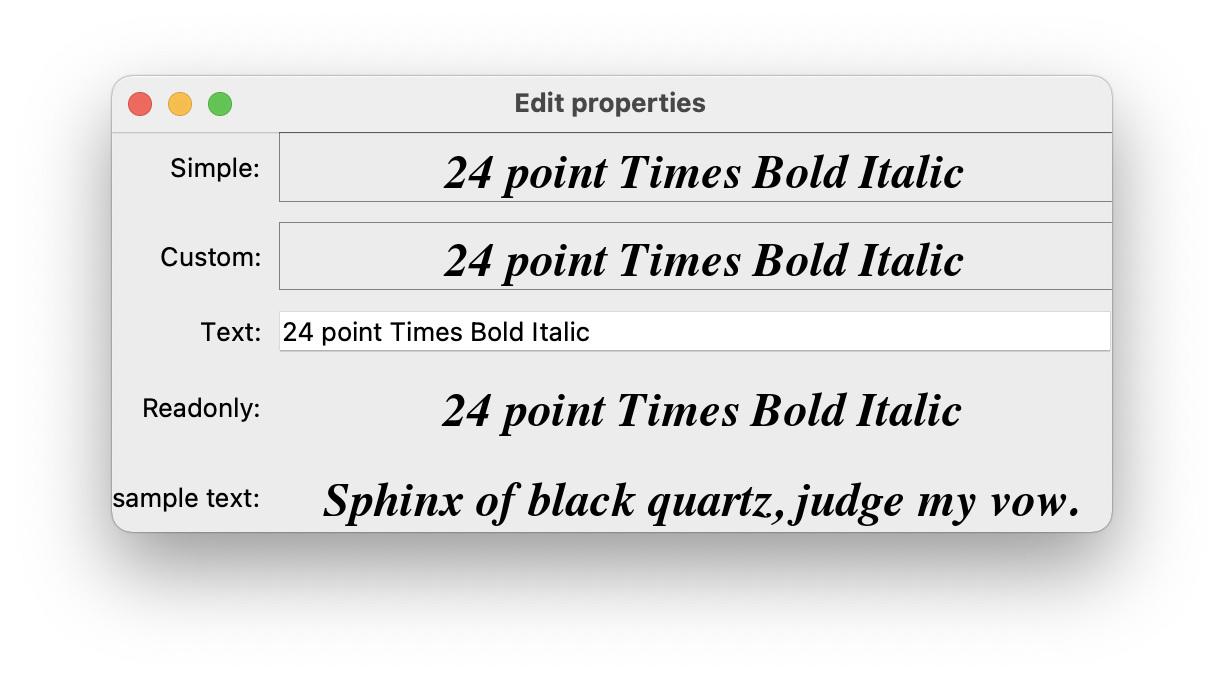
enable/demo/enable/editors/font_editor.py:Some functionality is broken out into experimental base classes for building editors with components in the thought that those may be independently useful in the future.
Things not done:
This is towards #922