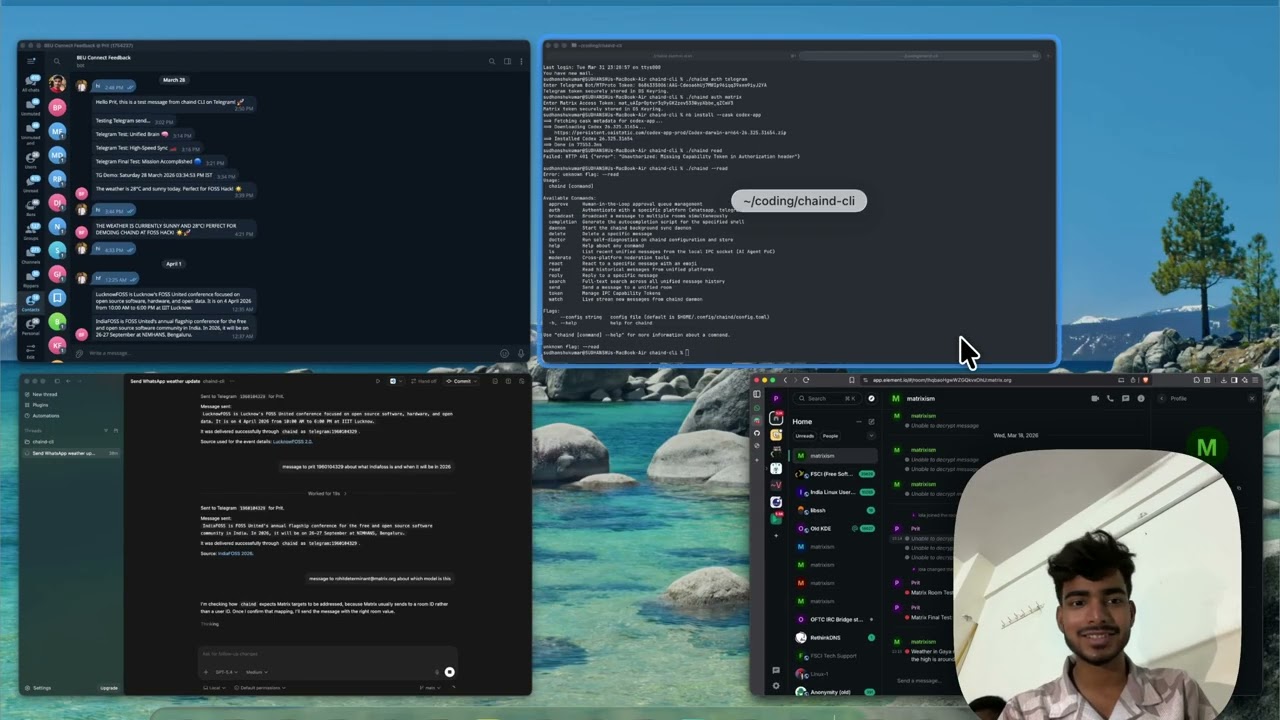
chaind is a sovereign data daemon that interfaces with your personal chat accounts (Telegram, Matrix, WhatsApp) and exposes them as a unified, local-first API over a secure Unix socket.
It is designed for personal scripts and AI agents to programmatically query messaging history and stream live events without relying on cloud webhooks, third-party databases, or second-class bot frameworks.
- Local-first: Data is synced directly to a local, high-concurrency SQLite (WAL) database.
- Native clients: Logs in directly through Telegram (MTProto/
gotd), Matrix (mautrix-go), and WhatsApp (Multi-device/whatsmeow) as an actively linked device. - Unified IPC: Exposes a single, normalized JSON schema via a Unix domain socket (
/tmp/chaind.sock), abstracting away platform-specific protocol details. - Zero dependencies: Distributed as a single, statically linked binary compiled in pure Go (no CGO overhead).
Download the binary from the releases page, or compile it from source (requires Go 1.25+):
git clone https://github.com/fossism/chaind-cli.git
cd chaind-cli
go build -o chaind .-
Boot the background daemon to initialize the storage and socket bindings:
./chaind daemon start
-
Authenticate the active network bridges:
./chaind auth telegram
./chaind auth matrix
-
Generate a local capability token for IPC access:
export CHAIND_TOKEN=$(./chaind token issue --role owner)
-
Monitor the live Server-Sent Events (SSE) stream of incoming messages:
./chaind watch --platform telegram
-
Dispatch a message to an active platform via the IPC router:
./chaind send --platform matrix --room "!room_id:example.com" --text "Hello world."
GPL-3.0