Semantic memory system with knowledge graph, spreading activation, embedding-based recall, autonomous dream consolidation, and C++ LSTM+kNN pattern learning for the Hermes Agent.
MSSQL users: run the production migration! Fixes NREM bloat, deduplicates everything, adds UNIQUE constraints:
cd ~/projects/neural-memory-adapter
python3 tools/mssql_production_migrate.py --force
SQLite users:
bash migrate.shstill works. See Production Migration for details.

- Semantic Memory Storage: Store memories with automatic embedding generation (
BAAI/bge-m3, 1024d, CUDA-accelerated) - Knowledge Graph: Automatic connection of related memories based on cosine similarity
- Spreading Activation: Explore connected ideas through BFS graph traversal with decay
- Conflict Detection: Automatically detect and supersede conflicting memories
- Dream Engine: Autonomous background consolidation (NREM/REM/Insight phases)
- LSTM+kNN Pattern Learning: C++ LSTM predicts next-relevant embedding from access sequences; kNN re-ranks by multi-signal score (embedding + temporal + frequency + graph)
- MSSQL Backend: Optional shared database for multi-agent setups — all dream operations write to the
connectionstable directly - CUDA Acceleration: GPU-accelerated embeddings via sentence-transformers
cd ~/projects/neural-memory-adapter
bash install_database.sh   # Setup database
bash install.sh # Install plugin| Mode | Command | RAM | Backend | Embeddings |
|---|---|---|---|---|
| Lite | bash install.sh --lite |
~50MB | SQLite | hash/tfidf (auto) |
| Full Stack | bash install.sh --full |
~500MB | SQLite + MSSQL | bge-m3 1024d + C++ LSTM+kNN |
Lite — Budget VPS friendly. No GPU, no Docker, no external services. Perfect for small setups.
Full Stack — Production. MSSQL shared database, sentence-transformers embeddings, optional GPU, C++ LSTM+kNN pattern learning. Supports multi-agent dream consolidation.
The installer will:
- Check/install Python dependencies
- Build the C++ library (optional)
- Create databases (SQLite + optionally MSSQL)
- Install the Hermes plugin
- Configure Hermes
- MSSQL Server running (
sudo systemctl start mssql-server) - ODBC Driver 18 (
yay -S msodbcsql18) pyodbc(pip install pyodbc)- C++ build:
cmake, C++17 compiler
If you're running MSSQL, the production migration script handles everything — diagnose, sync, dedup, V1→V2, constraints, verify:
cd ~/projects/neural-memory-adapter

# Quick verification (no changes)
python3 tools/mssql_production_migrate.py --verify-only

# Full migration
python3 tools/mssql_production_migrate.py --force

# Dry run (preview)
python3 tools/mssql_production_migrate.py --dry-run| Step | Action | Result |
|---|---|---|
| 1 | Diagnose | Tables, sizes, duplicates, orphans |
| 2 | SQLite → MSSQL sync | Merge all SQLite databases (no overwrite) |
| 3 | Deduplicate connections | 210 duplicates removed, keep highest weight |
| 4 | Deduplicate history | 709K → 42K rows (UNIQUE prevents future bloat) |
| 5 | V1 → V2 migration | Drop legacy GraphNodes/Edges, keep V2 |
| 6 | Drop legacy tables | NeuralMemory_old (117MB), connection_history_v2 duplicates |
| 7 | UNIQUE constraints | connections(source_id, target_id), connection_history(source_id, target_id) |
| 8 | Code verification | All INSERTs → MERGE/UPSERT confirmed |
| 9 | Functional verification | 14 automated checks |
Before:  490 MB, 11 tables, 709K history rows, 210 connection dupes
After:   284 MB, 8 tables, 42K history rows, zero dupes
Saved:   42% disk space
24 production verification tests across 7 categories:
# Full suite
python3 tools/test_mssql_production.py

# By tag
python3 tools/test_mssql_production.py --tags constraints,merge
python3 tools/test_mssql_production.py --tags schema,data| Tag | Tests |
|---|---|
| schema | Tables exist, no legacy, column types |
| constraints | UNIQUE indexes, FK relationships |
| data | Counts, zero dupes, zero orphans, bloat check |
| merge | MERGE on connections, MERGE on history, UNIQUE enforcement |
| integration | V2 sufficient, NeuralMemory, dream_sessions, DB size |
| performance | Recall <100ms, history lookup <50ms |
- Idempotent — safe to re-run, skips what's already clean
--dry-run— preview without changes--verify-only— only run checks, no modifications- Full test suite — 24 tests verify everything
For SQLite-only setups, the shell migration still works:
cd ~/projects/neural-memory-adapter
git pull
bash migrate.sh| Step | Action | Why |
|---|---|---|
| 1 | Backup database | Safety net — memory.db.bak.<timestamp> |
| 2 | Clean orphans | Remove connections pointing to deleted memories |
| 3 | Clean history bloat | Remove changelog entries for deleted memories |
| 4 | Deduplicate edges | Merge duplicate (source, target, type) triples |
| 5 | UNIQUE constraint | Prevent future duplicate edges at DB level |
| 6 | Retention indexes | Fast time-based cleanup queries |
| 7 | VACUUM | Reclaim wasted disk space |
| 8 | Patch dream_engine.py | Auto-prune every 50 Dream cycles (history 7d, sessions 30d, orphans) |
| 9 | Patch backends | MSSQL + C++ backend retention methods |
| 10 | Verify integrity | Full sanity check |
Before:  200-400 MB (depending on age)
After:   30-80 MB
Saved:   60-80% disk space
- Backup always created before any changes
- Idempotent — safe to re-run, skips what's already clean
--dry-run— preview without changes:bash migrate.sh --dry-run- Integrity verified after every run
The Dream Engine will now automatically prune old data every 50 cycles. No manual maintenance needed going forward.
MSSQL: UNIQUE constraints on connections and connection_history prevent NREM from creating duplicates. The Dream Engine uses MERGE/UPSERT — existing rows get updated, not duplicated.
SQLite: ON CONFLICT DO UPDATE provides the same protection.
Check database health:
# MSSQL
python3 tools/mssql_production_migrate.py --verify-only

# SQLite
sqlite3 ~/.neural_memory/memory.db "SELECT COUNT(*) FROM connection_history"
Should stay under 50K in normal operation.
All settings — including MSSQL credentials — live in ~/.hermes/config.yaml.
No .env vars needed. The plugin reads config.yaml and sets C++ bridge env vars internally.
memory:
  provider: neural
  neural:
    db_path: ~/.neural_memory/memory.db
    embedding_backend: sentence-transformers  # or: auto
    prefetch_limit: 10
    search_limit: 10
    dream:
      enabled: true
      idle_threshold: 600        # seconds before dream cycle
      memory_threshold: 50       # dream after N new memories
      mssql:                     # MSSQL backend config
        server: 127.0.0.1
        database: NeuralMemory
        username: SA
        password: 'your_password_here'
        driver: '{ODBC Driver 18 for SQL Server}'
How it works:
- Plugin loads
config.yamlviaconfig.py - Reads
memory.neural.dream.mssql.*settings - Sets
MSSQL_SERVER,MSSQL_DATABASE,MSSQL_USERNAME,MSSQL_PASSWORD,MSSQL_DRIVERintoos.environ - C++ bridge picks them up via
std::getenv()— no.envfile needed
When active, the following tools are available:
| Tool | Description |
|---|---|
neural_remember |
Store a memory (with conflict detection) |
neural_recall |
Search memories by semantic similarity |
neural_think |
Spreading activation from a memory |
neural_graph |
View knowledge graph statistics |
neural_dream |
Force a dream cycle (all/nrem/rem/insight) |
neural_dream_stats |
Dream engine statistics |
Autonomous background memory consolidation inspired by biological sleep:
Phase 1 — NREM (Replay & Consolidation) Replays 100 recent memories via spreading activation. Active connections strengthened (+0.05), inactive weakened (-0.01 with decay protection for strong/bridge edges). Dead connections pruned (<0.05).
Phase 2 — REM (Exploration & Bridge Discovery)
Finds 50 isolated memories (few connections). For each, searches for semantically similar unconnected memories via recall(). Creates tentative bridge connections in the connections table (weight = similarity × 0.3).
Phase 3 — Insight (Community Detection)
BFS connected component analysis on the full graph. Identifies bridge nodes spanning multiple communities. Creates cluster and bridge insight entries in dream_insights.
- Automatic: after 600s idle (configurable)
- Automatic: every 50 new memories (configurable)
- Manual:
neural_dreamtool - Cron: every 6 hours (default)
# One-shot cycle
python python/dream_worker.py

# Specific phase
python python/dream_worker.py --phase nrem

# Daemon mode
python python/dream_worker.py --daemon --idle 300The LSTM+kNN system learns when you'll need memories, not just what you'll need. It runs entirely in C++ via libneural_memory.so, with Python bindings through ctypes.
AccessLogger (Python)
  └─ logs every recall event (query embedding, result IDs, scores, timestamps)
  └─ circular buffer → JSON Lines persistence → co-occurrence analysis
  └─ extracts training pairs (sequence → target embedding)

LSTMPredictor (C++, 875 lines)
  └─ single-layer LSTM, Xavier-initialized
  └─ forward(): given sequence of recent access embeddings → predicted next embedding
  └─ train(): backprop on (sequence, target) pairs from AccessLogger
  └─ save/load weights to ~/.neural_memory/lstm_weights.bin

KNNEngine (C++, 281 lines)
  └─ multi-signal re-ranking of base recall results
  └─ score = w_embed × cosine + w_temporal × decay + w_freq × log(count) + w_graph × hop_distance
  └─ LSTM context dynamically adjusts weights (e.g., boost temporal if LSTM predicts time-sensitive query)
User query: "what pet do I have?"
    │
    ▼
1. Base recall (embedding search) → [memory#42: "dog named Lou", memory#88: "cat food"]
2. AccessLogger → recent sequence: [memory#17, memory#3, memory#42]
3. LSTMPredictor → predicts next embedding from sequence (what comes next?)
4. KNNEngine → re-ranks base results using 4 signals:
   - Embedding similarity (0.50 weight)
   - Temporal decay (0.20) — how recently was it accessed?
   - Frequency (0.15) — how often is it accessed?
   - Graph proximity (0.15) — how close in the knowledge graph?
5. LSTM context adjusts weights → final scored results
LSTM+kNN auto-initializes when libneural_memory.so is available. Falls back silently if not compiled.
| Parameter | Default | Description |
|---|---|---|
input_dim |
1024 | Embedding dimension (matches bge-m3) |
hidden_dim |
256 | LSTM hidden state size |
w_embedding |
0.50 | Cosine similarity weight |
w_temporal |
0.20 | Temporal decay weight |
w_frequency |
0.15 | Access frequency weight |
w_graph |
0.15 | Graph proximity weight |
half_life_hours |
24.0 | Temporal decay half-life |
When MSSQL is configured, the system uses the connections table as single source of truth for all graph operations:
| Operation | Source | Notes |
|---|---|---|
Semantic search (recall) |
Python → MSSQL/SQLite | bge-m3 embedding similarity |
Spreading activation (think) |
Python → MSSQL connections |
BFS with decay |
| Dream NREM strengthen/weaken/prune | pyodbc → MSSQL connections |
Direct SQL UPDATE/DELETE |
| Dream REM bridge creation | pyodbc → MSSQL connections |
INSERT with edge_type = 'bridge' |
| Dream Insight community detection | pyodbc → MSSQL connections |
BFS connected components |
| LSTM+kNN enhancement | C++ → Python | In-memory scoring |
| Session tracking | SQLite dream_sessions.db |
Lightweight metadata |
neural_memory.py: UnifiedMemoryclass (auto-detects MSSQL vs SQLite, LSTM+kNN integration)memory_client.py:NeuralMemoryclass (remember/recall/think/graph) +SQLiteStoreembed_provider.py: Embedding backends (sentence-transformers, tfidf, hash)dream_engine.py: Dream engine core +SQLiteDreamBackendcpp_dream_backend.py: MSSQL direct-query dream backend (pyodbc)dream_mssql_store.py: MSSQL dream session trackingaccess_logger.py: Recall event logging for LSTM traininglstm_knn_bridge.py: Python ctypes interface to C++ LSTM+kNN
libneural_memory.so: Main shared librarylstm.cpp(875 lines): LSTM forward/backward pass, Xavier init, weight save/loadknn.cpp(281 lines): Multi-signal kNN scoring enginec_api.cpp: C API surface (handles, type-safe wrappers)hopfield.cpp: Hopfield network for pattern completionknowledge_graph.cpp: Graph operations
cd ~/projects/neural-memory-adapter/python
python3 demo.py# Full suite (24 tests)
python3 tools/test_mssql_production.py
# Specific tags
python3 tools/test_mssql_production.py --tags constraints,merge
python3 tools/test_mssql_production.py --tags performanceneural-memory-adapter/
├── migrate.sh # One-shot Day-0 → Production migration
├── install.sh # Plugin installer (Lite/Full picker)
├── install_database.sh # Database setup (SQLite/MSSQL)
├── hermes-plugin/ # Plugin files (deployed to Hermes)
│ ├── __init__.py # MemoryProvider + tools
│ ├── config.py # Configuration loader
│ ├── plugin.yaml # Plugin metadata
│ ├── neural_memory.py # Unified Memory class
│ ├── memory_client.py # Main client
│ ├── embed_provider.py # Embedding backends
│ ├── dream_engine.py # Dream engine (SQLite backend)
│ ├── cpp_dream_backend.py # Dream engine (MSSQL direct queries)
│ ├── dream_mssql_store.py # Dream engine (MSSQL sessions)
│ ├── mssql_store.py # MSSQL storage backend
│ ├── access_logger.py # Recall event logger (LSTM training data)
│ ├── lstm_knn_bridge.py # C++ LSTM+kNN ctypes bridge
│ ├── cpp_bridge.py # C++ vector ops ctypes bridge
│ └── fast_ops.pyx # Cython cosine similarity
├── python/ # Python source (source of truth)
│ └── (mirrors hermes-plugin/ + demo.py, dream_worker.py)
├── src/ # C++ source
│ ├── core/c_api.cpp # C API surface
│ ├── memory/lstm.cpp # LSTM predictor
│ ├── memory/knn.cpp # kNN engine
│ └── memory/hopfield.cpp # Hopfield network
├── include/neural/ # C++ headers
│ ├── lstm.h # LSTM weights, forward pass, backprop
│ ├── knn.h # kNN config, multi-signal scoring
│ └── c_api.h # C API declarations
├── tools/
│ ├── mssql_production_migrate.py # MSSQL migration + verification pipeline
│ ├── test_mssql_production.py # 24 production verification tests
│ ├── production_upgrade.py # SQLite cleanup script (orphans, dedup, VACUUM)
│ └── dashboard/ # Interactive HTML dashboard
└── README.md
- MSSQL (primary):
127.0.0.1/NeuralMemory— 8 tables, V2 canonical layout - SQLite (fallback):
~/.neural_memory/memory.db(always active) - Embeddings:
BAAI/bge-m3(1024d) — auto-downloaded on first use, cached at~/.neural_memory/models/(~2.2 GB) - LSTM weights:
~/.neural_memory/lstm_weights.bin(persisted after training) - Access logs:
~/.neural_memory/access_logs/(JSON Lines, LSTM training data)
| Table | Purpose | Constraint |
|---|---|---|
| memories | Semantic memories with embeddings | PK: id |
| connections | Knowledge graph edges | UNIQUE: (source_id, target_id) |
| connection_history | Latest weight per edge (UPSERT) | UNIQUE: (source_id, target_id) |
| dream_sessions | Dream cycle tracking | PK: id |
| dream_insights | Community detection results | PK: id |
| NeuralMemory | Vector store (C++ bridge) | UNIQUE: legacy_id |
| GraphNodes_v2 | Graph node metadata | PK: node_id |
| GraphEdges_v2 | Graph edge metadata | PK: edge_id |
| Priority | Backend | Model | Dimensions | Requirements |
|---|---|---|---|---|
| 1st | sentence-transformers | BAAI/bge-m3 | 1024 | GPU recommended, auto-downloads |
| 2nd | tfidf | — | varies | numpy only |
| 3rd | hash | — | 384 | nothing (always works) |
When storing a memory with similar content to an existing one:
- High similarity (>0.7) + different content → updates existing memory
- Marks old memory as
[SUPERSEDED]and adds[UPDATED TO] - Returns the existing memory ID instead of creating duplicate
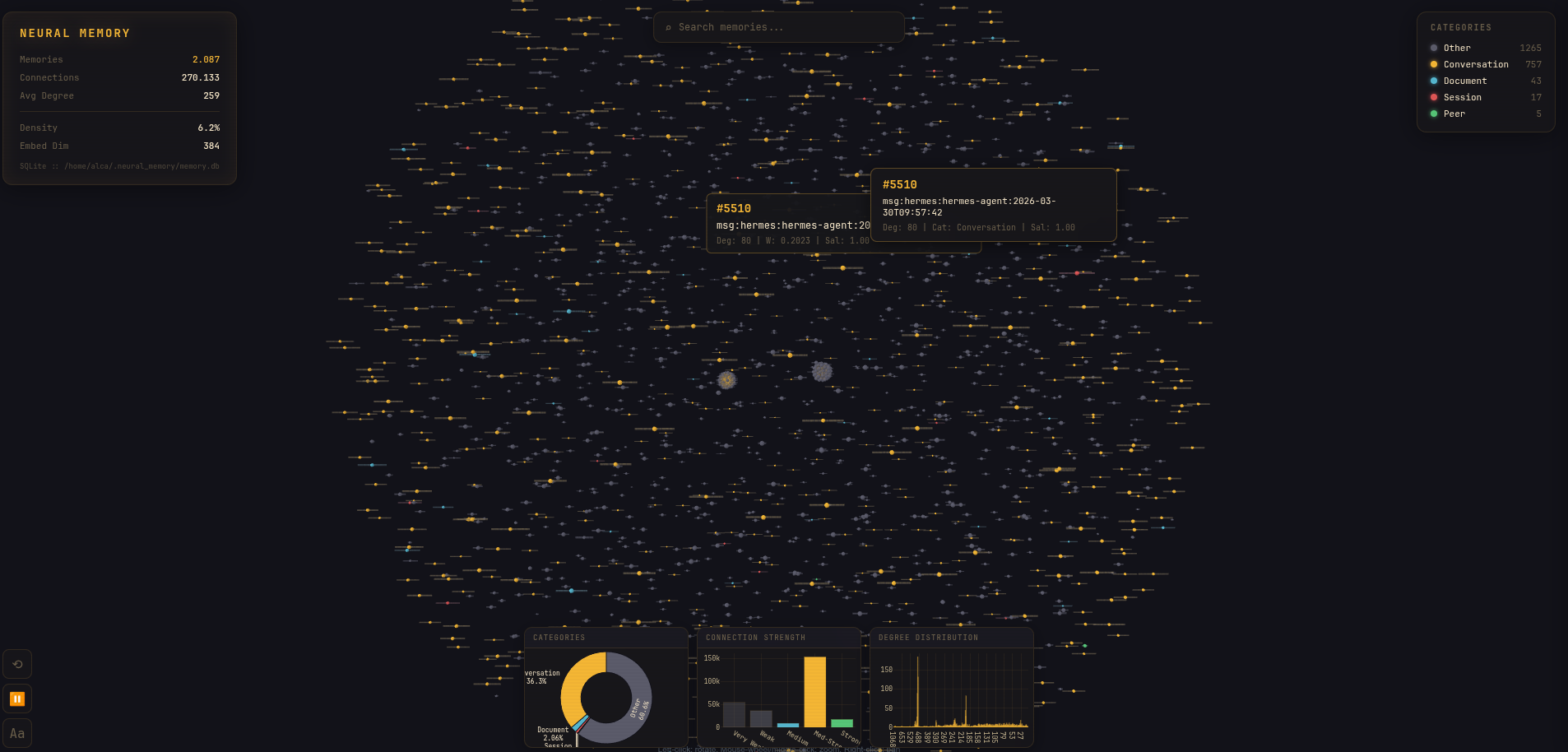
Interactive 3D knowledge graph visualization — fully offline, zero CDN dependencies.
cd tools/dashboard

# Generate from SQLite
python3 generate.py -o ~/neural_memory_dashboard.html

# Generate from MSSQL
python3 generate.py --mssql --mssql-password 'pass' -o ~/dashboard.html

# Generate + serve via HTTPS (self-signed cert)
python3 generate.py --serve --port 8443
Features:
- 3D Force Graph — full-viewport WebGL graph (vasturiano/3d-force-graph + Three.js), force-directed layout with directional particles, clickable nodes with camera focus
- Amber Theme —
#f5b731on deep black#0a0a12, matching hermelinChat skin - HUD Panel — top-left: memory count, connections, avg degree, graph density, embedding dim
- Detail Panel — right slide-in on node click: category, salience bar, degree (in/out/total), access count, connected nodes (clickable)
- Search — top-center fuzzy search by label or ID, click to focus + open detail
- Category Legend — top-right, click to highlight/filter nodes by category
- Mini Charts — bottom bar: category donut, connection strength bars, degree histogram (Plotly)
- Controls — camera reset, pause/resume simulation, toggle labels
Offline-First: All JS libraries (Plotly ~3.5 MB, Three.js ~670 KB, 3d-force-graph ~690 KB) embedded inline. SpriteText replaced with canvas-based inline class. No external CDN calls. Generated HTML is fully self-contained (~5.4 MB).
Library Cache: tools/dashboard/.lib_cache/ — auto-downloaded on first generate.py run.
grep -n "def tool_error" ~/.hermes/hermes-agent/tools/registry.py# Lite
pip install numpy
# Full Stack
pip install sentence-transformers pyodbc numpy cythonrm ~/.neural_memory/memory.db # fresh startgrep -A5 'mssql:' ~/.hermes/config.yaml
systemctl status mssql-server
ss -tlnp | grep 1433# Build
cd ~/projects/neural-memory-adapter/build
cmake .. -DCMAKE_BUILD_TYPE=Release
make neural_memory -j$(nproc)
# Verify
python3 -c "from lstm_knn_bridge import LSTMPredictor; print('OK')"See LICENSE file.