In this project, I built an application for a virtual card game of Slapjack from scratch. This game is built for exactly two players to compete on the same desktop device. They can play as many full games as they would like, and their win scores are saved to localStorage . The rules to this game and how the players can operate it, are explained in detail in both in the Project Brief and the deployed Github Page linked below.
Build my first complete game application based on a project brief and comp. Specific learning goals include:
- Practicing self-reliance to plan and build an advanced application independently from outside help.
- Using complex conditional logic to execute specific code.
- Working between multiple classes to operate the
Data Modeland separate it's actions from theDOM. - Writing and refactoring to
DRYcode with an additional focus onSRP. - Using
event delegationto handle and listen for like-events and page elements. - Using
localStorageto make data persist on page load.
- When it's their turn, players deal cards from their hand to a middle pile by keying
[q]and[p]. - Players can "slap" the middle pile using the
[f]and[j]keys with several outcomes: Jacks, Doubles, Sandwiches, and Bad Slaps. - Player turns are dependent on the following:
- If the other player does not have any cards left.
- If the other player just slapped the middle pile.
- Or if it was not their turn previously.
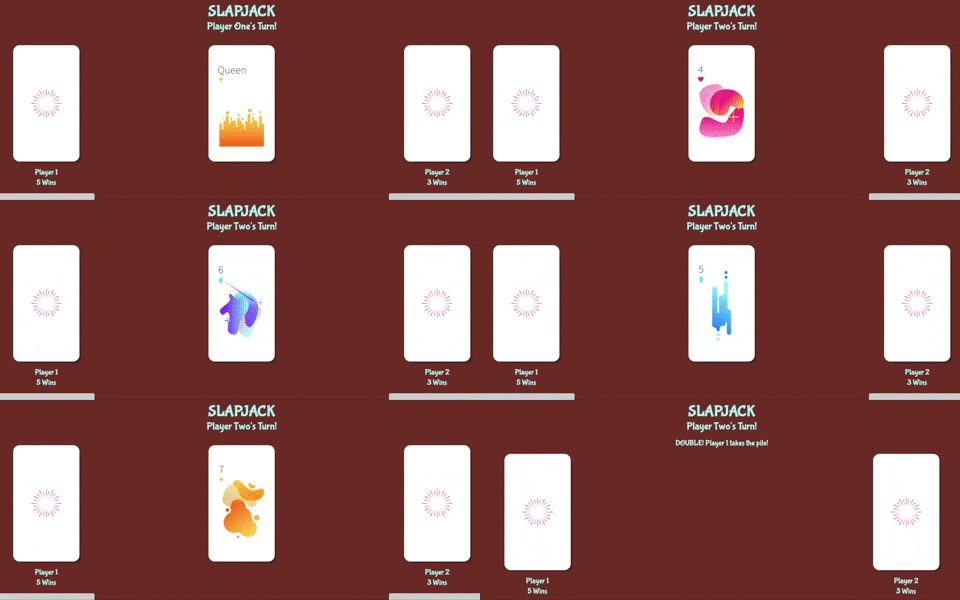
- The cards are shuffled in three instances:
- At the start of a new game - before the cards have been dealt to either player.
- After a player successfully slaps and adds the pile to their existing hand.
- After the player with cards has dealt all of theirs to the middle and before the cards are handed back to that player.
- When a player runs out of cards they have a chance to get back into the game by slapping a Jack as the other player continues to deal their cards. It is in this round where they can also be eliminated.
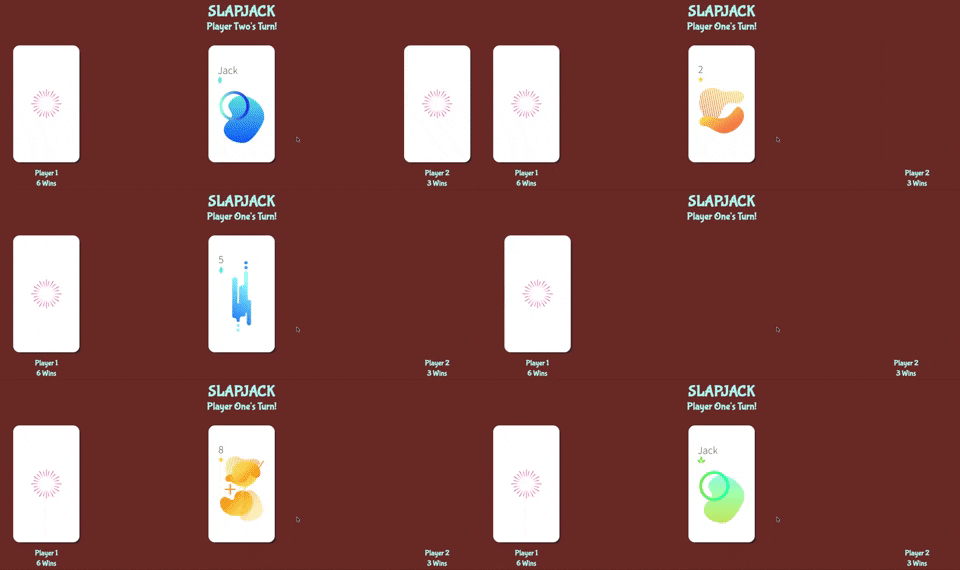
- When a player has won, the win score is updated to the
Data ModelandlocalStorage - The
DOMdisplays all of the data representing this game as events happen, to allow the users an experience of a real card game.
- HTML in
index.html - CSS in
styles.css - Vanilla JavaScript in
main.js,game.jsandplayer.js
This project was assigned mid-day on 9/17/20 and turned in on 9/22/20 in the evening with 4.5 days to complete it. Because it was a solo project, there was no DTR, but I did use a Kanban Project Board on Github to outline and track the project progression.
While it was an independent project, I did reach out to peers to discuss high level ideas when I was stuck. That said, the only people who reviewed this project or suggested specific code implementation were my mentor for a code review and my project manager who graded it and provided feedback.
- Shuffling the different card deck arrays. I needed to create a function that would completely randomize the order of arrays when I called it. This took some research to find a method and to understand it. I settled on the
Fisher Yates Shuffle, which runs a reverse loop through the array and replaces each index with another as it iterates. It was my first time using a reverse loop in anything other than just practice. - Writing DRY code for conditional logic that: handles how user's take their turns, handles all of the different slap outcomes, handles the rules for a survival round, and determines a winner.
- Tracking and manipulating various arrays of card objects in the
Data Model. - Utilizing
localStoragefor multiple keys with different values. I had not managed storage for more than one piece of data previously.
- Building the complete game free of bugs (as far as I am aware of). This required manual testing and console logging to debug. It also required moving slowly and intentionally through each planned step and refactoring before introducing new features.
- Reusing multiple functions for
DRYcode. Some examples are theshuffleDeck()andplayHand()methods ingame.jsas well as thestartNewGame()andresetPlayerDecks()functions inmain.js. - Completely separating the
DOMandData Modelresponsibilites. All data is manipulated in eitherplayer.jsormain.js. All global variables,DOMmanipulation, and event handlers occur inmain.js. - Combining
DOMmanipulation,event delegationand elegantCSSimplementation to create a user experience that makes the game actually fun to play. - Solving all main blockers explained in the
Challengessection independently of outside help.
- Fork this Github repository and clone it down to your local machine using the
git clonecommand in your Terminal. - Move into that directory with
cd slapjackin your Terminal. - Run
open index.htmlin your Terminal to run the application locally. - To see the code itself locally, run
<your text editor> .in your Terminal.
- JP Carey - Application/game creator
- David Becker - Code Reviewer and JP's Mentor
- Will Mitchell - Project Manager