Lightning Network multi-asset channels#72
Conversation


|
Thanks for your pull request! I'm personally very interested in getting support for cross-chain/tokens into lightning network spec, so work & thinking around this is greatly appreciated and is likely going to be a significant use case for the lightning network. I do have some feedback and suggestions, and am definitely interested in seeing this merged sooner rather than later, provided that implementations don't have to do significant (or any tangible) work towards supporting it today.
An area which I do not have strong opinions on is how to do this with minimal disruption towards existing implementations. I don't expect many implementation to support multiple assets for a while, so more thinking is needed on how to go about this flexibly without blocking existing work. The simplest thing would be to simply error the channel out when it sees more than one num-assets and/or the asset-id isn't bitcoin or whatever. Not sure if this is a good case for flagging as optional bits... I'll come up with more comments in the days ahead if anything comes up. Thanks~~~! |

I'm glad to hear that! Thanks for the enthusiasm (-:
One of the primary design goals for me was to make this as painless as possible for current implementations. Have you see the "Backwards Compatibility" section?
I'm thinking of "tokens" as the transferable units themselves and "asset" as the token types. But I have no strong preference either way.
To make this as least disruptive as possible to current implementations, I retained from moving things around too much. If we take the freedom to re-design the specs as we see fit, then yes - I think that some re-ordering is in order.
I have a slight preference for the format of every amount field grouping the values for all the assets together (can be thought of as
The extra two bytes are for identifying the protocol being used (Colu, Counterparty, Omni, etc). You're right in that IDs can always be trimmed down (at the cost of losing some collision resistance). If a total of 32 bytes is important then I would be okay with 2 bytes version + 30 bytes ID (but I do think that the version bytes should be there - see below for more on that).
I didn't see much importance for their order, just for the fact that a native token must be specified, but sure - we can add this as a requirement.
It's not part of the specs themselves, but I offered something similar under "Rationale" in the pull request (bullet 4): For native blockchain tokens, we can use the
Under what circumstances can we have multiple native tokens in the same channel? My understanding was that every channel conceptually represents a funding output, which can only exists on one blockchain which can only handle its own native tokens. Or are you thinking of "channels" as something that could conceptually span multiple blockchains/outputs? I'm aware of the hash-lock-based cross-chain swaps LN is capable of, but is it going to be abstracted as a single channel spanning multiple blockchains, or as multiple channels each in its own blockchain and using hash-locks to achieve atomicity between them?
The full paragraphs says this: "The receiving node MUST fail the channel if it contains any unknown or unsupported assets, does not contain any native blockchain assets, or contains more than one native blockchain assets."
Yeah, there's definitely some more work to do around these parts. I'll give it some thought.
That's what the prefix version bytes were meant to solve. Under your proposed solution, the asset id itself wouldn't convey information about the protocol being used - the user would have to specifically input the asset id in a Colu-only software, or manually pick "Colu" under some dropdown. I think that an asset id that users can send to each-other and which already encapsulates that information would be better. |

|
Joseph Poon <notifications@github.com> writes:
Thanks for your pull request! I'm personally very interested in getting support for cross-chain/tokens into lightning, so work & thinking around this is greatly appreciated and is likely going to be a significant use case for the lightning network.
I do have some feedback and suggestions, and am definitely interested in seeing this merged sooner rather than later, provided that implementations don't have to do significant (or any tangible) work towards supporting it today.
I agree that it's interesting, but I'm extremely reluctant to expand
the current spec. The upgrade path is fairly clear for doing this
later, though.
In practice, I'd want to see a scratch implementation before rushing
into a spec, because there are complexities all over this. In
particular, what does a commitment transaction which contains an
asset/token look like? That's the core problem to solve, and everything
else grows out of that. Perhaps that's already a solved problem?
Thanks,
Rusty.
|
We're definitely looking to implement the Colu coloring scheme using this protocol specification (based on lnd, in two stages - an abstraction layer for generic multi-asset support first, then a colu-specific "driver" built on top), but it is critical for us to know that we're doing this in a way that the community supports and which has a chance to eventually get merged back upstream. (BTW - we do have a PoC implementation of Colu coloring on top of lnd, but as a quick & dirty hack, without the generic multi-asset abstraction layer, and without using the wire protocol proposed here.)
The proposed specifications intentionally do not go into these details. They just extend the wire protocol to allow nodes to talk in terms of multiple asset types identified by IDs, and leaves all the coloring-scheme-specific details to implementations. That being said, the most common coloring schemes used today involve some variant of encoding meta protocol instructions in OP_RETURN outputs. A color-aware lightning implementation would need to mutate these OP_RETURN instructions as the state/commitment updates. |
|
Nadav Ivgi <notifications@github.com> writes:
That being said, the most common coloring schemes used today involve some variant of encoding meta protocol instructions in OP_RETURN outputs. A color-aware lightning implementation would need to mutate these OP_RETURN instructions as the state/commitment updates.
But this doesn't work, as you can't produce standard transactions with
multiple OP_RETURN.
And how do you encode a conditional transfer, eg. "You can have this
asset if you provide the payment preimage, otherwise I can have it back
after some period of time"?
The wire protocol is the least of your problems, AFAICT.
Hope that helps,
Rusty.
|
The
The Colu colored coins scheme is based on the output model of bitcoin and works alongside it. Script can still be used to put constrains on how the output can be spent, in the same manner that you would normally use it. This is also true of some of the other meta-asset protocols, but not all (like Omni, though I understand that they're showing some interest in moving to an output-based model for script- and LN- compatibility. @udiWertheimer can perhaps expand on that). As an example, a commitment transaction spending a colored funding output (of, say, crypto-euros) to HTLC outputs would look like that:
|

|
Hi guys, I'm relatively new in crypto and bitcoin and I'm not a coder either, but this project draws powerfully my attention for its enormous potential and I've been curious on and getting acquinted with lightning network for several months since last year. This multi-asset channel proposal is a very interesting pull request, and in the name of the progress I've decided taking the risk of making a fool of myself here, with these observations: 1°.- Conceptually, Lightning Network is a new layer of network services, which has been built over the layer of Bitcoin, but also directly over TCP/IP. As I see it, Lightning has two main modules of services and apps: The transaction handling module and the circuit-oriented network module. This last module relies strongly on TCP/IP and as I see it is a master piece. But by the other hand, the transaction module has been built directly over a Bitcoin network which do not exist yet: A Bitcoin layer WITH the Seg-Wit package of services. This by itself is not a problem, since I think Seg-Wit will be activated soon on Bitcoin, but this is a restriction for the adoption of cross-chain tokens (coloured coins) in this network. The reason for this is twofold. ONE: the very architecture of network layers as it has been evolving so far. Meta-Protocols came first. LN should adapt to meta-protocols, not the contrary. 2°.- LN project will be a very demanded app if it allows from its network layer, the development of future layers of new and interesting network services, which would use more complex smart contracts. In order to be able to do it, LN may provide you with an extra module of apps for allowing to the user more generic HTLC's. Not a big deal, LN just need HTLC's wich allows more elaborated booleans with hashes functions like Colu is trying to make some room for new features in LN (this request), and that´s interesting. I really apologize for these comments, if this is not the proper space to discuss them. In that case I would appreciate if you suggest another place I would go and post, but I thought this post would be a good start. 3.- Immunity to malleablity attacks over "Class C" transactions of meta-protocol layers. Meta protocols give a pretty high protection against malleability. LN may be adapted and benefit from the advantages of these protocols, but some extra (and simple) steps are required. To illustrate how simple it would be I'll describe an example: Opening a Channel. Let suppose Alice wants to fund a channel with Bob. Let's suppose it will be funded with a famous token, (allegedly) pegged to the dollar: The Tether, which is an Omni-Core token.
It can be proved that by taking similar simple steps (just few extra pre-funding tx's placing into certain P2SH addresses with few satoshios), the whole ligtning procedure can be perfectly implemented over these kind of meta protocol layers existing today, and with all the other (the vast majority of) tx's occuring off-chain. In conclusion: just wanted to leave my personal view on the best path for the LN evolution; If this sparks some interest, it will be great to approach the subject with more details, thus I'll be able to share my ideas about a LN opperating over meta-protocol layers and how would run a higher layer of merchant and trade network, calling to the services of LN. |

|
Seems things got a bit derailed here... @jjmr007, you clearly have a lot of interest in this, but it might be more constructive to discuss on the Mailing list or in a separate pull request. @shesek Any updates to share? |

|
Just to let you know, we are currently actively working on RGB — bitcoin-based assets with near-zero blockchain pollution and client-side validation, basing on original idea by Peter Todd on single-use seals. It has a special part allowing to add assets into LN channels, named Spectrum; you can read more on the topic at https://github.com/rgb-org/spec/blob/spectrum-0.5/04-lightning-network.md. Spectrum works fine with the current BOLTs, since it does not modifies the transaction structure; the only two things that are required to make it compatible with all existing LN nodes is to
|


|
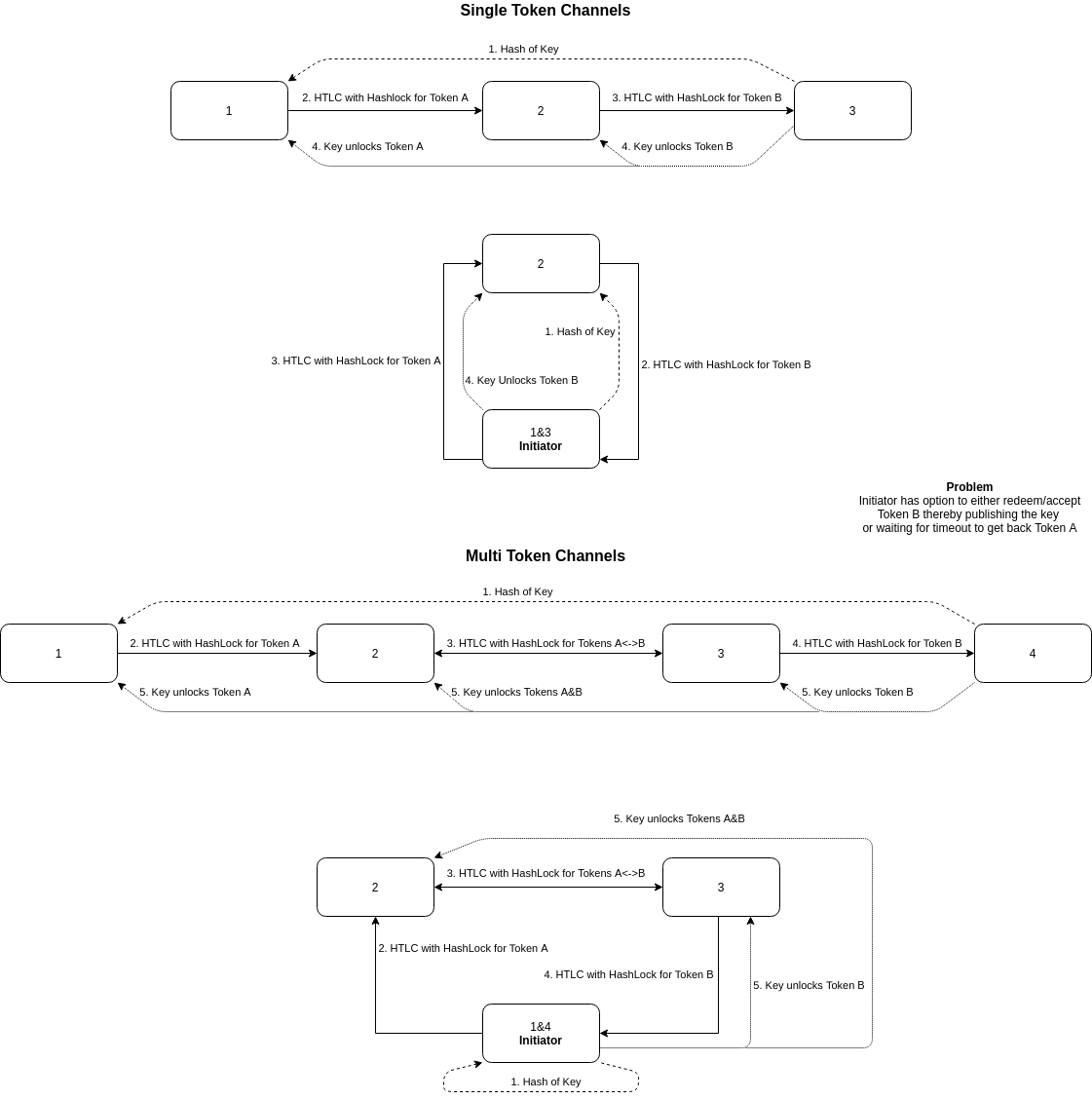
@dr-orlovsky @rustyrussell @Roasbeef @shesek I don't think it makes a whole lot of sense to do multi-asset payment channels. Today I took the time to really try to understand the theoretical attack vectors and we came with a vector of attack that I cannot see a way around leading us to believe that single asset LN is the only thing that will work, not to say that multi-asset strategies aren't useful just that using them on a singular p2p network doesn't make a whole lot of sense unless someone can show a way around the issue which is related to how payment channels work in our current understanding. Atomic swaps is going to be the only way to move assets across blockchains because the external rate exchange between the two tokens are attached to a single point in time and not susceptible to time-delay attacks.
As you can see, a single exchange rate in time cannot be chosen between the two tokens A and B, and thus the exchanger (channel between A<->B) either is going to be drained, or if parameters chosen in another way, will drain either ends up the parties looking to send payments through exchanging channels. If you assume that 1 and 4 user are the same person, they can set up an American Call Option to choose at the end of time delay to choose which side of the channel to accept based on economic incentives. This was described here https://lists.linuxfoundation.org/pipermail/lightning-dev/2018-December/001752.html by ZmnSCPxj. Because either way you cut it, economic incentives prevents dishonest players from creating risk-free arbitrage opportunities it is very likely only to make sense that off-chain payment systems will deal with single assets only unless the construction of such channels is drastically different. The only thing that I can see would offset it is premiums that are based on time value of the time lock timeout in relation to volatility. |

|
This has been inactive for a while, and other proposals exist for the use-case that don't require any change to the BOLTs (TapAss and RGB for example). |

8 participants


Abstract
Support for funding, managing and transferring multiple asset types within Lightning Network channels.
Motivation
Decrease the costs and confirmation times for transacting with meta-protocol assets ("colored coins") by allowing users to transfer them over Lightning Network channels.
This could allow LN to be used as a scalable payment solution for fiat-backed crypto-tokens (like USDT, which is running on Omni), for high-frequency trading of stocks (like the Mycelium crowdsale tokens, which are running on Colu), and more.
Specification
Each channel can have multiple asset types associated with it. Channels must have exactly one asset that represents the native token of a blockchain (e.g. BTC for Bitcoin), which is always required for fees, plus zero or more additional meta-protocol assets. Nodes should reject channel requests with unknown assets.
The wire protocol changes are rather minimal:
The crypto assets to be used throughout the channel are specified in the
open_channelmessage as[2:num-assets][num-assets*34:asset-ids].Any field that currently contains satoshis/millisataohis amounts is replaced with a variable-length
[num-assets*(4|8):amounts]field that specifies an amount for each of the channel's assets, in the same order as they originally appear inopen_channel.This effects the
open_channel,accept_channelandadd_update_htlcmessages.(See the attached patch for
02-peer-protocol.mdfor more details)Rationale
The proposed specs were designed to be as generic as possible and be agnostic to any specific meta-protocol implementation (Colu, Counterparty, ChromeWay, Omni, etc).
It is up to implementations to define specific behaviors for funding the channel with multiple asset types (that is, creating a funding output containing both BTC and the meta asset(s)), updating the channel's commitment (usually by modifying the
OP_RETURN-based meta-protocol instructions), etc.The proposed specs instruct implementations (as
SHOULD) to implicitly determine the underlying blockchain being used according to the specified native blockchain token (i.e. the BTC asset implies the Bitcoin blockchain). Current implementations are expected to only support Bitcoin, but this opens up the door for supporting additional blockchains in the future.An alternative approach is an explicit separate field to specify the blockchain.
Although the common case is channels with either one (just BTC) or two (BTC plus a single meta asset) assets, with 3 or more assets being an exception, these specs follow the Zero One Infinity priniciple (essentially, "Arbitrary fixed limits are a CodeSmell") and support any N number of assets.
The exact asset id structure is not strictly defined as part of the proposed specs and is open to interpretation by implementations.
The specs propose a 34 bytes long identifier, consisting of a 2 bytes protocol/version prefix followed by 32 bytes of arbitrary protocol-specific data (usually, a hash). This could perhaps be rounded up to 40 to add some extra space, like for flags/modifiers, but a hash should usually suffice. Some more input on this is needed from other meta-asset protocol developers.
For native blockchain tokens, we can use the
0x0000prefix followed by the blockchain's genesis block hash (or possiblyH(pow_function || block_interval || genesis)to be even more precise), but this requires further discussion and is not specified in the proposed specs.The proposed specs only include
num-assetsin the initialopen_channelmessage, and don't repeat it again in theaccept_channelorupdate_add_htlcmessages.The advantages are slightly smaller messages, less redundancy, and less code changes that are required in existing implementations (see "Backwards Compatibility").
The disadvantage is that the channel's state (the number of assets) is now required* to properly parse messages.
(* technically speaking, since the amounts are currently the only variable-length fields in the messages containing them, the number of assets could theoretically be deducted from the message itself - but this feels somewhat hacky and would break the moment another variable-length field is added.)
The proposed specs for
update_add_htlctakes a variable-length[num-assets*4:milliamounts]field, thus allowing the transfer of multiple asset types in a single message.If it feels like this adds too much complexity, this could be changed to something like
[34:asset-id][4:milliamount](or perhaps even[2:asset-index]instead of the fullasset-idto save some space) to support just a single asset.The
dust-limit-satoshisfield was left as-is and was not converted to a variable-length field. This is because, AFAICT, dust limits only ever make sense for the native blockchain token.That being said, an argument could be made that this should be supported, just for the sake of uniformity.
Since amounts do not necessarily represent "satoshis" now,
satoshiswas renamed to toamountsandmsatwas renamed tomilliamounts, but some other terminology like(m|milli)tokensor(m|milli)unitscould work too.The size of the
open_channel,accept_channelandupdate_add_htlcmessages is no longer fixed, and could vary based on the number of assets in the channel.This somewhat reduces the anonymity set for message size analysis, especially for channels with many assets - 1 asset (just BTC) would have the biggest anonymity set, 2 assets (BTC+meta-asset) would have a smaller one, and 3 (BTC+2 meta-assets) or more would (probably?) be tiny.
Backwards Compatibility
The new wire protocol is not backwards compatible with old software.
However, existing implementations have an easy upgrade route for quickly conforming to the new protocol specs while still only supporting BTC (until actual multi-asset support is built) - they just have to parse
num-assetsandassset-idsin theopen_channelmessage and reject any channels whoseasset-idsisn't exactly[ BTC ]. After verifying that, everything else remains (byte-for-byte) the same.Further work
The specification document was not fully updated to reflect all changes and still requires some additional re-phrasing, re-structuring and field re-naming (especially regarding the amount fields, which should all be renamed and documented as containing multiple values). This will be completed as we get more community feedback and a general ACK for the direction we're taking.
Disclaimer & Association
This work is funded by Colu, which has its own colored coins scheme which it intends to develop on top of this protocol specification.