
A RISC-V emulator of the Raspberry Pi RP2350 — written in C# / .NET 10.
Lemur runs RP2350 firmware against the real Raspberry Pi A2 boot ROM, executes the Hazard3 RISC-V core, and exposes a GDB server so you can debug your firmware from any GDB the same way you would on real hardware.
Warning
Early-stage development.
Lemur is a work-in-progress hobby project. The CPU core is in good shape and many simple firmware programs run end-to-end, but most peripherals are stubs or only partially implemented. Expect missing registers, missing interrupts, missing timing, and outright bugs. Do not use Lemur for anything that depends on hardware-accurate behaviour.
- Execute Hazard3 RISC-V firmware built with the official Pico SDK against the real RP2350 A2 boot ROM.
- Act as a GDB remote target — drop-in replacement for
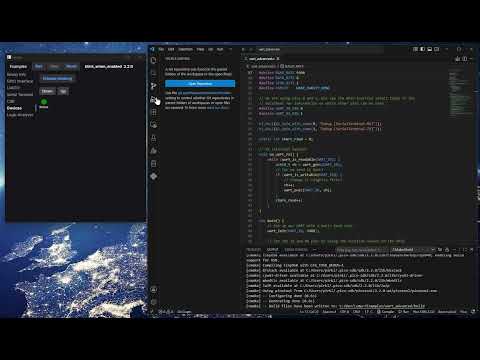
openocdfrom GDB's point of view (see GDB debugging below). - Drive a small Avalonia UI that visualises GPIO pin state, UART traffic, CSR contents, and a basic logic analyser, and lets you wire virtual devices (LEDs, buttons, switches, serial terminals) to the chip's pins.
- Run the included example binaries (
Examples/blink_simple.bin,hello_uart.bin,hello_gpio_irq.bin, …).
Legend: ✅ implemented · 🟡 partial / mock · ❌ not implemented
| Feature | Status | Notes |
|---|---|---|
| Hazard3 RV32I base ISA | ✅ | |
M extension (multiply/divide) |
✅ | |
A extension (atomics, LR/SC) |
✅ | |
C extension (compressed) |
✅ | |
Zba / Zbb / Zbs (bit manip) |
✅ | |
Zbkb / Zcb / Zcmp |
✅ | |
Hazard3 custom: Xh3bextm, Xh3power, Xh3irq |
✅ | |
| Machine + User privilege modes | ✅ | |
| Standard M-mode CSRs (mstatus, mtvec, mepc, mcause, mip, mie, …) | ✅ | |
| PMP (Physical Memory Protection) | ✅ | Configurable region count and grain |
| Performance counters (mcycle / minstret) | ✅ | |
Debug-mode CSRs (dcsr, dpc) |
🟡 | Minimal — used by the GDB stub |
Triggers (tselect, …) |
🟡 | Stub entries only |
| Second Hazard3 core (dual-core) | ❌ | Only core 0 is emulated |
| Cortex-M33 cores (the chip's other personality) | ❌ | RISC-V mode only |
| Region | Status | Notes |
|---|---|---|
| Boot ROM (32 KB) | ✅ | Real RP2350 A2 boot ROM is embedded |
| SRAM (520 KB) | ✅ | |
| XIP / external flash (up to 16 MB window, 2 MB backing) | 🟡 | Basic read/write; cache and aliases not modelled |
| USB DPRAM (4 KB) | 🟡 | Modelled as plain RAM |
| Peripheral | Status | Notes |
|---|---|---|
| SIO (GPIO low/high banks, output/OE/XOR) | ✅ | |
| IO_BANK0 (user-bank GPIO mux) | ✅ | |
| IO_QSPI (USB/QSPI bank GPIO mux) | ✅ | |
| PADS_BANK0 / PADS_QSPI | ✅ | |
| UART0 / UART1 (PL011) | ✅ | TX serialisation, RX, baud, IRQs |
| Watchdog | ✅ | Countdown, reset, scratch regs, REASON |
| Boot RAM (incl. boot locks) | ✅ | |
| TRNG | ✅ | Backed by RandomNumberGenerator |
| SHA-256 accelerator | ✅ | Instant digest (no timing) |
| TIMER0 / TIMER1 | 🟡 | Free-running counter only; alarms / IRQs not wired |
| CLOCKS | 🟡 | Source/divider readback; no real clock-tree simulation |
| RESETS | 🟡 | RESET_DONE always reports "out of reset" |
| XOSC, PLL_SYS, PLL_USB, ROSC | 🟡 | Status bits faked so SDK init proceeds |
| XIP_QMI | 🟡 | Identification register only |
| POWMAN | 🟡 | Enough to satisfy SDK boot path |
| OTP / OTP_DATA | 🟡 | A handful of fixed values |
| USBCTRL_REGS | 🟡 | Single status register faked |
| SYSINFO, SYSCFG, PSM, ACCESSCTRL, BUSCTRL | ❌ | Unimplemented stub |
| SPI0 / SPI1 | ❌ | Unimplemented stub |
| I2C0 / I2C1 | ❌ | Unimplemented stub |
| ADC | ❌ | Unimplemented stub |
| PWM | ❌ | Unimplemented stub |
| PIO0 / PIO1 / PIO2 | ❌ | Unimplemented stub |
| DMA | ❌ | Unimplemented stub |
| HSTX_CTRL / HSTX_FIFO / XIP_CTRL / XIP_AUX | ❌ | Unimplemented stub |
| TICKS | ❌ | Unimplemented stub |
| TBMAN, DFT, GLITCH_DETECTOR | ❌ | Unimplemented stub |
| CoreSight components (ROM table, AHB-AP, CTI, TPIU, trace, …) | ❌ | Unimplemented stub |
"Unimplemented stub" means the address range is decoded and reads return 0 without crashing, but no register behaviour is modelled. "Partial / mock" means specific registers return values that allow the SDK or boot ROM to make progress, but the peripheral does not really do anything.
Lemur ships a GDB remote-protocol server on TCP port 3333 — the same port
OpenOCD listens on by default. As far as GDB is concerned, Lemur is a drop-in
replacement for openocd: just point GDB at it.
file your_firmware.elf
set architecture riscv:rv32
target remote localhost:3333
The supplied GDB/sim.gdb script does exactly this. You can use
plain riscv32-unknown-elf-gdb (or the gdb-multiarch shipped with the Pico
toolchain); no OpenOCD process is required.
Supported GDB commands include reading/writing registers and CSRs, reading/writing memory, software breakpoints, single-step, continue, and reset.
Requires the .NET 10 SDK.
dotnet run --project Lemur/Lemur.csprojThe Avalonia window opens and the GDB server starts listening on
localhost:3333. Load a firmware image via GDB's load command (or use one of
the example .bin files under Examples/).
| Path | Purpose |
|---|---|
Lemur/ |
The emulator and Avalonia UI (main project) |
Tests/ |
xUnit tests, including official RISC-V compliance suite |
GdbDiff/ |
Tool that runs Lemur and real hardware in lock-step and diffs state |
Docs/ |
RP2350 and Hazard3 datasheets, split into per-chapter Markdown |
Examples/ |
Pre-built example firmware images |