Skip to content

Added support for wagyu on polygon overzooming and clipping#100

Closed
flippmoke wants to merge 5 commits intomasterfrom
wagyu
Closed

Added support for wagyu on polygon overzooming and clipping#100
flippmoke wants to merge 5 commits intomasterfrom
wagyu

Conversation

@flippmoke
Copy link
Member

Currently we can produce rings with the incorrect winding order due to the lack of wagyu being used in our clipping step.

@flippmoke flippmoke requested a review from a team as a code owner August 7, 2019 21:35
@flippmoke flippmoke requested a review from springmeyer August 7, 2019 22:15
Copy link
Contributor

@springmeyer springmeyer left a comment

Choose a reason for hiding this comment

The reason will be displayed to describe this comment to others. Learn more.

My thoughts are:

  • If invalid polygons are being passed to vtcomposite, it is not vtcomposite's job to clean them up. Rather they should be fixed upstream.
  • If vtcomposite is creating invalid polygons from valid polygons, this is a bug that should be solvable without needing to depend on wagyu to do cleanup

So, without evidence that wagyu is actually needed here I think this is not the right approach.

}
mapbox::geometry::multi_polygon<coordinate_type> results;
mapbox::geometry::wagyu::wagyu<std::int64_t> wagyu;
bool data_added = false;
Copy link
Contributor

Choose a reason for hiding this comment

The reason will be displayed to describe this comment to others. Learn more.

It seems like it might be clearer to combine data_added and !skip_inner as a single added_outer_ring condition.

@flippmoke
Copy link
Member Author

@springmeyer in the process of clipping you can create an invalid polygon, even if they were valid prior. I honestly do not trust the boost implementation of intersection to get the results of clipping correct and if I remember this is partially why we started to use angus and then wagyu.

Copy link
Contributor

@e-n-f e-n-f left a comment

Choose a reason for hiding this comment

The reason will be displayed to describe this comment to others. Learn more.

This looks good to me. My questions about why each outer ring and its children are cleaned separately rather than doing the entire geometry together were answered in Slack.

@e-n-f
Copy link
Contributor

e-n-f commented Aug 7, 2019

@flippmoke Could you add one of the known-bad tiles here as a test case to demonstrate the problem and prevent future regressions?

Any easy one to reproduce:

  • Natural Earth bathymetry
  • Tile with maxzoom of 4 with tippecanoe -f -o bathymetry.mbtiles -zg --drop-densest-as-needed Downloads/ne_10m_bathymetry_all/*json
  • Fails in z8 at 37.564/130.923

@springmeyer
Copy link
Contributor

@springmeyer in the process of clipping you can create an invalid polygon, even if they were valid prior.

The fundamental design of vtcomposite is based on the premise that boost::geometry::intersection will produce valid geometries if the input geometries are valid. If this is not the case then you need to provide evidence in the form of a reduced testcase. Then we need to figure out if the problem is a boost geometry bug (like boostorg/geometry#566 perhaps?) or not.

I honestly do not trust the boost implementation of intersection to get the results of clipping correct

Don't trust it because you see obvious cases where it will produce valid geometries or don't trust it due to the potential for software bugs?

and if I remember this is partially why we started to use angus and then wagyu.

We needed wagyu at the tile generation stage for the clipping arbitrary input geometries that were potentially invalid because boost::geometry::intersection algorithm would throw on invalid geometries (as it is designed to expecting valid input). In vtcomposite we can and want to assume all input geometries are valid and therefore wagyu should be unneeded, right?

@springmeyer
Copy link
Contributor

and was being broken by the previous clipping implementation here during overzooming.

@ericfischer how exactly is the output tile being broken by the current implementation?

@e-n-f
Copy link
Contributor

e-n-f commented Aug 8, 2019

@springmeyer The best example I have for this is tile 4/13/6 in enf.4djr0amh (Natural Earth bathymetry), tiled to z4, overzoomed to tile 8/221/99.

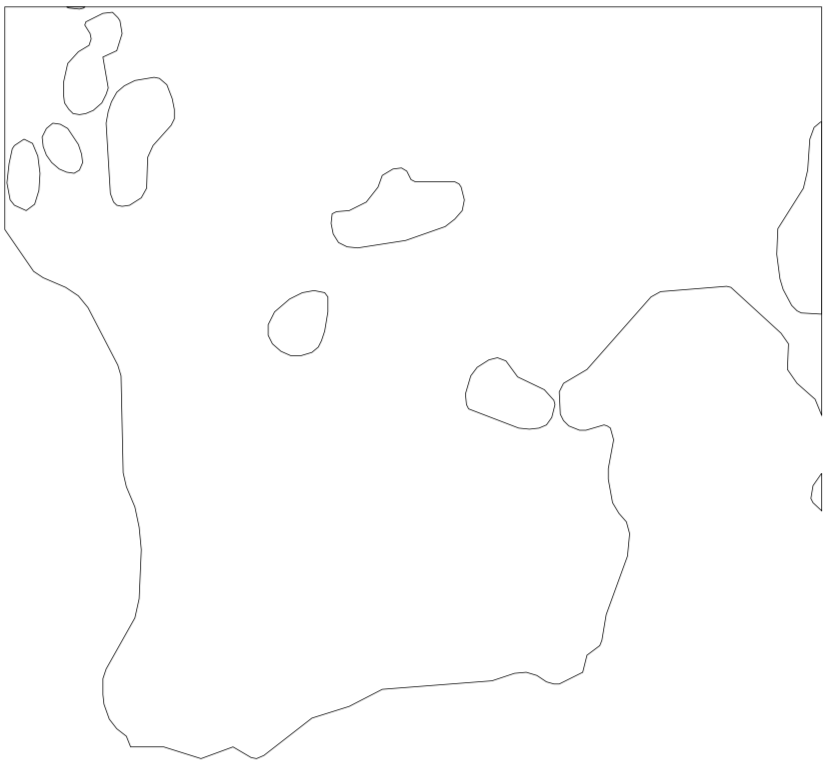
As you can see here, two of the clipped inner rings have a collinear edge with the right or top side of the outer ring, an invalid geometry that causes triangulation errors and causes the entire tile to be filled instead of just the area excluding the holes.

Screen Shot 2019-08-07 at 6 02 20 PM

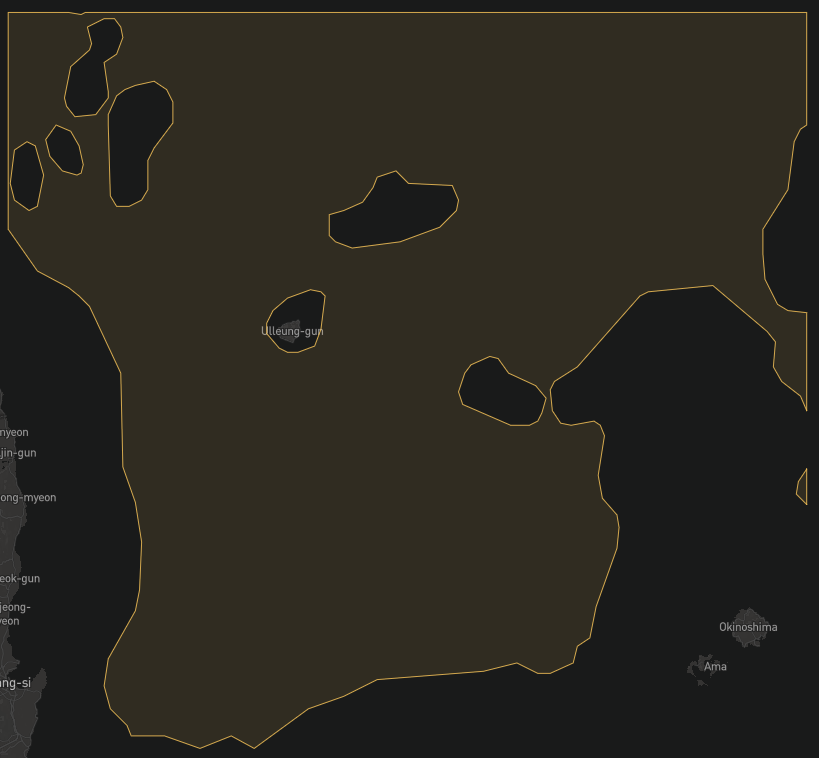
Wagyu correctly cuts both of these out of the outer ring instead.

Screen Shot 2019-08-07 at 6 05 58 PM

@e-n-f
Copy link
Contributor

e-n-f commented Aug 8, 2019

@springmeyer To be even clearer: the fundamental flaw of the current implementation is that it clips each polygon ring independently instead of considering the feature as a whole, so it will always be wrong when the edge of the clip region intersects a hole.

@artemp
Copy link
Contributor

artemp commented Aug 8, 2019

@ericfischer Clipping individual rings is the issue, I'll look into fixing this. Thanks for providing background here!
/cc @springmeyer

@springmeyer
Copy link
Contributor

springmeyer commented Aug 8, 2019

Per chat with @ericfischer and @artemp, @artemp is going to create a second branch for comparison and testing purposes that attempts to fix the problem @ericfischer describes clearly at #100 (comment) by changing the usage of boost::geometry. I think it makes sense to continue to try to get this branch (wagyu method) production ready and the two approaches can be compared before releasing.

For historical reference, wagyu was integrated in an experimental way last year in #45 but abandoned since it was only considered at that time for handling known invalid v1 vector tiles and other workarounds were successful.

@flippmoke
Copy link
Member Author

node bench/bench.js --iterations 1000 --concurrency 5 --package vtcomposite

Performance in master:

1: single tile in/out ... 43478 runs/s (23ms)
2: two different tiles at the same zoom level, zero buffer ... 6250 runs/s (160ms)
3: two different tiles from different zoom levels (separated by one zoom), zero buffer ... 1082 runs/s (924ms)
4: two different tiles from different zoom levels (separated by more than one zoom), zero buffer ... 1838 runs/s (544ms)
5: tiles completely made of points, overzooming, no properties ... 9346 runs/s (107ms)
6: tiles completely made of points, same zoom, no properties ... 40000 runs/s (25ms)
7: tiles completely made of points, overzoooming, lots of properties ... 6452 runs/s (155ms)
8: tiles completely made of points, same zoom, lots of properties ... 34483 runs/s (29ms)
9: buffer_size 128 - tiles completely made of points, same zoom, lots of properties ... 25641 runs/s (39ms)
10: tiles completely made of linestrings, overzooming and lots of properties ... 2294 runs/s (436ms)
11: tiles completely made of polygons, overzooming and lots of properties ... 493 runs/s (2027ms)
12: tiles completely made of points and linestrings, overzooming and lots of properties ... 20000 runs/s (50ms)
13: buffer_size 128 - tiles completely made of points and linestrings, overzooming and lots of properties ... 20408 runs/s (49ms)
14: tiles completely made of points and linestrings, overzooming (2x) and lots of properties ... 24390 runs/s (41ms)
15: tiles completely made of polygons, overzooming and lots of properties ... 1859 runs/s (538ms)
16: tiles completely made of polygons, overzooming (2x) and lots of properties ... 3610 runs/s (277ms)
17: buffer_size 4096 - tiles completely made of polygons, overzooming (2x) and lots of properties ... 1587 runs/s (630ms)
Note: pass --mem to track memory usage
Benchmark iterations: 1000 concurrency: 5

Performance with wagyu:

1: single tile in/out ... 47619 runs/s (21ms)
2: two different tiles at the same zoom level, zero buffer ... 6098 runs/s (164ms)
3: two different tiles from different zoom levels (separated by one zoom), zero buffer ... 732 runs/s (1366ms)
4: two different tiles from different zoom levels (separated by more than one zoom), zero buffer ... 1078 runs/s (928ms)
5: tiles completely made of points, overzooming, no properties ... 13889 runs/s (72ms)
6: tiles completely made of points, same zoom, no properties ... 9259 runs/s (108ms)
7: tiles completely made of points, overzoooming, lots of properties ... 6897 runs/s (145ms)
8: tiles completely made of points, same zoom, lots of properties ... 17241 runs/s (58ms)
9: buffer_size 128 - tiles completely made of points, same zoom, lots of properties ... 22727 runs/s (44ms)
10: tiles completely made of linestrings, overzooming and lots of properties ... 2222 runs/s (450ms)
11: tiles completely made of polygons, overzooming and lots of properties ... 337 runs/s (2970ms)
12: tiles completely made of points and linestrings, overzooming and lots of properties ... 20000 runs/s (50ms)
13: buffer_size 128 - tiles completely made of points and linestrings, overzooming and lots of properties ... 19608 runs/s (51ms)
14: tiles completely made of points and linestrings, overzooming (2x) and lots of properties ... 29412 runs/s (34ms)
15: tiles completely made of polygons, overzooming and lots of properties ... 1024 runs/s (977ms)
16: tiles completely made of polygons, overzooming (2x) and lots of properties ... 2294 runs/s (436ms)
17: buffer_size 4096 - tiles completely made of polygons, overzooming (2x) and lots of properties ... 1041 runs/s (961ms)
Note: pass --mem to track memory usage
Benchmark iterations: 1000 concurrency: 5

@artemp
Copy link
Contributor

artemp commented Aug 9, 2019

@ericfischer @flippmoke @springmeyer - Fixed in b404cf2 , working on a test..

artemp added a commit that referenced this pull request Aug 9, 2019
@flippmoke flippmoke mentioned this pull request Aug 9, 2019
@flippmoke
Copy link
Member Author

closed for now in favor of #101

@flippmoke flippmoke closed this Aug 14, 2019
Sign up for free to join this conversation on GitHub. Already have an account? Sign in to comment

Labels

None yet

Projects

None yet

Development

Successfully merging this pull request may close these issues.

4 participants