[MRG] Add events/annotations tutorial #5608
Conversation


 massich
force-pushed
the
annotation_tutorial
branch
from
massich
force-pushed
the
annotation_tutorial
branch
from
b2dc85f to
180620d
Compare

Codecov Report
@@            Coverage Diff             @@
##           master    #5608      +/-   ##
==========================================
+ Coverage   88.55%   88.57%   +0.01%
==========================================
  Files         369      369
  Lines       69182    69194      +12
  Branches    11653    11654       +1
==========================================
+ Hits        61266    61286      +20
+ Misses       5060     5056       -4
+ Partials 2856 2852 -4 |

|
@massich do we need this for 0.17? If so it's likely to be one of the last blockers for release |

 massich
force-pushed
the
annotation_tutorial
branch
from
massich
force-pushed
the
annotation_tutorial
branch
from
48a7308 to
80c6966
Compare
|
From the whish list in #5201 it mainly addresses point 4 which is the urgent part to get in 0.17. (So I'll edit the PR description) |
massich
changed the title
|
There's still one broken link. |
|
I don't understand why this link does not work and it does not appear in the build as broken |
|
its the same as this is linking to. But here renders properly. I don't get it. |

| @@ -0,0 +1,134 @@ | |||
| """ | |||
| .. _tut_events_and_annotation_objects: | |||

There was a problem hiding this comment.
remove this label, we do not need it (it's in other examples for historical reasons and those should be removed, too)
we can use the auto-generated sphx_glr_... labels instead
| Events and annotations are quite similar. This tutorial highlights their | ||
| differences and similitudes and tries to shade some light to which one is | ||
| preferred to use in different situations when using MNE. | ||
| Here follows both terms definition from the glossary. |
There was a problem hiding this comment.
Would be good to add a RST link to the glossary
There was a problem hiding this comment.
yes but I did not find how. I don't think is referenceable yet.

| events | ||
| Events correspond to specific time points in raw data; e.g., triggers, | ||
| experimental condition events, etc. MNE represents events with integers | ||
| that are stored in numpy arrays of shape (n_events, 3). Such arrays are |

There was a problem hiding this comment.
I am always forget what the second column of the events array is. Maybe it's worth repeating here what the three columns represent?
There was a problem hiding this comment.
For this you need an example where the second column is more than array of 0s. And is not yet covered in this tutorial.
| Events correspond to specific time points in raw data; e.g., triggers, | ||
| experimental condition events, etc. MNE represents events with integers | ||
| that are stored in numpy arrays of shape (n_events, 3). Such arrays are | ||
| classically obtained from a trigger channel, also referred to as stim |
There was a problem hiding this comment.
stim is really an abbreviation. Since it's a tutorial, I'd suggest expanding to the full name
There was a problem hiding this comment.
My only goal here was just to replicate whatever is in glossary. Once glossary is linkable I would remove it.
| classically obtained from a trigger channel, also referred to as stim | ||
| channel. | ||
|
|
||
| annotations |
There was a problem hiding this comment.
Link to documentation of annotations class?
There was a problem hiding this comment.
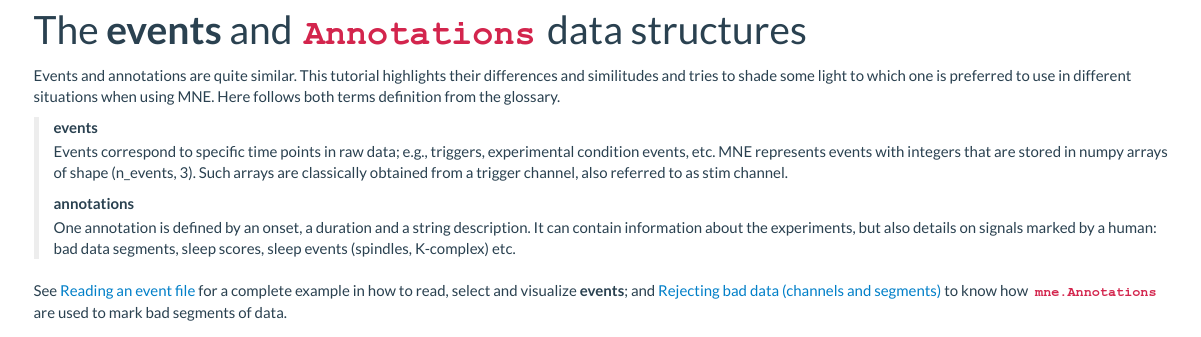
It is linked everywhere, but here 'cos this is a citation of the glossary:
massich
force-pushed
the
annotation_tutorial
branch
from
b18b962 to
a9c0e66
Compare
|
I think I've addressed everybody's concerns. What I did not manage is to link to the annotations attributes. (ie: @larsoner yes, they are inconsistent. I did not check if the inconsistency was released already. But I was certainly planning to correct it after the release due to #5699. And maybe find a better name for Please, give a read to the tutorial. Thx a lot. |
tutorials/plot_object_annotations.py
Outdated
|
|
||
| Both events and :class:`Annotations <mne.Annotations>` be seen as triplets | ||
| where the first element answers to **when** something happens and the last | ||
| element refers to **what** is it. |
tutorials/plot_object_annotations.py
Outdated
| the description is an integer value. | ||
| In contrast, :class:`Annotations <mne.Annotations>` represents the | ||
| ``onset`` in seconds (relative to the reference ``orig_time``), | ||
| and the ``description`` is an arbitrary string. |
tutorials/plot_object_annotations.py
Outdated
| # Create an annotation object with orig_time | ||
| orig_time = '2002-12-03 19:01:31.676071' | ||
| my_datetime = datetime.strptime(orig_time, '%Y-%m-%d %H:%M:%S.%f') | ||
| posix_timestamp = (my_datetime - datetime(1970, 1, 1)).total_seconds() |
There was a problem hiding this comment.
this is not used in the annotations object
There was a problem hiding this comment.
No I used only for printing. There's a subtiliy. the orig_time has to be .6760709 otherwise they wont match.
There was a problem hiding this comment.
well okay but you don't use this orig_time either ...
There was a problem hiding this comment.
print(posix_timestamp - annot_orig.orig_time)1.1920928955078125e-07I am using the same number. (except the rounding error)
There was a problem hiding this comment.
1038942091.676071 is the POSIX timestamp of 2002-12-03 19:01:31.676071
it only differs in the .6760709
There was a problem hiding this comment.
okay maybe then it's a matter of renaming your variables. Because I see this:
orig_time = '2002-12-03 19:01:31.676071'and I'm confused why in the class instantiation you do: orig_time=1038942091.6760709.
also how much does the 1e-7 matter? couldn't we live with a slightly offset annotation with 1 sample?

There was a problem hiding this comment.
@jasmainak I agree it's probably too much to ask to our user to understand this gymnastic of dates.
I am going to push now a way to pass directly '2002-12-03 19:01:31.676071' to the Annotations constructor.
tutorials/plot_object_annotations.py
Outdated
|
|
||
| annot = mne.Annotations(onset=[10], duration=[0.5], | ||
| description=['foobar'], | ||
| orig_time=1038942091.6760709) |
There was a problem hiding this comment.
I don't see this timestamp as a problem. At least now it is stated that it has been 'chosen' and that is not completely arbitrary. But shows that orig_time is under the hood this kind of ugly floats.
There was a problem hiding this comment.
Sorry to insist here.
But if a user wanted to use the Annotations class, how do you propose that they would set orig_time? I don't think anyone could dream up this number. If the idea to expose this parameter is that allows people to adjust the orig_time if it's not aligned. You could perhaps make it annot.orig_time - 0.2 to shift orig time ...

|
Onsets no longer match: We need to be able to parse |

|
we should round at the microsecond
|
|
I pushed a commit that at least makes things pass on both systems. Had to use |
|
Pushed a better version that did not necessitate using |
|
It should be able to go in once green. |
|
@jasmainak feel free to merge when you are happy |


|
Looks really nice. Thanks @massich and @agramfort for the teamwork ! |
|
great !
|

| annotated_blink_raw = raw.copy() | ||
| eog_events = mne.preprocessing.find_eog_events(raw) | ||
| n_blinks = len(eog_events) | ||
| # Center to cover the whole blink with full duration of 0.5s: |

There was a problem hiding this comment.
this may be a bit misleading - the events are centered and we are actually de-cenetering them by pushing them back in time to mark onset, not event center.
|
please send a quick PR.
|

|
@agramfort sure thing, I have some other small suggestions. :) |
|
go for it !
|
6 participants


From the whish list in #5201 it mainly addresses point 4.