Conversation


 beamalsky
left a comment
beamalsky
left a comment
beamalsky
left a comment
There was a problem hiding this comment.
Hey @noah-marcus! I'm Bea, and I'll be reviewing your code challenge and co-interviewing you with Derek this week.
Lots of good stuff here. I found your code clear to read and appreciated the thorough commenting on your thought processes, though I'd like to see explicit testing instructions in your README. I left a few additional comments inline, and a couple ways you could improve your error handling.
We'd like you to respond to the review and make the requested changes before your interview, if time allows. For guidance, we like and try to stick to Thoughtbot's guide to code review when working together on pull requests.
Let me know in the relevant thread if you have any questions, etc., and I'll be sure to get back to you ASAP. Look forward to talking more tomorrow.
|
|
||
| **Note:** You can use the following address strings for testing during implementation: | ||
|
|
||
| - ✅ Valid: `123 main st chicago il` |
There was a problem hiding this comment.
In condensing this README, you lost the testing instructions! Could you add these test strings back, either in this README or in your PR description? For reference, here's DataMade's pull request template.
There was a problem hiding this comment.
Whoops! Thanks for catching that. I added it back into the README. Change has been committed here.
| returns the expected output. | ||
|
|
||
| You can run the tests using Docker: | ||
| You can run some tests using Docker: |
There was a problem hiding this comment.
We'd appreciate a description of precisely what these tests are looking for. Could you expand this section?
There was a problem hiding this comment.
Sure thing. I added some more details here. Please let me know if you think I should add more detail!
| </table> | ||
| </div> | ||
| <div id="parse-error" class="alert alert-danger mt-2 text-center" style="display:none" role="alert"> | ||
| Uh-oh -- The inputted address could not be parsed! |
There was a problem hiding this comment.
Nice job anticipating the edge case of an empty string submission 👍
| class AddressParse(APIView): | ||
| renderer_classes = [JSONRenderer] | ||
|
|
||
| # parse requested address string and return components to frontend |
There was a problem hiding this comment.
Nice job documenting the types, but this could be a docstring! Could you create one for both this function and parse()?
There was a problem hiding this comment.
Thank you for pointing that out, my knowledge of Python conventions is not my strongest asset 😳. Here is my attempt at converting my comments to docstrings.
| address_string = '123 main st chicago il' | ||
| pytest.fail() | ||
|
|
||
| expected_return_input_string = '123 main st chicago il' |
There was a problem hiding this comment.
Why do you need this assigned separately from address_string above?
There was a problem hiding this comment.
Yeah, I understand why that is confusing. I made that choice for my own visual preference. When writing my tests, I like to compartmentalize what I am giving to the test and what I expect in return.
Since there is an intended overlap (the expected return string should be the given address string), my expected_return_input_string is redundant and does not need to be assigned separately. I'll fix that up!
|
|
||
| expected_return_input_string = '123 main st chicago il' | ||
| expected_return_address_components = OrderedDict([('AddressNumber', '123'), ('StreetName', 'main'), ('StreetNamePostType', 'st'), ('PlaceName', 'chicago'), ('StateName', 'il')]) | ||
| excpected_return_address_type = 'Street Address' |
There was a problem hiding this comment.
Looks like you've got a typo in the variable name here.
There was a problem hiding this comment.
Good catch, I need to install a spell checker into my IDE! (Updated here)
| assert response.data['input_string'] == expected_return_input_string | ||
| assert response.data['address_components'] == expected_return_address_components | ||
| assert response.data['address_type'] == excpected_return_address_type | ||
| # pytest.fail() |
There was a problem hiding this comment.
You don't need this commented-out code.
| var input_string = $('#address').val(); | ||
|
|
||
| // only parse input if user inputted something | ||
| if (input_string != ""){ |
There was a problem hiding this comment.
If a user submits a string of spaces (eg, ' '), this is the result:
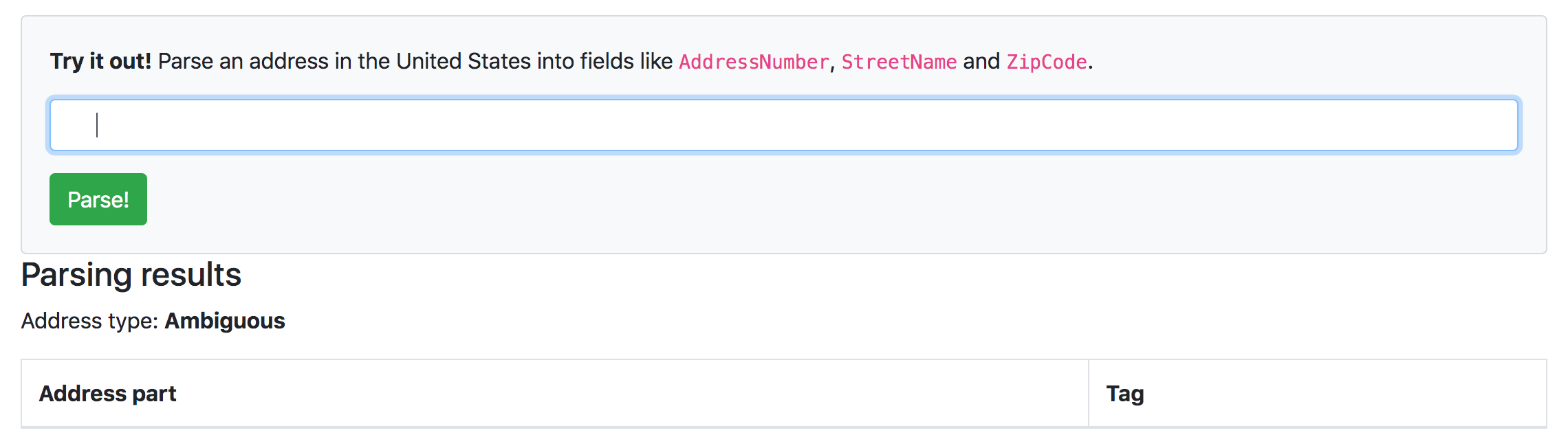
How can you handle that case so that this submit function treats it as an empty string?
There was a problem hiding this comment.
I would have never thought of that edge case, thanks! I added .trim() to when I capture the input. Commit is here.
| # pass request address to parse method | ||
| try: | ||
| address_components, address_type = self.parse(input_string) | ||
| except Exception as e: |
There was a problem hiding this comment.
If you look at e here there are more details on the error. For example, by inserting print(str(e)) in this except block and submitting 123 main st chicago il 123 main to the form I can see:
parserator  | ERROR: Unable to tag this string because more than one area of the string has the same label
parserator  |
parserator  | ORIGINAL STRING:  123 main st chicago il 123 main
parserator  | PARSED TOKENS:    [('123', 'AddressNumber'), ('main', 'StreetName'), ('st', 'StreetNamePostType'), ('chicago', 'PlaceName'), ('il', 'StateName'), ('123', 'AddressNumber'), ('main', 'StreetName')]
parserator  | UNCERTAIN LABEL:  AddressNumber
parserator  |
parserator  | When this error is raised, it's likely that either (1) the string is not a valid person/corporation name or (2) some tokens were labeled incorrectly
parserator  |
parserator  | To report an error in labeling a valid name, open an issue at https://github.com/datamade/usaddress/issues/new - it'll help us continue to improve probablepeople!
parserator  |
parserator  | For more information, see the documentation at https://usaddress.readthedocs.io/
Could you capture this error message and display it on the frontend in a way that's useful to a user?
There was a problem hiding this comment.
Yeah, I was struggling with figuring out what message to pass on to the user and was not sure how much information was too much. In this commit here, I am now capturing the entire message and displaying it on the frontend. I think the benefit to this approach is that the user will always receive a detailed and specific message from the backend.
Also, I'm not sure how to capture this new message for the unit test check? The commit above is a work in progress because the error handling is failing. @beamalsky, any advice?
There was a problem hiding this comment.
There's some room for personal style here, and you don't know who your users are in this theoretical app so what you included as an error message is definitely reasonable.
One way I've handled returning the full error code without overwhelming users is to have a human-friendly error on top, and then the error stashed in under a "See more" collapsed section.
Instead of returning a ParseError for a bad request, you could return a Response with a 400 error code. Something like this:
return Response({
	'input_string': addr,
	'address_components': '',
	'address_type': '',
	'error' : str(e)},
	status=400
)
That way, you'll have access to the full error text from usaddress under error and a Response to test the attributes of in your test in a way that mirrors successful submission.
There was a problem hiding this comment.
That makes a lot of sense, thanks for clearing that up! I updated my code in this commit and the test is working again!
2 participants


DataMade Code Challenge Submission
This is my submission for the DataMade Code Challenge!