Bug 1759667: Add the official 4.2 channels to cluster upgrade settings #2935
Conversation


 openshift-ci-robot
added
the
do-not-merge/hold
openshift-ci-robot
added
the
do-not-merge/hold

|
@spadgett: This pull request references Bugzilla bug 1759667, which is valid. The bug has been moved to the POST state. The bug has been updated to refer to the pull request using the external bug tracker. DetailsIn response to this:
Instructions for interacting with me using PR comments are available here. If you have questions or suggestions related to my behavior, please file an issue against the kubernetes/test-infra repository. |
openshift-ci-robot
added
bugzilla/valid-bug
openshift-ci-robot
added
the
approved

|
/retest |


There was a problem hiding this comment.
We're still debating the next name to add. It will be one other name.
There was a problem hiding this comment.
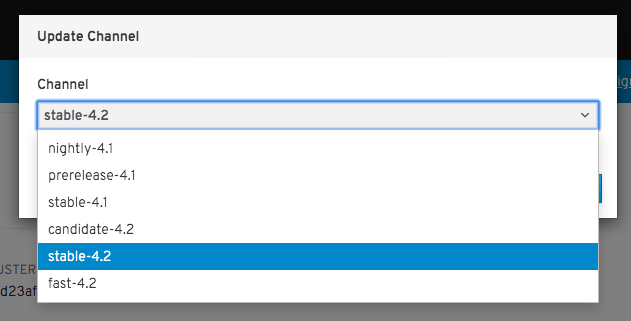
Add fast-4.2 and candidate-4.2, remove prerelease-4.2.
There was a problem hiding this comment.
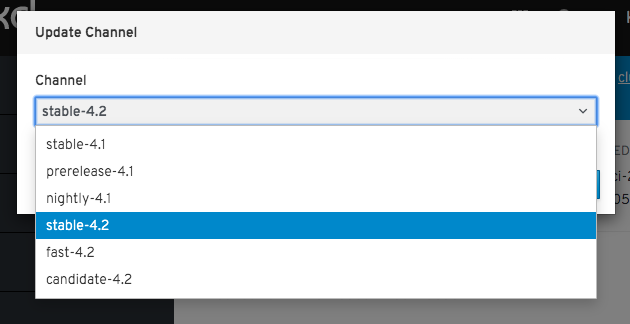
Ordering wise, will stable show up at top, then fast, then candidate?
 spadgett
force-pushed
the
stable-4.2-channel
branch
from
spadgett
force-pushed
the
stable-4.2-channel
branch
from
7f0291a to
0cca886
Compare
|
@smarterclayton updated
|

|
See my order comment |
 spadgett
force-pushed
the
stable-4.2-channel
branch
from
spadgett
force-pushed
the
stable-4.2-channel
branch
from
0cca886 to
813e1a0
Compare
|
I updated the ordering:
|
 smarterclayton
changed the title
smarterclayton
changed the title
smarterclayton
changed the title
smarterclayton
changed the title
|
/lgtm |
|
[APPROVALNOTIFIER] This PR is APPROVED This pull-request has been approved by: smarterclayton, spadgett The full list of commands accepted by this bot can be found here. The pull request process is described here DetailsNeeds approval from an approver in each of these files:
Approvers can indicate their approval by writing |

|
/retest e2e-aws |
|
/retest |
|
/test e2e-aws |
|
/retest |
openshift-ci-robot
removed
the
do-not-merge/hold
 mrunalp
added
the
cherry-pick-approved
mrunalp
added
the
cherry-pick-approved
|
/retest |

|
@spadgett: All pull requests linked via external trackers have merged. Bugzilla bug 1759667 has been moved to the MODIFIED state. DetailsIn response to this:
Instructions for interacting with me using PR comments are available here. If you have questions or suggestions related to my behavior, please file an issue against the kubernetes/test-infra repository. |

This commit adds the ability to store release metadata, for example
the list of channels that a release is in:

  $ curl -sH 'Accept:application/json' 'https://api.openshift.com/api/upgrades_info/v1/graph?channel=stable-4.2' | jq -r '.nodes[] | select(.version == "4.2.4").metadata["io.openshift.upgrades.graph.release.channels"] | split(",")[]'
  candidate-4.2
  fast-4.2
  stable-4.2

That will allow the console and other downstream tooling to expose a
list of channels available to a given cluster right now, instead of
hard-coding an expected list [1].  This will account for things like
phased releases, where we may not recommend an upgrade for your
particular stable-4.2 cluster even though we are recommending the
upgrade for other stable-4.2 clusters.

Pivoting around this retyping in Go will require consumer bumps, but I
don't think it's a breaking change because the only YAML removal is
'force', which is meaningless in AvailableUpdates.  So I don't think
this needs to count as a backwards-compat-breaking schema bump.

Autogenerated bumps via:

  $ hack/update-swagger-docs.sh
  $ make update-codegen-crds

[1]: openshift/console#2935
This commit adds the ability to store release metadata, for example
the list of channels that a release is in:

  $ curl -sH 'Accept:application/json' 'https://api.openshift.com/api/upgrades_info/v1/graph?channel=stable-4.2' | jq -r '.nodes[] | select(.version == "4.2.4").metadata["io.openshift.upgrades.graph.release.channels"] | split(",")[]'
  candidate-4.2
  fast-4.2
  stable-4.2

That will allow the console and other downstream tooling to expose a
list of channels available to a given cluster right now, instead of
hard-coding an expected list [1].  This will account for things like
phased releases, where we may not recommend an upgrade for your
particular stable-4.2 cluster even though we are recommending the
upgrade for other stable-4.2 clusters.

Pivoting around this retyping in Go will require consumer bumps, but I
don't think it's a breaking change because the only YAML removal is
'force', which is meaningless in AvailableUpdates.  So I don't think
this needs to count as a backwards-compat-breaking schema bump.

Autogenerated bumps via:

  $ unset GOBIN  # vendor/k8s.io/code-generator/generate-groups.sh and such require "${GOPATH}/bin/deepcopy-gen"
  $ go get k8s.io/gengo/examples/deepcopy-gen
  $ hack/update-deepcopy.sh
  $ hack/update-swagger-docs.sh
  $ make update-codegen-crds

[1]: openshift/console#2935
This commit adds the ability to store release metadata, for example
the list of channels that a release is in:

  $ curl -sH 'Accept:application/json' 'https://api.openshift.com/api/upgrades_info/v1/graph?channel=stable-4.2' | jq -r '.nodes[] | select(.version == "4.2.4").metadata["io.openshift.upgrades.graph.release.channels"] | split(",")[]'
  candidate-4.2
  fast-4.2
  stable-4.2

That will allow the console and other downstream tooling to expose a
list of channels available to a given cluster right now, instead of
hard-coding an expected list [1].  This will account for things like
phased releases, where we may not recommend an upgrade for your
particular stable-4.2 cluster even though we are recommending the
upgrade for other stable-4.2 clusters.

Pivoting around this retyping in Go will require consumer bumps, but I
don't think it's a breaking change because the only YAML removal is
'force', which is meaningless in AvailableUpdates.  So I don't think
this needs to count as a backwards-compat-breaking schema bump.

Autogenerated bumps via:

  $ unset GOBIN  # vendor/k8s.io/code-generator/generate-groups.sh and such require "${GOPATH}/bin/deepcopy-gen"
  $ go get k8s.io/gengo/examples/deepcopy-gen
  $ hack/update-deepcopy.sh
  $ hack/update-swagger-docs.sh
  $ make update-codegen-crds

[1]: openshift/console#2935
This commit adds the ability to store release metadata, for example
the list of channels that a release is in:

  $ curl -sH 'Accept:application/json' 'https://api.openshift.com/api/upgrades_info/v1/graph?channel=stable-4.2' | jq -r '.nodes[] | select(.version == "4.2.4").metadata["io.openshift.upgrades.graph.release.channels"] | split(",")[]'
  candidate-4.2
  fast-4.2
  stable-4.2

That will allow the console and other downstream tooling to expose a
list of channels available to a given cluster right now, instead of
hard-coding an expected list [1].  This will account for things like
phased releases, where we may not recommend an upgrade for your
particular stable-4.2 cluster even though we are recommending the
upgrade for other stable-4.2 clusters.

Pivoting around this retyping in Go will require consumer bumps, but I
don't think it's a breaking change because the only YAML removal is
'force', which is meaningless in AvailableUpdates.  So I don't think
this needs to count as a backwards-compat-breaking schema bump.

Autogenerated bumps via:

  $ unset GOBIN  # vendor/k8s.io/code-generator/generate-groups.sh and such require "${GOPATH}/bin/deepcopy-gen"
  $ go get k8s.io/gengo/examples/deepcopy-gen
  $ hack/update-deepcopy.sh
  $ hack/update-swagger-docs.sh
  $ make update-codegen-crds

[1]: openshift/console#2935
This commit adds the ability to store release metadata, implementing
openshift/enhancements@2eb16cf80d
(enhancements/update/available-update-metadata: Propose a new
enhancement, 2020-07-20, openshift/enhancements#123).  For example the
list of channels that a release is in:

  $ curl -sH 'Accept:application/json' 'https://api.openshift.com/api/upgrades_info/v1/graph?channel=stable-4.2' | jq -r '.nodes[] | select(.version == "4.2.4").metadata["io.openshift.upgrades.graph.release.channels"] | split(",")[]'
  candidate-4.2
  fast-4.2
  stable-4.2

That will allow the console and other downstream tooling to expose a
list of channels available to a given cluster right now, instead of
hard-coding an expected list [1].  This will account for things like
phased releases, where we may not recommend an upgrade for your
particular stable-4.2 cluster even though we are recommending the
upgrade for other stable-4.2 clusters.

Pivoting around this retyping in Go will require consumer bumps, but I
don't think it's a breaking change because the only YAML removal is
'force', which is meaningless in AvailableUpdates.  So I don't think
this needs to count as a backwards-compat-breaking schema bump.

Autogenerated bumps via:

  $ unset GOBIN  # vendor/k8s.io/code-generator/generate-groups.sh and such require "${GOPATH}/bin/deepcopy-gen"
  $ go get k8s.io/gengo/examples/deepcopy-gen
  $ hack/update-deepcopy.sh
  $ hack/update-swagger-docs.sh
  $ make update-codegen-crds

[1]: openshift/console#2935
This commit adds the ability to store release metadata, implementing
openshift/enhancements@2eb16cf80d
(enhancements/update/available-update-metadata: Propose a new
enhancement, 2020-07-20, openshift/enhancements#123) as adjusted by
openshift/enhancements@12eff48079
(enhancements/update/available-update-metadata: 'url' docstring
context, 2020-07-21, openshift/enhancements#408).  For example the
list of channels that a release is in:

  $ curl -sH 'Accept:application/json' 'https://api.openshift.com/api/upgrades_info/v1/graph?channel=stable-4.2' | jq -r '.nodes[] | select(.version == "4.2.4").metadata["io.openshift.upgrades.graph.release.channels"] | split(",")[]'
  candidate-4.2
  fast-4.2
  stable-4.2

That will allow the console and other downstream tooling to expose a
list of channels available to a given cluster right now, instead of
hard-coding an expected list [1].  This will account for things like
phased releases, where we may not recommend an upgrade for your
particular stable-4.2 cluster even though we are recommending the
upgrade for other stable-4.2 clusters.

Pivoting around this retyping in Go will require consumer bumps, but I
don't think it's a breaking change because the only YAML removal is
'force', which is meaningless in AvailableUpdates.  So I don't think
this needs to count as a backwards-compat-breaking schema bump.

Autogenerated bumps via:

  $ unset GOBIN  # vendor/k8s.io/code-generator/generate-groups.sh and such require "${GOPATH}/bin/deepcopy-gen"
  $ go get k8s.io/gengo/examples/deepcopy-gen
  $ hack/update-deepcopy.sh
  $ hack/update-swagger-docs.sh
  $ make update-codegen-crds

[1]: openshift/console#2935
Bug 1759667: Add the official 4.2 channels to cluster upgrade settings
8 participants


/assign @rhamilto @jwforres
/hold