A background service to update a seedbox IP for MAM and an HTTP server to manage it.

This can be helpful if you are using a host/VPN/seedbox to seed and its IP address is not stable.
Features:
-
Background service that regularly updates MAM with the IP address of the host.
Before an update, Mousehole checks that it actually needs to update by comparing the host's current IP address and AS and with the last MAM response.
-
Frontend website to manage the service, allowing:
- Setting your MAM cookie
- Displaying status information
- Manual triggering of checks
-
API server with management endpoints.
See API.md for details.
To use Mousehole, you need to:
services:
  gluetun:
    image: qmcgaw/gluetun:latest
    cap_add:
      - NET_ADMIN
    devices:
      - /dev/net/tun:/dev/net/tun
    ports:
      - "5010:5010" # Mousehole port
      - "8080:8080" # qBittorrent Web UI port
      - "6881:6881/tcp" # qBittorrent TCP torrent port
      - "6881:6881/udp" # qBittorrent UDP torrent port
    environment:
      VPN_SERVICE_PROVIDER: "your-vpn-provider"
      FIREWALL_VPN_INPUT_PORTS: "6881" # qBittorrent torrent
      # more is needed here -- see Gluetun documentation
      # https://github.com/qdm12/gluetun-wiki
      # https://github.com/qdm12/gluetun-wiki/tree/main/setup/providers
    restart: unless-stopped

  qbittorrent:
    image: lscr.io/linuxserver/qbittorrent:latest
    network_mode: "service:gluetun"
    environment:
      TZ: Etc/UTC # Set to your timezone for localization
      WEBUI_PORT: 8080
      TORRENTING_PORT: 6881
    restart: unless-stopped

  mousehole:
    image: tmmrtn/mousehole:latest
    network_mode: "service:gluetun"
    environment:
      TZ: Etc/UTC # Set to your timezone for localization
    volumes:
      # persist cookie data across container restarts
      - "mousehole:/srv/mousehole"
    restart: unless-stopped

volumes:
  mousehole:
Starter Docker Compose examples:
Any VPN setup can be adapted to include Mousehole as a sidecar. See Using Mousehole as a Sidecar with Docker Compose for details.
See the Unraid Installation Guide for instructions.
Run the server with:
bun run startOnce Mousehole is running, navigate to its web UI at http://<host>:5010 in
your browser. This is likely to be http://localhost:5010 if you are running it
locally.
When running for the first time (or if the cookie gets out of sync), you need to set Mousehole's cookie manually.
On navigating to the Mousehole web interface, you will see a form to set the cookie -- paste your cookie and click the "Set" button.
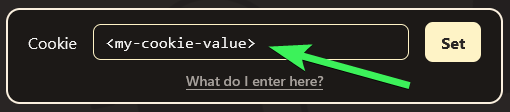
If you need help getting the cookie, click the "What do I enter here?" button for a tutorial.
Even with Mousehole up and running, things can still go wrong that Mousehole cannot fix automatically. Here are some of the common ones:
Mousehole publishes several image tags to Docker Hub:
- SemVer versions (
0,0.1,0.1.11, etc) latest, the latest released versionedge, the tip ofmasterbranch- Pull requests targeting
masterfor testing, tagged aspr-<number>
Choose latest if you do not know which to pick.
MOUSEHOLE_PORT: (Default5010) The port on which the HTTP server will listen.MOUSEHOLE_STATE_DIR_PATH: (Default/srv/mousehole) The directory where the service will store its data.MOUSEHOLE_USER_AGENT: (Defaultmousehole-by-timtimtim/<version>) The user agent to use for requests to MAM.MOUSEHOLE_CHECK_INTERVAL_SECONDS: (Default300(5 minutes)) The interval in seconds between checks.MOUSEHOLE_STALE_RESPONSE_SECONDS: (Default86400(1 day)) The number of seconds after which a MAM response is considered stale. This ensures that Mousehole is still talking with MAM at some regular interval and is detecting out-of-band changes to the cookie.TZ: (DefaultEtc/UTC) The timezone for displaying localized times.
Want to contribute? Check out the contribution guidelines.
There is also a contrib directory with useful, supplementary
functionality.
-
Start the dev server with:
bun run dev
-
New versions can be tagged, released and pushed to Docker Hub by simply changing the version in
package.jsonand pushing to GitHub. The CI workflows will take care of the rest.
Mouse Hole by Sergey Demushkin from Noun Project (CC BY 3.0)