









✨ I write simple, stupid and hence, readable "okay" codes with less WTFs/min from code reviews - mostly in Flutter, Node.js.
✨ Industries: Offshore IT Industry, Digital Agency, Health, Education, Finance.
Things you should know -
- 🔭 Currently working on: Dart & Flutter
- 🌱 Getting better at: Flutter, Swift, Kotlin, Agile Software Development, Technical Product Management
- 📫 Reach me out: Shoot a mail at
⚡️ Languages






Level novice or no more worked


⚡️ IDE / Editor






⚡️ Data






⚡️ Frameworks / Platforms






⚡️ Tools










Worked (Alphabetical order)


⚡️ Github Status

📕 Latest Blog Posts
- Switching Between Multiple Claude Code Accounts (Bedrock SSO + Claude.ai Team)
- Data Architecture’s Secret Weapon – RX vs. Protobuf
- Modernizing Monorepo Architectures: Principles & Trade-offs
- A Comprehensive Guide to Flutter Widget Previews (Beta)
- Silence Isn't a Barrier: My System for Redesigning Tech Leadership
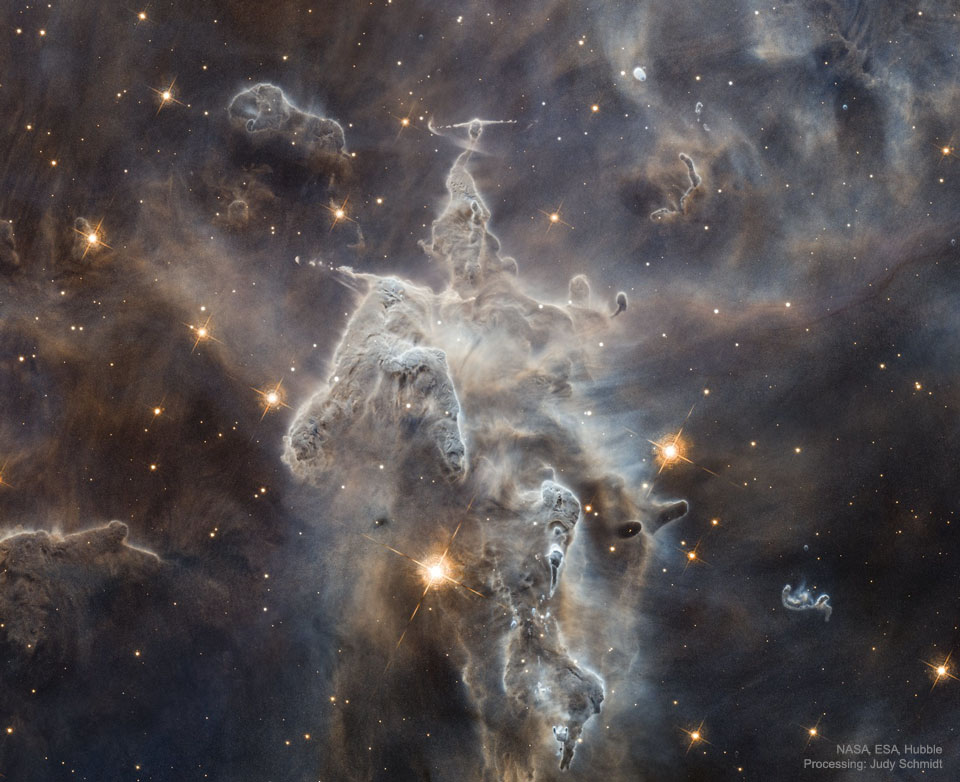
Inside the head of this interstellar monster is a star that is slowly destroying it. The huge monster, actually an inanimate series of pillars of gas and dust, measures light years in length. The in-head star is not itself visible through the opaque interstellar dust but is bursting out partly by ejecting opposing beams of energetic particles called Herbig-Haro jets. Located about 7,500 light years away in the Carina Nebula and known informally as Mystic Mountain, the appearance of these pillars is dominated by dark dust even though they are composed mostly of clear hydrogen gas. The featured image was taken with the Hubble Space Telescope. All over these pillars, the energetic light and winds from massive newly formed stars are evaporating and dispersing the dusty stellar nurseries in which they formed. Within a few million years, the head of this giant, as well as most of its body, will have been completely evaporated by internal and surrounding stars.
NASAI'm looking for sponsors to support my open source development, I appreciate your support! :)


