Skip to content

Conversation

@kv2019i
Copy link
Collaborator

@kv2019i kv2019i commented Nov 2, 2021

Draft PR to see how much dropping the two unnecessary mixer components would bring.

Includes:

Add a lightweight load calculatio to ll_tasks_execute() and prints out
the average every 2^10 runs (roughly once per second on most systems).

Example log output:
--cut--
[     6950848.421715] (      809129.187500) c0 ll-schedule        ./schedule/ll_schedule.c:139  INFO ll avg 19720/38400
[     8868838.449667] (      679100.000000) c0 ll-schedule        ./schedule/ll_schedule.c:139  INFO ll avg 19658/38400
[    10802857.643650] (      565147.187500) c0 ll-schedule        ./schedule/ll_schedule.c:139  INFO ll avg 19822/38400
--cut--

Signed-off-by: Kai Vehmanen <kai.vehmanen@linux.intel.com>
Fix the documentation to match actual topology definition. The comments
did not include addition of mixers nor the capture PCMs. Also many
comments reflect a fixed core id that is no longer accurate.

Signed-off-by: Kai Vehmanen <kai.vehmanen@linux.intel.com>
Remove mixers from PCM1 and PCM2 as with only one source there
is no need to mix anything.

This reduces the DSP load that is very high when all pipelines
of the topology are used at the same time.

Signed-off-by: Kai Vehmanen <kai.vehmanen@linux.intel.com>
@kv2019i kv2019i requested review from ranj063 and singalsu November 2, 2021 12:15
@kv2019i
Copy link
Collaborator Author

kv2019i commented Nov 2, 2021

Results can be seen now in CI results.

SOF main with mixer:
https://sof-ci.01.org/sofpr/PR4943/build10955/devicetest/?model=ADLP_RVP_NOCODEC&testcase=multiple-pipeline-all
Worst case load when streams are running:
[ 6230869.283657] ( 2323.906250) c0 ll-schedule ./schedule/ll_schedule.c:139 INFO ll avg 43889/38400

Same with this patch (two mixers):
https://sof-ci.01.org/sofpr/PR4948/build10968/devicetest/?model=ADLP_RVP_NOCODEC&testcase=multiple-pipeline-all
Worst case load:
[ 10039033.976085] ( 4546.093750) c0 ll-schedule ./schedule/ll_schedule.c:139 INFO ll avg 37764/38400

So that's a 14% reduction in worstDSP load (115% -> 98%).

The target would be to keep the per-core DSP load under 80%. #4940 and #4944 will both help, but to reach 80%, we should probably consider dropping the unnecessary mixers. @ranj063 is there some reason you added mixers to all?

@ranj063
Copy link
Collaborator

ranj063 commented Nov 2, 2021

@ranj063 is there some reason you added mixers to all?

@kv2019i the reason we added the mixer to all is because of 2 reasons:

  1. the SSP port that we want to add the deep buffer pipeline to is different for BXT compared to other platforms. It was easier to make all playback pipelines mixer-based and then just add the deep-buffer pipeline wherever needed. easier to review as well
  2. we want to move away from the general idea of pipelines extending all the way from the host to a DAI. So the split to have a from-end pipeline or host -facing pipeline connected to a backend pipeline is the right thing to do

@kv2019i
Copy link
Collaborator Author

kv2019i commented Nov 4, 2021

@ranj063 is there some reason you added mixers to all?

@kv2019i the reason we added the mixer to all is because of 2 reasons:

1. the SSP port that we want to add the deep buffer pipeline to is different for BXT compared to other  platforms. It was easier to make all playback pipelines mixer-based and then just add the deep-buffer pipeline wherever needed. easier 

Ack, and indeed I broke the APL nocodec config with this version of the PR.

2. we want to move away from the general idea of pipelines extending all the way from the host to a DAI. So the split to have a from-end pipeline or host -facing pipeline connected to a backend pipeline is the right thing to do

Hmm, why? Wouldn't be importat to test both kind of topologies?

Still, even if we agree on that target, it's still not ok to overload the DSP, so we have to find another way to meet the above goal, but do it in a way that keeps the per-core DSP load at sensible level (<80% is good magic number).

I'll wait until @singalsu 's optimization work for mixer and iir-eq are merged and do a re-measurement. If we are still above 80%, we should either drop one (or two mixers), or come up with another way to realize a two part pipeline.

@plbossart
Copy link
Member

  1. we want to move away from the general idea of pipelines extending all the way from the host to a DAI. So the split to have a from-end pipeline or host -facing pipeline connected to a backend pipeline is the right thing to do

Hmm, why? Wouldn't be importat to test both kind of topologies?

Simple:
a) if you already have a split between host and dai pipeline, it's trivial to add a second source or N sources to a mixer. Or alternatively we can remain with a single source and be iso-feature/iso-load.

b) If we have pre-canned pipelines that go from host to dai in one shot, it's virtually impossible to break-up.

So it's not about adding mixers and new sources for the sake of adding them, it's to enable their addition if we need/want to. It's really a flexibility/capability update.

@kv2019i
Copy link
Collaborator Author

kv2019i commented Nov 4, 2021

  1. we want to move away from the general idea of pipelines extending all the way from the host to a DAI. So the split to have a from-end pipeline or host -facing pipeline connected to a backend pipeline is the right thing to do

@plbossart wrote:

Hmm, why? Wouldn't be importat to test both kind of topologies?

Simple: a) if you already have a split between host and dai pipeline, it's trivial to add a second source or N sources to a mixer. Or alternatively we can remain with a single source and be iso-feature/iso-load.

Ack, so this is really to make the tplg a better starting point for future extensions.

So it's not about adding mixers and new sources for the sake of adding them, it's to enable their addition if we need/want to. It's really a flexibility/capability update.

Ack. Let's see if the mixer optimizations help enough. Having the flexibility is of course better, so if they fit the budget (or can be fitted with reasonable extra work), all the better.

@plbossart
Copy link
Member

plbossart commented Nov 4, 2021

Simple: a) if you already have a split between host and dai pipeline, it's trivial to add a second source or N sources to a mixer. Or alternatively we can remain with a single source and be iso-feature/iso-load.

Ack, so this is really to make the tplg a better starting point for future extensions.

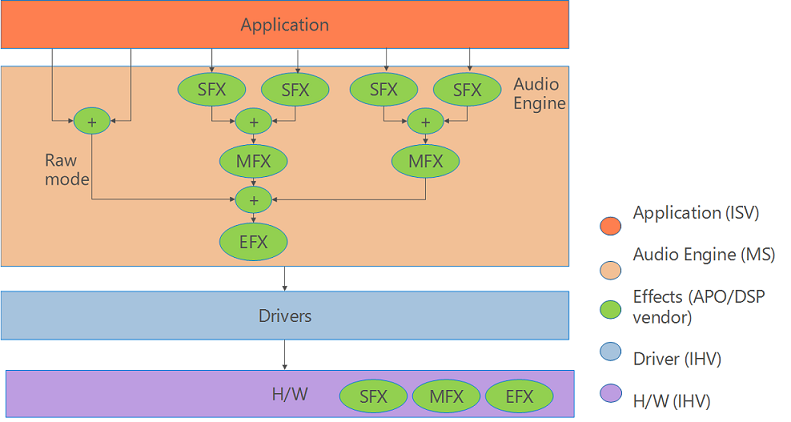
Note that it's only a starting point, we will also have a need for 'intermediate' pipelines that deal with mode effects, see e.g. how Windows represent their processing tree. The layers don't matter for firmware, the point is that we can have two stages of mixers.

audio-apo-software-effects-summary

@lgirdwood
Copy link
Member

@kv2019i the first two patches can go in, no opens for them IIUC..

@kv2019i
Copy link
Collaborator Author

kv2019i commented Dec 8, 2021

Seems mixers are needed, so close this.

@kv2019i kv2019i closed this Dec 8, 2021
Sign up for free to join this conversation on GitHub. Already have an account? Sign in to comment

Labels

None yet

Projects

None yet

Development

Successfully merging this pull request may close these issues.

4 participants