trigger workflows to run for pull_request event#86
Conversation


 seanpreston
changed the title
seanpreston
changed the title
pull_request_target event

|
I'd love a few others to weigh in here on the security side (paging @ThomasLaPiana and @PSalant726) just so we get this right. I like the idea of allowing forked PRs to run our actions for CI, but want to ensure we are very careful about how that can expose the GitHub secrets. A couple articles I found on this:
On my reading I think I'd prefer:
|

| on: [push] | ||
| on: [ | ||
| push, | ||
| pull_request_target |

There was a problem hiding this comment.
TL;DR from my comment (#86 (comment))
If you set this to pull_request instead of pull_request_target for now, we'll get 90% of the value of CI but I'd expect tests that rely on secrets to fail. That's a secure place to start from
There was a problem hiding this comment.
Building on this, I don't think it achieves what we want anyway. From the documentation linked by Sean:
This event runs in the context of the base of the pull request, rather than in the merge commit as the
pull_requestevent does.
I could be misunderstanding, but I interpret this as "run our workflows against the commit from which the PR was branched", not the latest commit on the PR itself. It's intended to be used as more of a housekeeping trigger, to add labels etc. to PRs. Isn't the intent to run CI actions against the changeset on the PR?
Separately, these changes, as written, don't seem to be using any of the additional permissions afforded by the pull_request_target trigger except to allow for execution of the external resource integration tests. Effectively, this change only serves to expose the ${{ secrets.REDSHIFT_TEST_URI }} and ${{ secrets.SNOWFLAKE_TEST_URI }} values to PRs opened by potentially untrusted users (repo forks).

Will update.
I'd like to understand more about how the tokens are issued too. If it's the case that the tokens are short lived and can be set to only be generated on manual approval of a job run, it might not be a huge issue either way. |

 PSalant726
left a comment
PSalant726
left a comment
PSalant726
left a comment
There was a problem hiding this comment.
@NevilleS 's suggestion about configuring the external integration tests to only run against PR's labeled safe-to-test (or similar) seems like a good potential route forward.
As another option, we could create an additional, similar automation that restricts the execution of the external integration tests only to PRs opened either 1) from a branch off of the repo itself (not a fork) or 2) by a member of the Ethyca GH org and/or the @ethycadev user group.
I don't see any way for us to safely automate the execution of any job that requires access to repository secrets when the PR being tested was opened by an untrusted user. For PRs opened by external contributors, I would recommend that an Ethyca employee first reviews the code changes here on GH, then, if everything seems safe, checkout the fork's branch locally and execute the external integration tests manually. Since all PRs require an approval from a maintainer before merging anyway, this extra step doesn't seem like that much to ask.
As a last step, we should find a way to mark the external integration tests as "not run", and prevent the pipeline from displaying as passed, so we don't miss the previous manual step.
| on: [push] | ||
| on: [ | ||
| push, | ||
| pull_request_target |
There was a problem hiding this comment.
Building on this, I don't think it achieves what we want anyway. From the documentation linked by Sean:
This event runs in the context of the base of the pull request, rather than in the merge commit as the
pull_requestevent does.
I could be misunderstanding, but I interpret this as "run our workflows against the commit from which the PR was branched", not the latest commit on the PR itself. It's intended to be used as more of a housekeeping trigger, to add labels etc. to PRs. Isn't the intent to run CI actions against the changeset on the PR?
Separately, these changes, as written, don't seem to be using any of the additional permissions afforded by the pull_request_target trigger except to allow for execution of the external resource integration tests. Effectively, this change only serves to expose the ${{ secrets.REDSHIFT_TEST_URI }} and ${{ secrets.SNOWFLAKE_TEST_URI }} values to PRs opened by potentially untrusted users (repo forks).
|
From what I can see, the safe approach here for forks is to either do a
manual checkout or use something that only we approve, ie labels or some
more complex action like the `ok-to-test` action that is also linked in one
of the GitHub security articles. But yeah running our regular CI tests
without secrets is OK with me - with the collaborator approval that is,
just to also defend against spurious PRs costing us a lot of action minutes
😁
…On Thu, Nov 18, 2021, 12:45 PM Phil Salant ***@***.***> wrote:
***@***.**** requested changes on this pull request.
@NevilleS <https://github.com/NevilleS> 's suggestion about configuring
the external integration tests to only run against PR's labeled
safe-to-test (or similar) seems like a good potential route forward.
As another option, we could create an additional, similar automation that
restricts the execution of the external integration tests only to PRs
opened either 1) from a branch off of the repo itself (not a fork) or 2) by
a member of the Ethyca GH org and/or the @ethycadev user group.
I don't see any way for us to safely automate the execution of any job
that requires access to repository secrets when the PR being tested was
opened by an untrusted user. For PRs opened by external contributors, I
would recommend that an Ethyca employee first reviews the code changes here
on GH, then, if everything seems safe, checkout the fork's branch locally
and execute the external integration tests manually. Since all PRs require
an approval from a maintainer before merging anyway, this extra step
doesn't seem like *that* much to ask.
As a last step, we should find a way to mark the external integration
tests as "not run", and prevent the pipeline from displaying as passed, so
we don't miss the previous manual step.
------------------------------
In .github/workflows/pr_checks.yml
<#86 (comment)>:
> @@ -1,5 +1,8 @@
name: Run CI
-on: [push]
+on: [
+ push,
+ pull_request_target
Building on this, I don't think it achieves what we want anyway. From the documentation
linked by Sean
<https://docs.github.com/en/actions/learn-github-actions/events-that-trigger-workflows#pull_request_target>
:
This event runs in the context of the base of the pull request, rather
than in the merge commit as the pull_request event does.
I could be misunderstanding, but I interpret this as "run our workflows
against the commit from which the PR was branched", not the latest commit
on the PR itself. It's intended to be used as more of a housekeeping
trigger, to add labels etc. to PRs. Isn't the intent to run CI actions
against the changeset on the PR?
Separately, these changes, as written, don't seem to be using any of the
additional permissions afforded by the pull_request_target trigger
*except* to allow for execution of the external resource integration
tests. Effectively, this change *only* serves to expose the ${{
secrets.REDSHIFT_TEST_URI }} and ${{ secrets.SNOWFLAKE_TEST_URI }} values
to PRs opened from by potentially untrusted users (repo forks).
—
You are receiving this because you were mentioned.
Reply to this email directly, view it on GitHub
<#86 (review)>,
or unsubscribe
<https://github.com/notifications/unsubscribe-auth/AAN72N276IWZIILV3PTUNBTUMU3VJANCNFSM5IJL42OA>
.
Triage notifications on the go with GitHub Mobile for iOS
<https://apps.apple.com/app/apple-store/id1477376905?ct=notification-email&mt=8&pt=524675>
or Android
<https://play.google.com/store/apps/details?id=com.github.android&referrer=utm_campaign%3Dnotification-email%26utm_medium%3Demail%26utm_source%3Dgithub>.
|
|
To be thorough I have done some testing this afternoon by opening up a PR against this repo from a new account. I can confirm that the new account is unable to add labels:
|
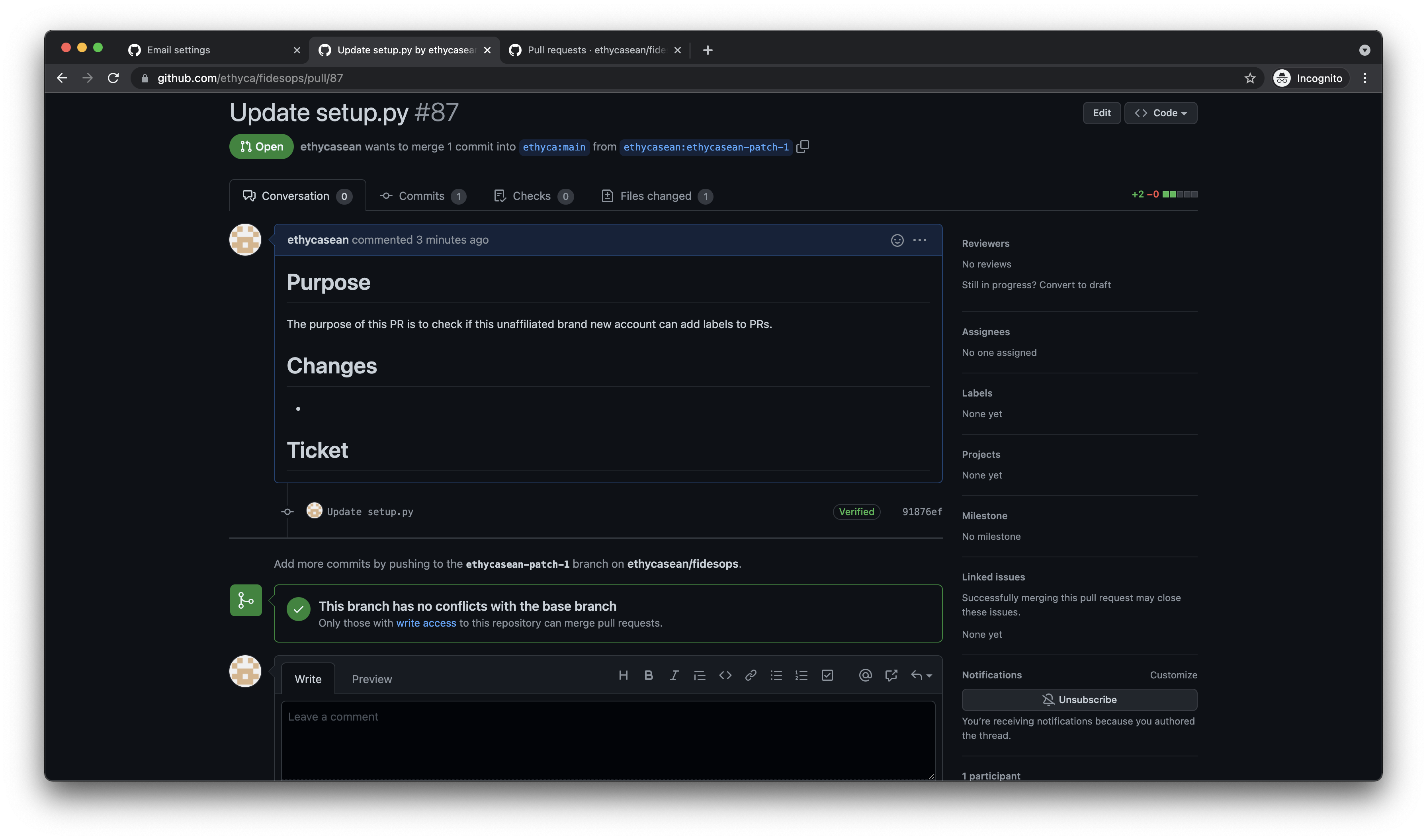

|
Given that we're referencing |
seanpreston
changed the title
pull_request_target eventpull_request event
@PSalant726, it looks like this happens automatically:
UPDATE: and then once the label has been added: We ought to stop every step from re-running each time a PR is |


…l name to better reflect the action
seanpreston
added
run unsafe ci checks
seanpreston
removed
the
run unsafe ci checks
|
I've updated this PR to factor in a couple of changes requested by both @NevilleS and @PSalant726:
|
seanpreston
added
run unsafe ci checks

| jobs: | ||
| Integration-Tests-External: | ||
| runs-on: ubuntu-latest | ||
| if: contains(github.event.pull_request.labels.*.name, 'run unsafe ci checks') |
There was a problem hiding this comment.
This condition was a bit confusing to me on first pass, so to break down for anyone else:
github.event.pull_request.labels.*.name this statement is applying a filter on the github.event.pull_request.labels var, pull out a list of label names, e.g. ["safe to run", "dont merge", ...].
contains(list, "value") is then check if "value" is an element of list.
It seems simple when you put it that way, but if you don't know about the filter stage, it could look as though github.event.pull_request.labels.*.name evaluates to a string and we're checking if that string contains the PR name (which would be less robust).
https://docs.github.com/en/actions/learn-github-actions/expressions#object-filters
There was a problem hiding this comment.
This looks good to me now.
However, with the number of actions we're running, I think we need to combine some of these jobs together to make the whole thing run faster because we're definitely burning a ton of CI minutes on every single PR
I'll open a new issue for that
The number of minutes burned might actually go down with this change, since we're switching from running the workflows on every |

PSalant726
left a comment
PSalant726
left a comment
There was a problem hiding this comment.
However, with the number of actions we're running, I think we need to combine some of these jobs together to make the whole thing run faster because we're definitely burning a ton of CI minutes on every single PR
Ideally the pipeline would:
- Build the container artifacts in a
buildstage, and make them available to the other stages that require them - Execute static analysis tools and test harnesses in discreet pipeline
lintandteststages, dependent on the build artifacts where needed (and, crucially, not dependent where not needed)
We have an issue in fidesctl to make a similar change.
@seanpreston -
It's not enough to block this PR for me, but I think a cleaner implementation would keep things in a single file with a generic name like Fidesops. The jobs are still discreet and can have if conditions applied independently.
I did have it like this initially. Because we're using both |
* trigger workflows to run for pull_request_target event

* change to only pull_request

* check safe to test label

* what happens when a PR with the safe-to-test label is pushed to

* split pr_checks into safe + unsafe

* update names of jobs

* try removing push trigger

* add push trigger back so we can see the check as skipped, change label name to better reflect the action

* add pull_request back to safe checks

* remove push because pull_request synchronize should cover it

* remove arbitrary change
5 participants


Purpose
This PR adds the
pull_request_targetevent to our workflows, which should allow PRs on forked repos to trigger workflow events (ie. CI via Github Actions).See: https://docs.github.com/en/actions/learn-github-actions/events-that-trigger-workflows#pull_request_target for full docs.
This event runs in the base context of a pull request, so I believe this change has to be made in the repo itself, before any workflows on forked PRs will run.
As @iamkelllly has mentioned here: #26 (comment), there's also something we'll need to do with the Github tokens, to stop them from being able to read secrets being stored in the underlying repository, so in lieu of completing that here I've changed the repository settings to force us to approve any workflow runs for outside collaborators, which we can choose to not do until we're sure the token issue is handled.
This should yield an approval process like: https://docs.github.com/en/actions/managing-workflow-runs/approving-workflow-runs-from-public-forks
Ticket
Closes #26